University of Alabama at Birmingham, Department of Medicine, Birmingham, AL, USA.
Novartis Institutes for BioMedical Research, Cambridge, MA, USA.
Int J Chron Obstruct Pulmon Dis. 2020 Oct 5;15:2399-2409. doi: 10.2147/COPD.S257474. eCollection 2020.
Excess mucus plays a key role in COPD pathogenesis. Cigarette smoke-induced cystic fibrosis transmembrane conductance regulator (CFTR) dysfunction may contribute to disease pathogenesis by depleting airway surface liquid and reducing mucociliary transport; these defects can be corrected in vitro by potentiating CFTR.
To assess the efficacy of the CFTR potentiator icenticaftor in improving airflow obstruction in COPD patients with symptoms of chronic bronchitis.
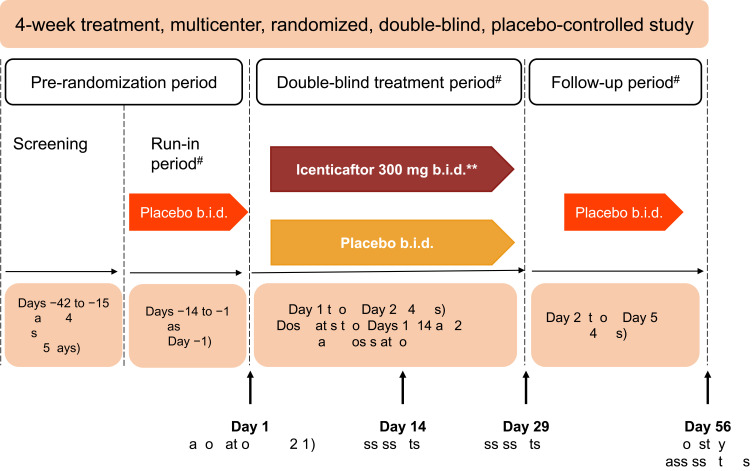
In this double-blind, placebo-controlled study, COPD patients were randomized (2:1) to either icenticaftor 300 mg or placebo b.i.d. This non-confirmatory proof of concept study was powered for lung clearance index (LCI) and pre-bronchodilator FEV, with an estimated sample size of 90 patients. The primary endpoint was change from baseline in LCI for icenticaftor versus placebo at Day 29; key secondary endpoints included change from baseline in pre- and post-bronchodilator FEV on Day 29. Key exploratory endpoints included change from baseline in sweat chloride, plasma fibrinogen levels, and sputum colonization.
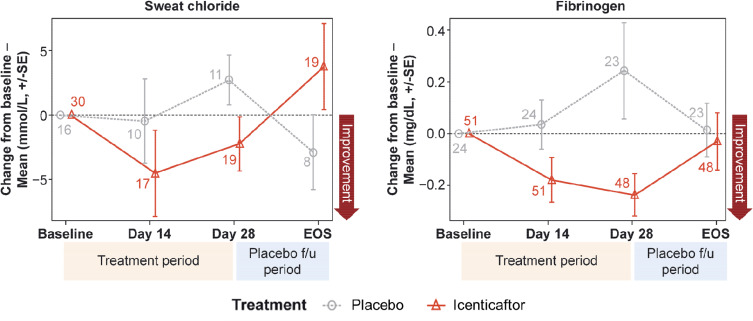
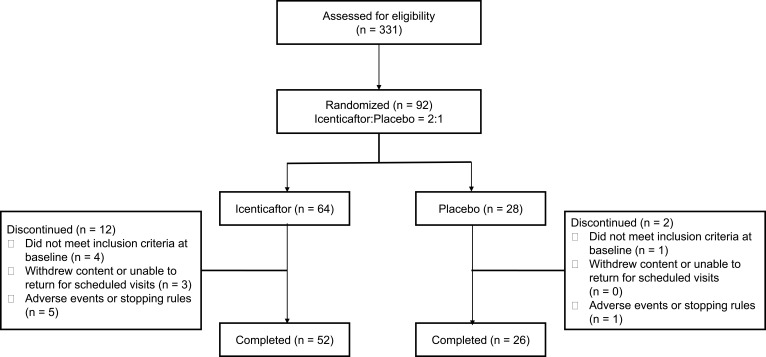
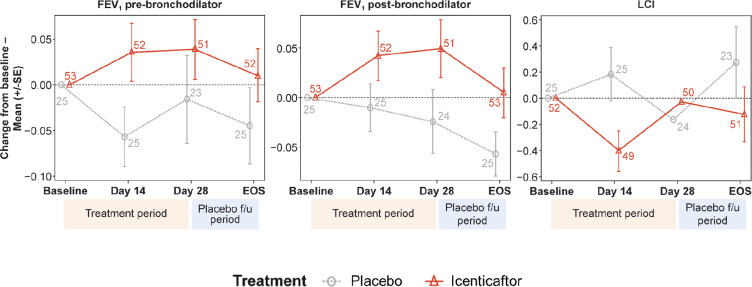
Ninety-two patients were randomized (icenticaftor, n=64; placebo, n=28). At Day 29, icenticaftor showed no improvement in change in LCI (treatment difference: 0.28 [19% probability of being better than placebo]), an improvement in pre-bronchodilator FEV (mean: 50 mL [84% probability]) and an improvement in post-bronchodilator FEV (mean: 63 mL [91% probability]) over placebo. Improvements in sweat chloride, fibrinogen and sputum bacterial colonization were also observed. Icenticaftor was safe and well tolerated.
The CFTR potentiator icenticaftor increased FEV versus placebo after 28 days and was associated with improvements in systemic inflammation and sputum bacterial colonization in COPD patients; no improvements in LCI with icenticaftor were observed.
过多的黏液在 COPD 发病机制中起着关键作用。香烟烟雾诱导的囊性纤维化跨膜电导调节剂(CFTR)功能障碍可通过耗尽气道表面液体和减少黏液纤毛运输来导致疾病发病机制;这些缺陷可以通过增强 CFTR 在体外得到纠正。
评估 CFTR 增强剂 icenticaftor 改善有慢性支气管炎症状的 COPD 患者气流阻塞的疗效。
在这项双盲、安慰剂对照研究中,将 COPD 患者随机(2:1)分为 icenticaftor 300mg 或安慰剂 bid。这项非确证性概念验证研究的效力为肺清除指数(LCI)和预支气管扩张剂 FEV,估计样本量为 90 例患者。主要终点是第 29 天 icenticaftor 与安慰剂相比 LCI 的基线变化;关键次要终点包括第 29 天预支气管扩张剂和后支气管扩张剂 FEV 的基线变化。关键探索终点包括汗氯、血浆纤维蛋白原水平和痰定植的基线变化。
92 例患者被随机分配(icenticaftor,n=64;安慰剂,n=28)。在第 29 天,icenticaftor 显示在 LCI 的变化方面没有改善(治疗差异:0.28[比安慰剂更好的概率为 19%]),预支气管扩张剂 FEV 改善(平均:50mL[比安慰剂更好的概率为 84%])和后支气管扩张剂 FEV 改善(平均:63mL[比安慰剂更好的概率为 91%])。也观察到汗氯、纤维蛋白原和痰细菌定植的改善。Icenticaftor 安全且耐受良好。
CFTR 增强剂 icenticaftor 在 28 天后增加了 FEV 与安慰剂相比,并且与 COPD 患者的全身炎症和痰细菌定植的改善相关;在 icenticaftor 中没有观察到 LCI 的改善。