Cui Meiying, Li Pan, Mao Ying, Zhang Lan, Xia Peiyi, Liu Enjie, Wang Weiwei, Zhang Jianying, Jiang Guozhong, Li Wencai
Department of Pathology, The First Affiliated Hospital of Zhengzhou University, Zhengzhou, Henan, Mainland China; Department of Pathology, School of Basic Medicine, Zhengzhou University, Zhengzhou, Henan, People's Republic of China.
State Key Laboratory of Esophageal Cancer Prevention & Treatment, Zhengzhou University, Zhengzhou, Henan, People's Republic of China.
Cancer Manag Res. 2020 Oct 19;12:10287-10295. doi: 10.2147/CMAR.S274187. eCollection 2020.
Microsatellite instability (MSI) has been a hot topic in cancer research. Determining MSI status greatly aids tumor prognosis and treatment plans. However, MSI data for Asian cancer patients with prognostic information are scarce. Here, our aim was to clarify MSI status and its prognostic value in a large Chinese cohort with different tumors.
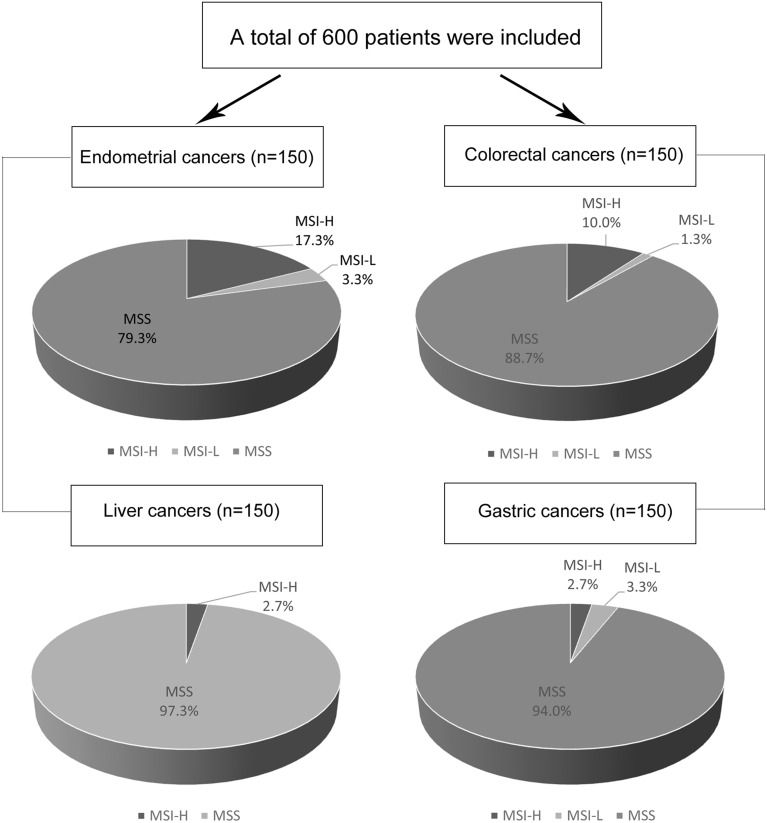
Tissue samples from 600 Chinese cases, including 150 endometrial cancers, 150 colorectal cancers, 150 liver cancers and 150 gastric cancers, were used for IHC and MSI examinations. Two mononucleotide and three dinucleotide markers were used to analyze MSI status.
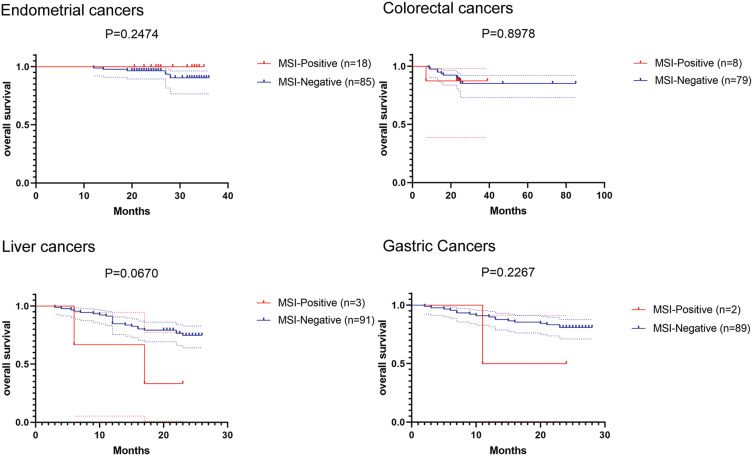
In total,17.3% (26/150) of endometrial cancer patients showed positive MSI,10.0% (15/150) in colorectal cancer, 2.7% (4/150) in liver cancer, and 2.7% (4/150) in gastric cancer. Tumor location (P < 0.001 for colorectal cancer) and clinical stage (P =0.038 for gastric cancer) showed significant correlations with MSI status in gastrointestinal carcinogenesis. The mismatch repair (MMR) deficiency was observed in 20 colorectal cases (13.3%) and was significantly more frequent in the MSI-positive group (P < 0.001). Interestingly, the prevalence of MSI-H was mostly occurred in early-stage tumors, and none was in late stage (stage IV). Meanwhile, low clinicopathological stage had significant correlation with longer survival in multiple cancers here.
The incidence of microsatellite instability varies among different cancer types. And the prevalence of MSI-H mostly occurred early clinicopathological stage. In addition, our study provided a large Asian cohort screened by five loci PCR method and significantly increased knowledge on the prognostic significance of MSI in Asia.
微卫星不稳定性(MSI)一直是癌症研究中的热门话题。确定MSI状态对肿瘤预后和治疗方案有很大帮助。然而,有预后信息的亚洲癌症患者的MSI数据稀缺。在此,我们的目的是阐明一大群不同肿瘤类型的中国患者的MSI状态及其预后价值。
来自600例中国患者的组织样本,包括150例子宫内膜癌、150例结直肠癌、150例肝癌和150例胃癌,用于免疫组化(IHC)和MSI检测。使用两个单核苷酸和三个二核苷酸标记来分析MSI状态。
总体而言,17.3%(26/150)的子宫内膜癌患者显示MSI阳性,结直肠癌患者中为10.0%(15/150),肝癌患者中为2.7%(4/150),胃癌患者中为2.7%(4/150)。在胃肠道肿瘤发生过程中,肿瘤位置(结直肠癌P < 0.001)和临床分期(胃癌P = 0.038)与MSI状态显示出显著相关性。在20例结直肠癌病例(13.3%)中观察到错配修复(MMR)缺陷,在MSI阳性组中显著更常见(P < 0.001)。有趣的是,MSI-H的患病率大多发生在早期肿瘤中,晚期(IV期)无一例。同时,低临床病理分期与这里多种癌症的较长生存期显著相关。
微卫星不稳定性的发生率在不同癌症类型中有所不同。并且MSI-H的患病率大多发生在临床病理早期。此外,我们的研究提供了一个通过五位点PCR方法筛选的大型亚洲队列,并显著增加了对亚洲MSI预后意义的认识。