Pchitskaya Ekaterina, Bezprozvanny Ilya
Laboratory of Molecular Neurodegeneration, Institute of Biomedical Systems and Biotechnology, Peter the Great St. Petersburg Polytechnic University, St. Petersburg, Russia.
Department of Physiology, UT Southwestern Medical Center at Dallas, Dallas, TX, United States.
Front Synaptic Neurosci. 2020 Sep 30;12:31. doi: 10.3389/fnsyn.2020.00031. eCollection 2020.
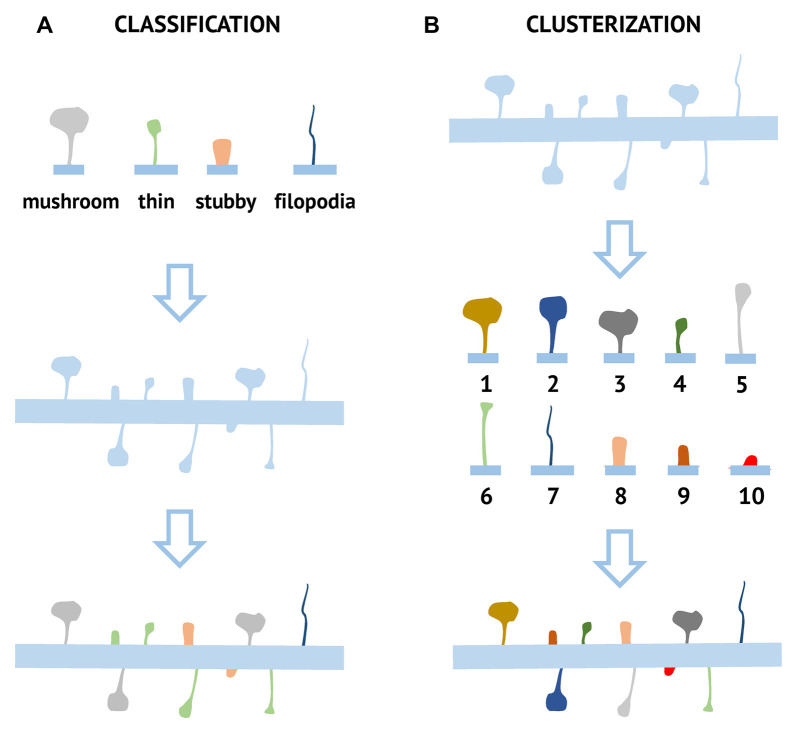
Dendritic spines are small protrusions from the dendrite membrane, where contact with neighboring axons is formed in order to receive synaptic input. Changes in size, shape, and density of synaptic spines are associated with learning and memory, and observed after drug abuse in a variety of neurodegenerative, neurodevelopmental, and psychiatric disorders. Due to the preeminent importance of synaptic spines, there have been major efforts into developing techniques that enable visualization and analysis of dendritic spines in cultured neurons, in fixed slices and in intact brain tissue. The classification of synaptic spines into predefined morphological groups is a standard approach in neuroscience research, where spines are divided into fixed categories such as thin, mushroom, and stubby subclasses. This study examines accumulated evidence that supports the existence of dendritic spine shapes as a continuum rather than separated classes. Using new approaches and software tools we reflect on complex dendritic spine shapes, positing that understanding of their highly dynamic nature is required to perform analysis of their morphology. The study discusses and compares recently developed algorithms that rely on clusterization rather than classification, therefore enabling new levels of spine shape analysis. We reason that improved methods of analysis may help to investigate a link between dendritic spine shape and its function, facilitating future studies of learning and memory as well as studies of brain disorders.
树突棘是从树突膜伸出的小突起,与相邻轴突形成接触以接收突触输入。突触棘的大小、形状和密度变化与学习和记忆相关,并且在多种神经退行性、神经发育性和精神疾病的药物滥用后也可观察到。由于突触棘极为重要,人们已做出重大努力来开发能够在培养的神经元、固定切片和完整脑组织中对树突棘进行可视化和分析的技术。将突触棘分类为预定义的形态学组是神经科学研究中的一种标准方法,其中棘被分为固定类别,如细、蘑菇状和短粗子类。本研究考察了支持树突棘形状为连续体而非分离类别的累积证据。使用新方法和软件工具,我们思考复杂的树突棘形状,认为需要了解其高度动态的性质才能对其形态进行分析。该研究讨论并比较了最近开发的依赖聚类而非分类的算法,从而实现了新水平的棘形状分析。我们推断,改进的分析方法可能有助于研究树突棘形状与其功能之间的联系,促进未来对学习和记忆以及脑部疾病的研究。