Gao Yan, Zhang Yongfang, Dong Yunxia, Wu Xiuying, Liu Hongtao
Department of Anesthesiology, The First Affiliated Hospital of Hebei North University, Zhangjiakou, China.
Department of Anesthesiology, Shengjing Hospital of China Medical University, Shenyang, China.
Front Pharmacol. 2020 Oct 7;11:555532. doi: 10.3389/fphar.2020.555532. eCollection 2020.
Exploring the effective therapy for neonatal hypoxic-ischemic brain injury is an important goal. This study was designed to investigate how dexmedetomidine (DEX) contribute to hypoxic brain injury.
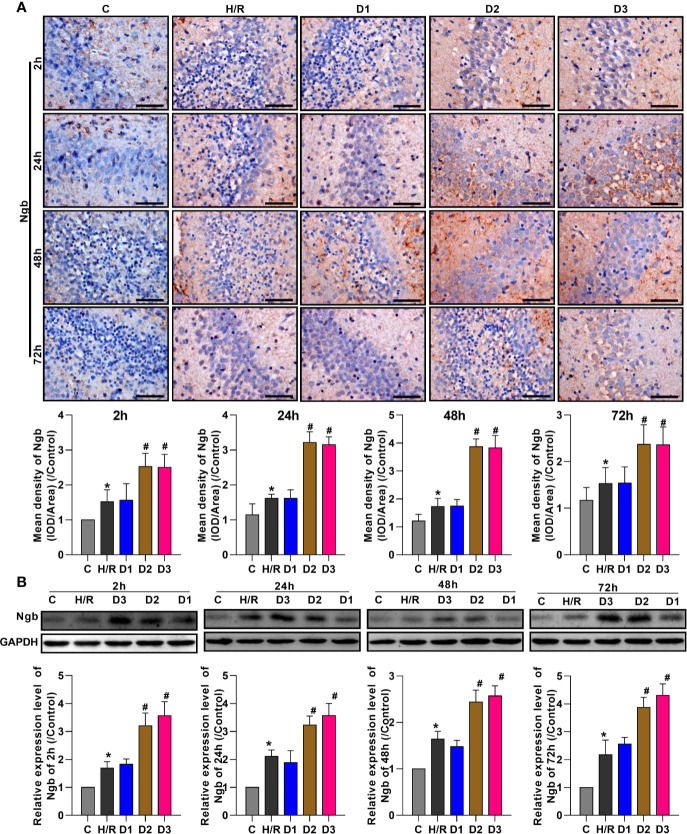
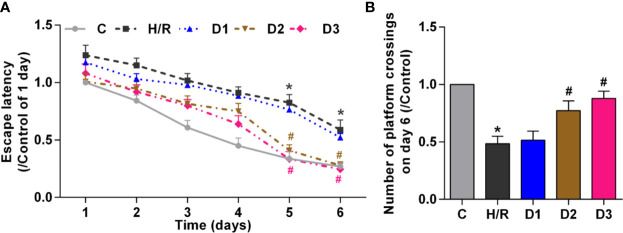
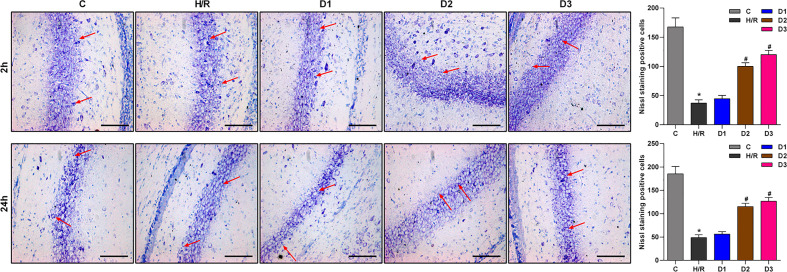
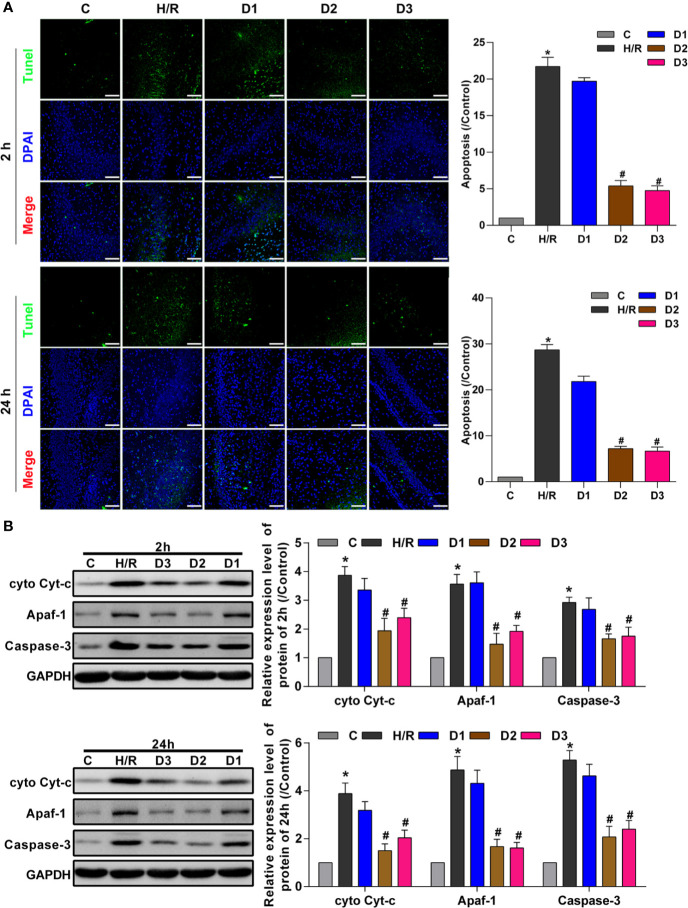
Developing Sprague-Dawley rat models of hypoxia/reoxygenation (H/R) injury were constructed to simulate neonatal hypoxic brain injury for DEX treatment. Immunohistochemistry and western blot were performed to measure neuroglobin (Ngb) protein expression in hippocampal tissues. Hippocampal neuron injury and apoptosis were detected by Nissl staining and TUNEL assay, respectively. A Morris water maze (MWM) test was performed to evaluate the long-term learning and memory function.
The expression of Ngb was increased following H/R model establishment and up-regulated by medium and high doses of DEX, but not up-regulated by low doses of DEX. Medium and high doses of DEX alleviated the H/R injury as well as induced the reduction of Nissl bodies and apoptosis. Besides, medium and high doses of DEX down-regulated cytosolic Cyt-c, Apaf-1, and caspase-3 in H/R injury model. MWM test showed that medium and high doses of DEX significantly shortened the escape latency and enhanced the number of platform crossings. However, low doses of DEX have no effect on Nissl bodies, mitochondrial apoptosis, expression of apoptosis-related proteins and long-term learning functions.
DEX induced Ngb expression in H/R rat models. The neuroprotection of DEX-mediated Ngb up-regulation may be achieved by inhibiting neuronal apoptosis through the mitochondrial pathway. Findings indicated that DEX may be useful as an effective therapy for neonatal hypoxic brain injury.
探索新生儿缺氧缺血性脑损伤的有效治疗方法是一个重要目标。本研究旨在调查右美托咪定(DEX)如何影响缺氧性脑损伤。
构建发育中的Sprague-Dawley大鼠缺氧/复氧(H/R)损伤模型,以模拟新生儿缺氧性脑损伤并进行DEX治疗。采用免疫组织化学和蛋白质印迹法检测海马组织中神经球蛋白(Ngb)的蛋白表达。分别通过尼氏染色和TUNEL检测法检测海马神经元损伤和凋亡情况。进行莫里斯水迷宫(MWM)试验以评估长期学习和记忆功能。
建立H/R模型后Ngb表达增加,中、高剂量DEX可上调其表达,但低剂量DEX无此作用。中、高剂量DEX减轻了H/R损伤,减少了尼氏体数量并诱导凋亡减少。此外,中、高剂量DEX下调了H/R损伤模型中胞质细胞色素C、凋亡蛋白酶激活因子-1(Apaf-1)和半胱天冬酶-3的表达。MWM试验表明,中、高剂量DEX显著缩短了逃避潜伏期并增加了穿越平台的次数。然而,低剂量DEX对尼氏体、线粒体凋亡、凋亡相关蛋白表达及长期学习功能均无影响。
DEX可诱导H/R大鼠模型中Ngb表达。DEX介导的Ngb上调所产生的神经保护作用可能是通过线粒体途径抑制神经元凋亡来实现的。研究结果表明,DEX可能是治疗新生儿缺氧性脑损伤的有效药物。