Dai Xin, Hou Huiqin, Zhang Wanru, Liu Tianyu, Li Yun, Wang Sinan, Wang Bangmao, Cao Hailong
Department of Gastroenterology and Hepatology, Tianjin Medical University General Hospital, Tianjin Institute of Digestive Diseases, Tianjin Key Laboratory of Digestive Diseases, Tianjin, China.
Department of Pharmacy, General Hospital, Tianjin Medical University, Tianjin, China.
Front Microbiol. 2020 Oct 7;11:567654. doi: 10.3389/fmicb.2020.567654. eCollection 2020.
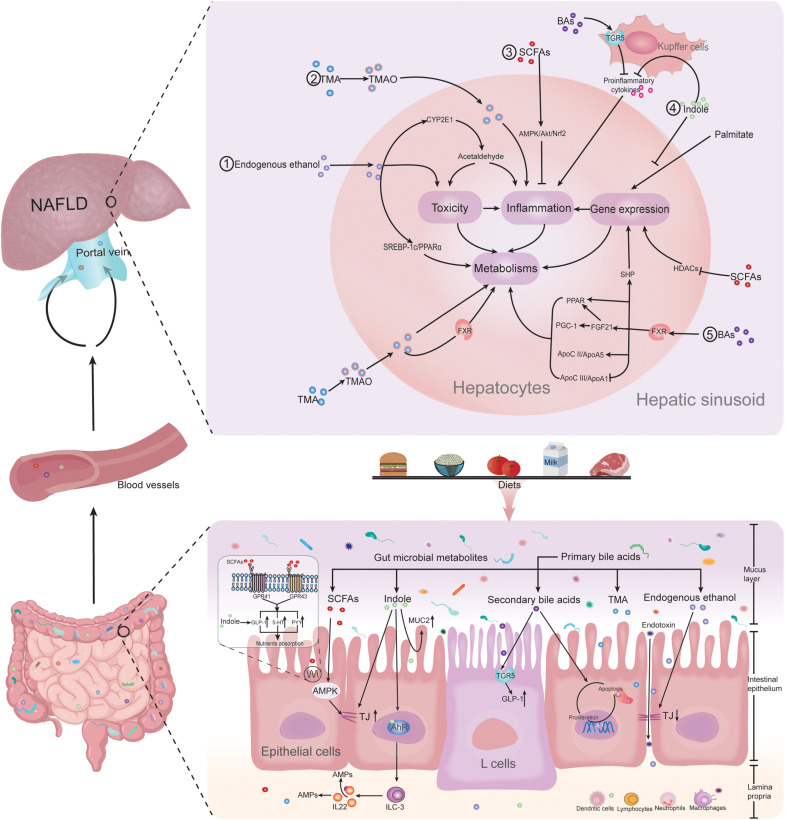
Non-alcoholic fatty liver disease (NAFLD) is the most common form of chronic liver disease throughout the world. The relationship between gut microbiota and NAFLD has been extensively investigated. The gut microbiota is involved in the regulation of NAFLD by participating in the fermentation of indigestible food, interacting with the intestinal mucosal immune system, and influencing the intestinal barrier function, leading to signaling alteration. Meanwhile, the microbial metabolites not only affect the signal transduction pathway in the gut but also reach the liver far away from gut. In this review, we focus on the effects of certain key microbial metabolites such as short-chain fatty acids, trimethylamine-N-oxide, bile acids, and endogenous ethanol and indole in NAFLD, and also summarize several potential therapies targeting the gut-liver axis and modulation of gut microbiota metabolites including antibiotics, prebiotics, probiotics, bile acid regulation, and fecal microbiota transplantation. Understanding the complex interactions between microbial metabolites and NAFLD may provide crucial insight into the pathogenesis and treatment of NAFLD.
非酒精性脂肪性肝病(NAFLD)是全球最常见的慢性肝病形式。肠道微生物群与NAFLD之间的关系已得到广泛研究。肠道微生物群通过参与难消化食物的发酵、与肠道黏膜免疫系统相互作用以及影响肠道屏障功能来参与NAFLD的调节,从而导致信号改变。同时,微生物代谢产物不仅影响肠道中的信号转导途径,还能到达远离肠道的肝脏。在这篇综述中,我们重点关注某些关键微生物代谢产物如短链脂肪酸、氧化三甲胺、胆汁酸、内源性乙醇和吲哚在NAFLD中的作用,还总结了几种针对肠-肝轴和调节肠道微生物群代谢产物的潜在疗法,包括抗生素、益生元、益生菌、胆汁酸调节和粪便微生物群移植。了解微生物代谢产物与NAFLD之间的复杂相互作用可能为NAFLD的发病机制和治疗提供关键见解。