Guo Jin, Shi Chun-Xia, Zhang Qing-Qi, Deng Wei, Zhang Lu-Yi, Chen Qian, Zhang Dan-Mei, Gong Zuo-Jiong
Department of Infectious Diseases, Renmin Hospital of Wuhan University, Wuhan, China.
Department of Infectious Diseases, Renmin Hospital of Wuhan University, Jiefang Road 238, Wuchang District, Wuhan, Hubei 430060, China.
Therap Adv Gastroenterol. 2022 Dec 6;15:17562848221138676. doi: 10.1177/17562848221138676. eCollection 2022.
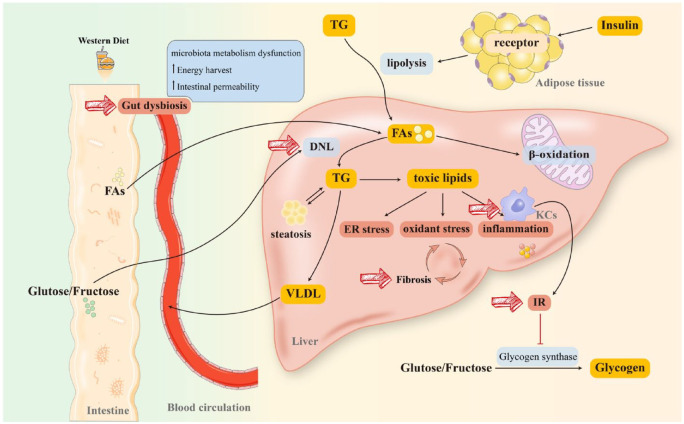
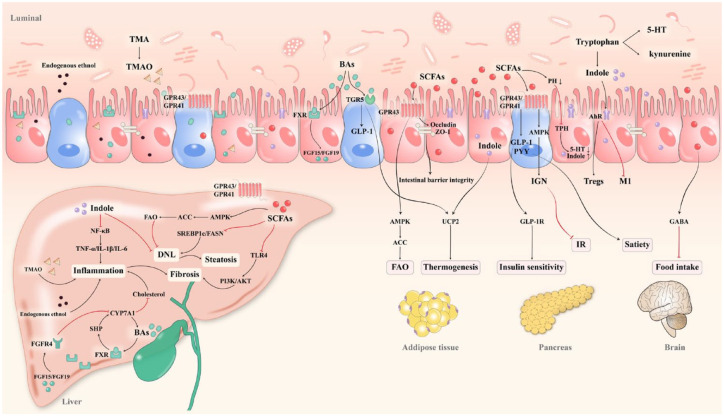
Over the past two decades, non-alcoholic fatty liver disease (NAFLD) has become a leading burden of hepatocellular carcinoma and liver transplantation. Although the exact pathogenesis of NAFLD has not been fully elucidated, recent hypotheses placed more emphasis on the crucial role of the gut microbiome and its derivatives. Reportedly, microbial metabolites such as short-chain fatty acids, amino acid metabolites (indole and its derivatives), bile acids (BAs), trimethylamine N-oxide (TMAO), and endogenous ethanol exhibit sophisticated bioactive properties. These molecules regulate host lipid, glucose, and BAs metabolic homeostasis modulating nutrient absorption, energy expenditure, inflammation, and the neuroendocrine axis. Consequently, a broad range of research has studied the therapeutic effects of microbiota-derived metabolites. In this review, we explore the interaction of microbial products and NAFLD. We also discuss the regulatory role of existing NAFLD therapies on metabolite levels and investigate the potential of targeting those metabolites to relieve NAFLD.
在过去二十年中,非酒精性脂肪性肝病(NAFLD)已成为肝细胞癌和肝移植的主要负担。尽管NAFLD的确切发病机制尚未完全阐明,但最近的假说更加强调肠道微生物群及其衍生物的关键作用。据报道,微生物代谢产物如短链脂肪酸、氨基酸代谢产物(吲哚及其衍生物)、胆汁酸(BAs)、氧化三甲胺(TMAO)和内源性乙醇具有复杂的生物活性。这些分子调节宿主脂质、葡萄糖和胆汁酸代谢稳态,调节营养吸收、能量消耗、炎症和神经内分泌轴。因此,广泛的研究探讨了微生物衍生代谢产物的治疗作用。在这篇综述中,我们探讨了微生物产物与NAFLD的相互作用。我们还讨论了现有NAFLD疗法对代谢产物水平的调节作用,并研究了针对这些代谢产物缓解NAFLD的潜力。