Department of Rheumatology, The First Affiliated Hospital of Guangzhou University of Chinese Medicine, Guangzhou, China.
Guangzhou University of Chinese Medicine, Guangzhou, China.
Front Immunol. 2020 Oct 7;11:556526. doi: 10.3389/fimmu.2020.556526. eCollection 2020.
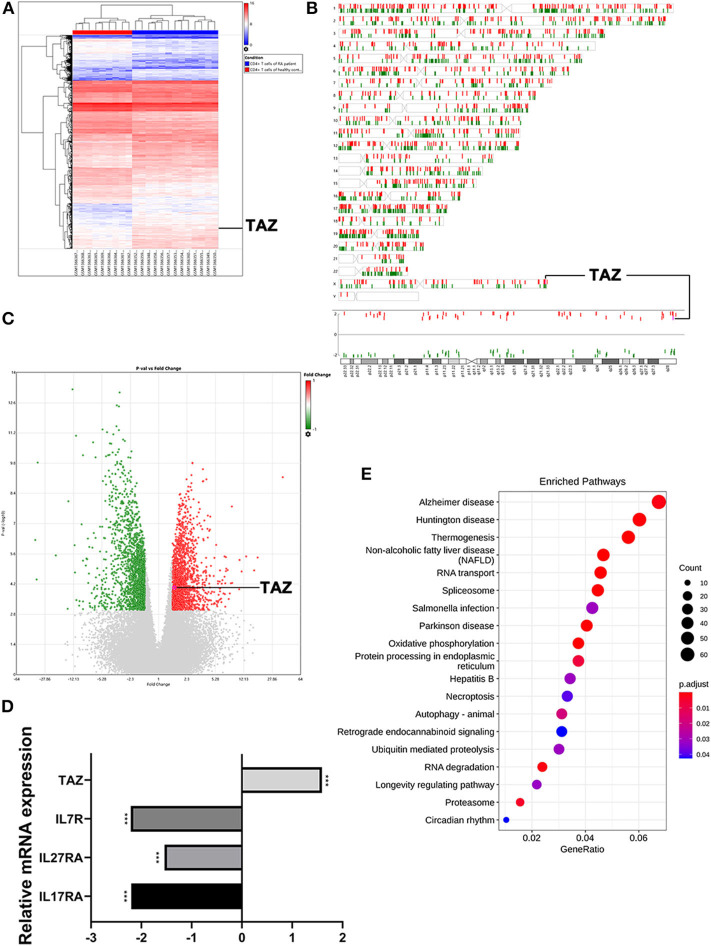
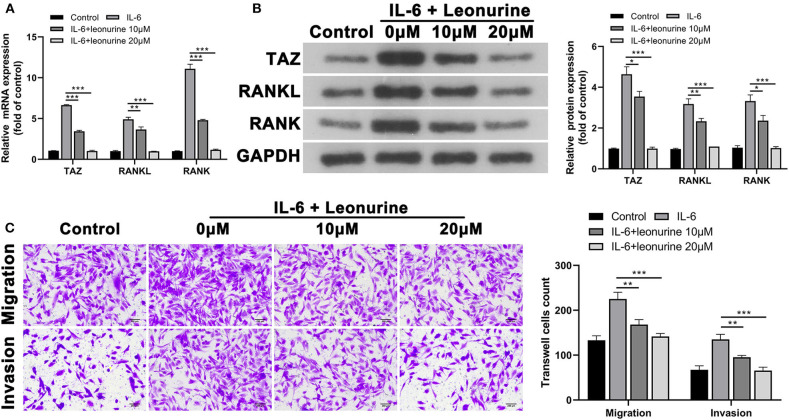
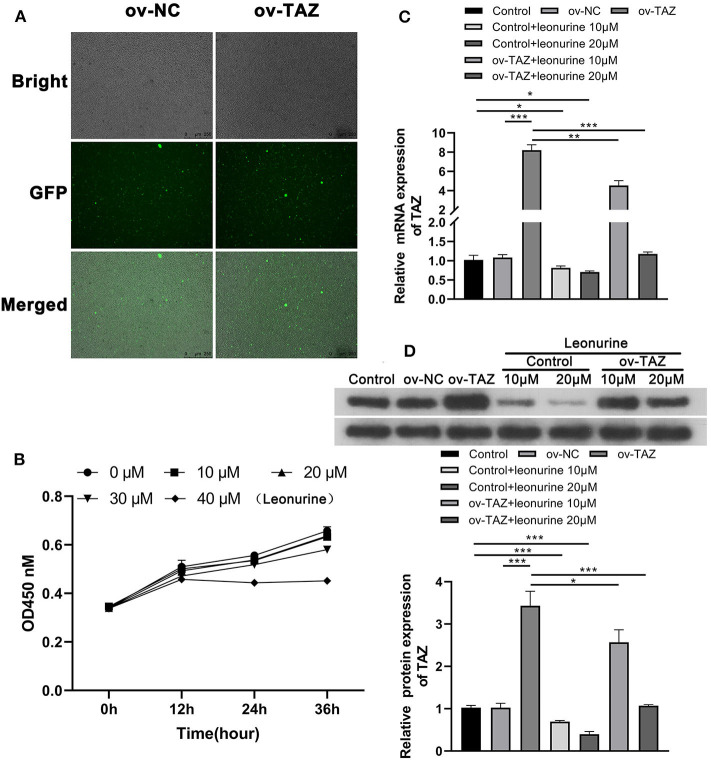
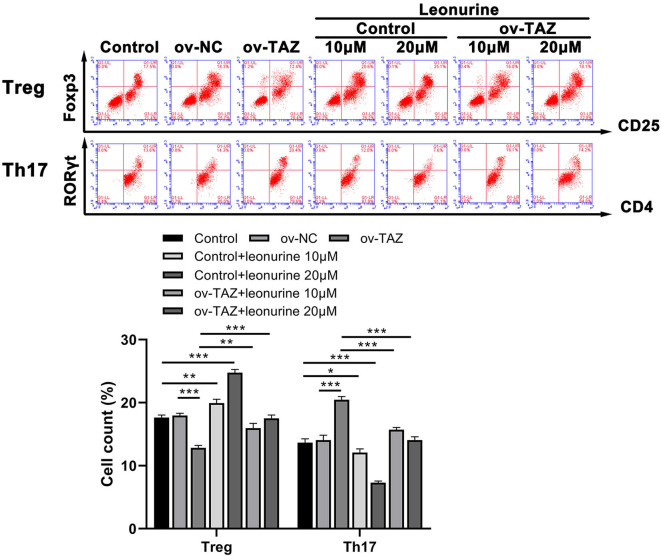
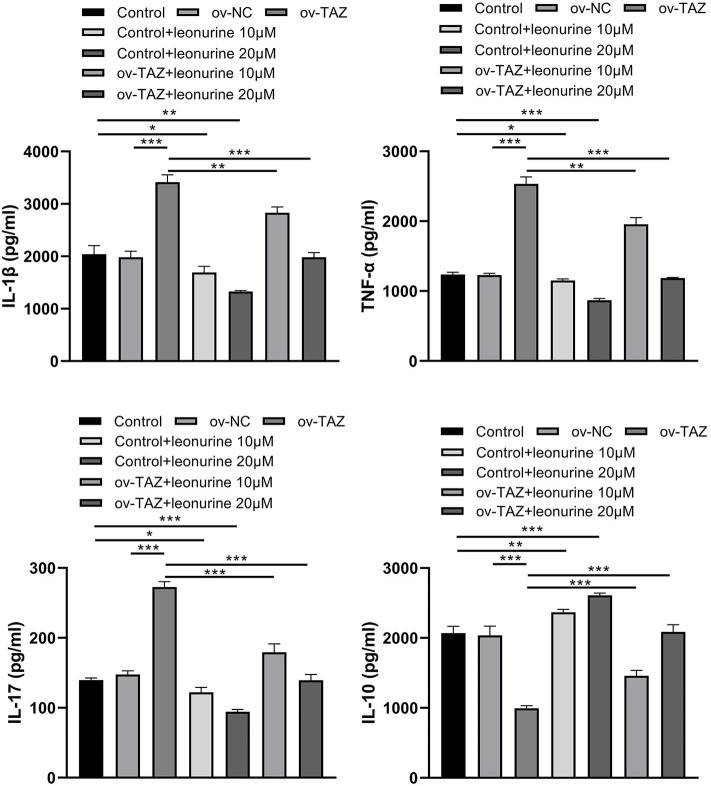
Leonurine, an active alkaloid extracted from , is reported to have potent anti-inflammatory activity against rheumatoid arthritis (RA). However, the molecular mechanism of action of leonurine in RA remains poorly understood. In this study, we detected 3,425 mRNAs differentially expressed between CD4 T cells of RA patients and those of healthy individuals using microarray raw data mining. Kyoto Encyclopedia of Genes and Genomes enrichment analysis revealed that transcriptional coactivator with PDZ-binding motif (TAZ) regulates a variety of biological processes including T-helper (Th)-17 cell development, and was thus selected for functional verification. In a naïve CD4 T cell differentiation assay, we found that TAZ overexpression was associated with impaired balance between T regulatory (Treg) and Th17 cells . TAZ overexpression increased the levels of the pro-inflammatory cytokines interleukin (IL)-17, IL-1β, and tumor necrosis factor (TNF)-α and decreased that of the anti-inflammatory cytokine IL-10. Leonurine treatment had a direct recovery effect on the impaired balance and reduced the expression of TAZ and led to normalization of IL-17, IL-1β, and TNF-α and IL-10. Furthermore, IL-6 was found to promote the expression of TAZ and receptor activator of nuclear factor kappa-B ligand (RANKL), and RANK. Leonurine significantly inhibited TAZ-mediated expression of RANKL, and RANK and IL-6 in synovial fibroblasts. We conclude that the therapeutic effect of leonurine was through suppression of TAZ led to restoration of Treg/Th17 balance and suppression of synovial fibroblast action.
汉桃叶,一种从汉桃叶中提取的活性生物碱,据报道具有很强的抗类风湿关节炎(RA)的抗炎活性。然而,汉桃叶素在 RA 中的作用机制尚不清楚。在这项研究中,我们使用微阵列原始数据挖掘检测到 RA 患者和健康个体的 CD4 T 细胞之间差异表达的 3425 个 mRNAs。京都基因与基因组百科全书富集分析显示,转录共激活因子与 PDZ 结合基序(TAZ)调节多种生物过程,包括 T 辅助(Th)-17 细胞发育,因此被选择进行功能验证。在幼稚 CD4 T 细胞分化实验中,我们发现 TAZ 过表达与 T 调节(Treg)和 Th17 细胞之间的平衡受损有关。TAZ 过表达增加了促炎细胞因子白细胞介素(IL)-17、IL-1β 和肿瘤坏死因子(TNF)-α的水平,降低了抗炎细胞因子 IL-10 的水平。汉桃叶素治疗对受损的平衡具有直接的恢复作用,降低了 TAZ 的表达,并使 IL-17、IL-1β 和 TNF-α和 IL-10 正常化。此外,发现白细胞介素-6(IL-6)促进 TAZ 和核因子 kappa-B 受体激活剂配体(RANKL)、RANK 的表达。汉桃叶素显著抑制 TAZ 介导的 RANKL、RANK 和 IL-6 在滑膜成纤维细胞中的表达。我们得出结论,汉桃叶素的治疗效果是通过抑制 TAZ 导致 Treg/Th17 平衡的恢复和抑制滑膜成纤维细胞的作用。