Department of Microbial Sciences, University of Surrey, Guildford, United Kingdom.
Front Immunol. 2020 Oct 1;11:568412. doi: 10.3389/fimmu.2020.568412. eCollection 2020.
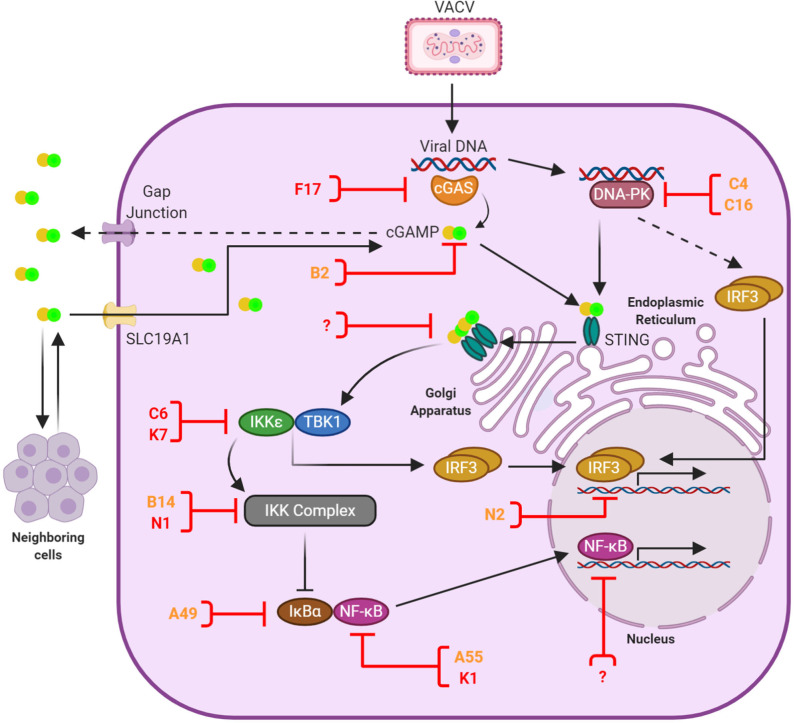
Cells express multiple molecules aimed at detecting incoming virus and infection. Recognition of virus infection leads to the production of cytokines, chemokines and restriction factors that limit virus replication and activate an adaptive immune response offering long-term protection. Recognition of cytosolic DNA has become a central immune sensing mechanism involved in infection, autoinflammation, and cancer immunotherapy. Vaccinia virus (VACV) is the prototypic member of the family Poxviridae and the vaccine used to eradicate smallpox. VACV harbors enormous potential as a vaccine vector and several attenuated strains are currently being developed against infectious diseases. In addition, VACV has emerged as a popular oncolytic agent due to its cytotoxic capacity even in hypoxic environments. As a poxvirus, VACV is an unusual virus that replicates its large DNA genome exclusively in the cytoplasm of infected cells. Despite producing large amounts of cytosolic DNA, VACV efficiently suppresses the subsequent innate immune response by deploying an arsenal of proteins with capacity to disable host antiviral signaling, some of which specifically target cytosolic DNA sensing pathways. Some of these strategies are conserved amongst orthopoxviruses, whereas others are seemingly unique to VACV. In this review we provide an overview of the VACV replicative cycle and discuss the recent advances on our understanding of how VACV induces and antagonizes innate immune activation via cytosolic DNA sensing pathways. The implications of these findings in the rational design of vaccines and oncolytics based on VACV are also discussed.
细胞表达多种分子,旨在检测入侵的病毒和感染。对病毒感染的识别会导致细胞因子、趋化因子和限制因子的产生,这些因子限制病毒复制并激活适应性免疫反应,提供长期保护。细胞内 DNA 的识别已成为感染、自身炎症和癌症免疫治疗中涉及的中央免疫感应机制。牛痘病毒 (VACV) 是正痘病毒科的典型成员,也是用于根除天花的疫苗。VACV 具有巨大的疫苗载体潜力,目前正在针对传染病开发几种减毒菌株。此外,由于其在缺氧环境中的细胞毒性能力,VACV 已成为一种流行的溶瘤剂。作为一种正痘病毒,VACV 是一种异常的病毒,其大量的细胞质 DNA 基因组仅在感染细胞的细胞质中复制。尽管产生大量的细胞质 DNA,但 VACV 通过部署一系列具有使宿主抗病毒信号失活能力的蛋白质来有效地抑制随后的先天免疫反应,其中一些蛋白质专门针对细胞质 DNA 感应途径。这些策略中的一些在正痘病毒中是保守的,而另一些则似乎是 VACV 所独有的。在这篇综述中,我们概述了 VACV 的复制周期,并讨论了我们对 VACV 如何通过细胞质 DNA 感应途径诱导和拮抗先天免疫激活的理解的最新进展。还讨论了这些发现对基于 VACV 的疫苗和溶瘤剂的合理设计的意义。