Huang Chung-Hsiung, Lu Shueh-Yu, Tsai Wei-Chung
Department of Food Science, National Taiwan Ocean University, 2 Pei-Ning Road, Keelung 20224, Taiwan, ROC.
Biosci Microbiota Food Health. 2020;39(4):234-242. doi: 10.12938/bmfh.2020-014. Epub 2020 Jul 4.
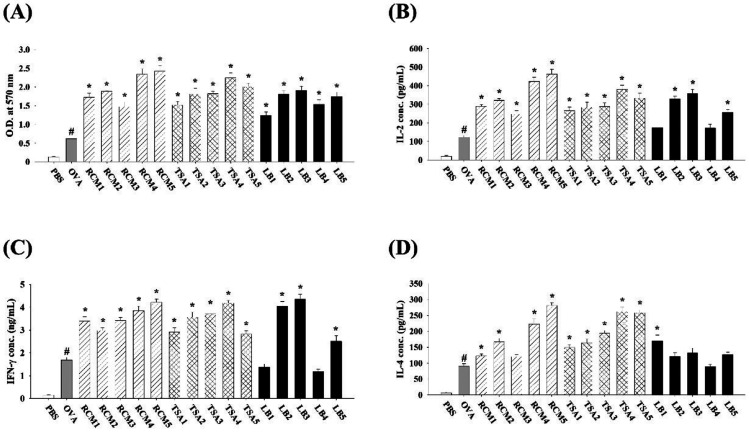
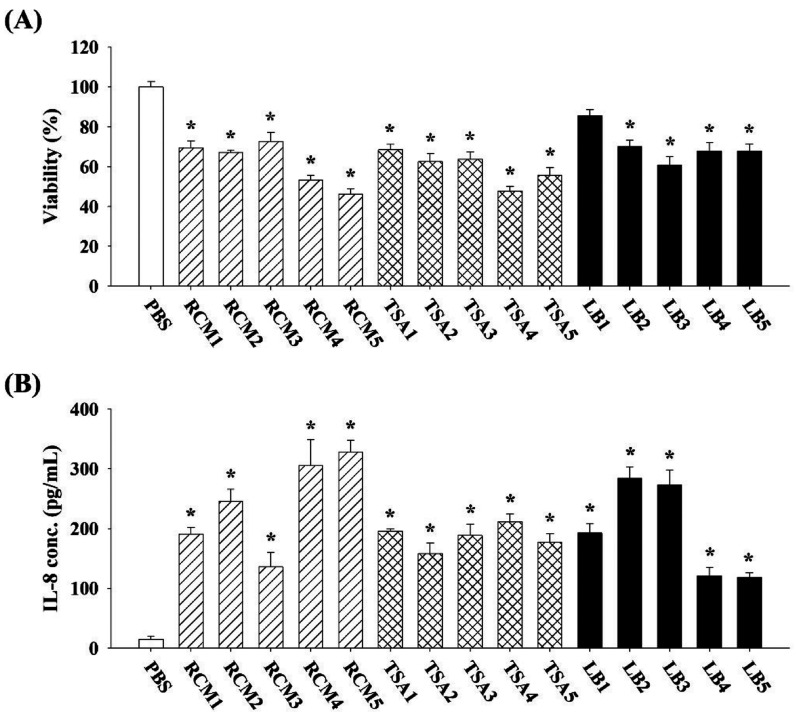
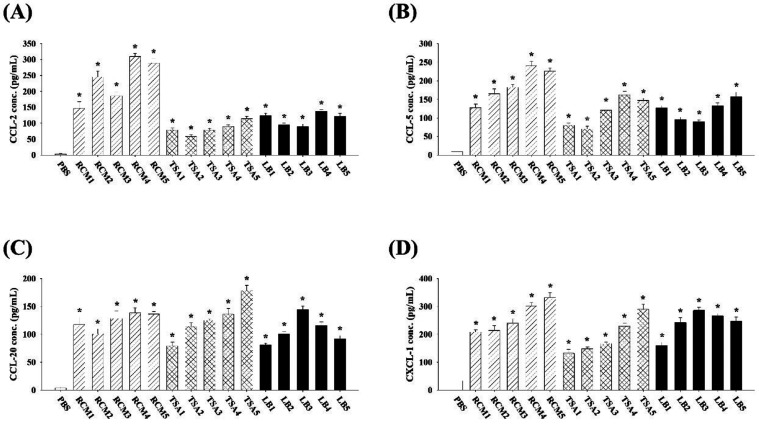
The objective of this study was to identify the relevant fecal microbes from mice with food allergy and investigate the impact of these microbes on intestinal epithelial cells and allergen-specific T-cell responses. A murine model of ovalbumin (OVA)-induced food allergy was employed. The profile of fecal microbiota was evaluated by the traditional plating method and next-generation sequencing (NGS) of the 16S ribosomal RNA gene. The density of fecal bacteria growth on RCM, TSA and LB plates was elevated in mice with food allergy, whereas the diversity of fecal bacteria was decreased. Additionally, the relative abundances of Prevotellaceae and were increased. The isolated fecal strains, mostly belonging to and significantly reduced the viability of intestinal Caco-2 cells but increased the production of interleukin (IL)-8, C-C motif chemokine ligand (CCL)-2, CCL-5, CCL-20 and C-X-C motif chemokine ligand (CXCL)-1. Moreover, cell expansion and secretion of IL-2, interferon (IFN)-γ, IL-4 and IL-17 by mesenteric lymph node (MLN) cells were augmented, whereas the production of IL-10 and transforming growth factor (TGF)-β was diminished. Although individual fecal strains had varying degrees of impact on Caco-2 cells and MLN cells, these results precisely indicate a different profile of fecal microbiota between normal mice and allergic mice. Most important, the relevant fecal microbes involved in allergen-induced dysbiosis have the potential to induce intestinal cytokine/chemokine network and T-cell immune responses.
本研究的目的是鉴定食物过敏小鼠的相关粪便微生物,并研究这些微生物对肠上皮细胞和过敏原特异性T细胞反应的影响。采用卵清蛋白(OVA)诱导的食物过敏小鼠模型。通过传统平板培养法和16S核糖体RNA基因的新一代测序(NGS)评估粪便微生物群的特征。食物过敏小鼠在RCM、TSA和LB平板上的粪便细菌生长密度升高,而粪便细菌的多样性降低。此外,普雷沃氏菌科的相对丰度增加。分离出的粪便菌株大多属于,显著降低了肠Caco-2细胞的活力,但增加了白细胞介素(IL)-8、C-C基序趋化因子配体(CCL)-2、CCL-5、CCL-20和C-X-C基序趋化因子配体(CXCL)-1的产生。此外,肠系膜淋巴结(MLN)细胞的IL-2、干扰素(IFN)-γ、IL-4和IL-17的细胞扩增和分泌增加,而IL-10和转化生长因子(TGF)-β的产生减少。尽管单个粪便菌株对Caco-2细胞和MLN细胞有不同程度的影响,但这些结果准确地表明了正常小鼠和过敏小鼠之间粪便微生物群的不同特征。最重要的是,参与过敏原诱导的生态失调的相关粪便微生物有可能诱导肠道细胞因子/趋化因子网络和T细胞免疫反应。