Sandra Verstraelen, An Jacobs, Jo Van Laer, Masha Van Deun, Diane Bertels, Witters Hilda, Sylvie Remy, Lieve Geerts, Lize Deferme, Evelien Frijns
VITO NV (Flemish Institute for Technological Research), Unit HEALTH, Mol, Belgium.
VITO NV, Unit SCT (Separation and Conversion Technology), Mol, Belgium.
MethodsX. 2020 Oct 8;7:101088. doi: 10.1016/j.mex.2020.101088. eCollection 2020.
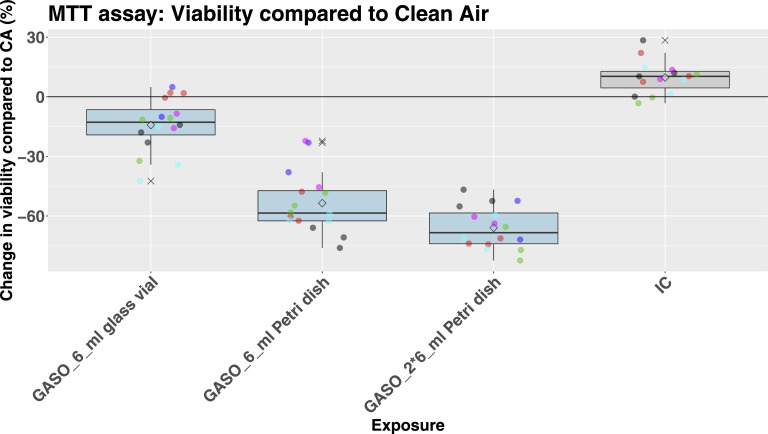
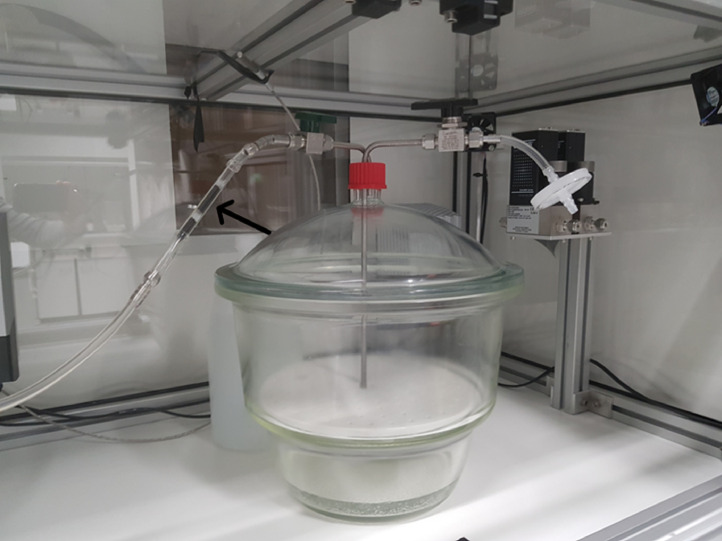
-based new approach methodologies (NAMs) provide a pragmatic solution to animal testing of petroleum substances and their constituents. A previous study exposed an in vitro model (A549 cells) at the air-liquid interface (ALI) to assess inhalation toxicity of a single compound, ethylbenzene. Experimental conditions using VITROCELL 24/48 exposure system were optimized to achieve a deposition efficiency that resulted in dose-dependent biological changes. The feasibility of this set-up was evaluated for testing the complex substance gasoline, which, at only high concentrations, can induce mild respiratory irritation in animals and cough in humans.•Results showed that perpendicular ALI exposure flow systems (VITROCELL® 6/4 and 24/48) may not be appropriate for testing gasoline because it was not possible to achieve enough deposition onto the cells and in the culture medium to measure dose and to determine dose-dependent biological changes (more information can be found in 'Supplementary material and/or Additional information' section).•Structural features ( aromatic or saturated hydrocarbon structure) and high hydrophobicity, together with the low concentrations of individual components in gasoline, may have caused the low deposition.•To achieve a higher deposition on the cells, A549 cells were exposed to gasoline at the ALI by passive dosing.The results demonstrate that the presented methodology is a promising NAM for inhalation toxicity testing of (semi-)volatile complex substances with low aqueous solubility.
基于新方法的技术(NAMs)为石油物质及其成分的动物试验提供了一种实用的解决方案。先前的一项研究将气液界面(ALI)处的体外模型(A549细胞)暴露于单一化合物乙苯中,以评估其吸入毒性。使用VITROCELL 24/48暴露系统对实验条件进行了优化,以实现沉积效率,从而导致剂量依赖性生物学变化。对该设置测试复杂物质汽油的可行性进行了评估,汽油仅在高浓度下会在动物中引起轻度呼吸道刺激,并在人类中引起咳嗽。•结果表明,垂直ALI暴露流动系统(VITROCELL®6/4和24/48)可能不适用于测试汽油,因为无法在细胞和培养基上实现足够的沉积以测量剂量并确定剂量依赖性生物学变化(更多信息可在“补充材料和/或附加信息”部分中找到)。•结构特征(芳香族或饱和烃结构)和高疏水性,以及汽油中单个成分的低浓度,可能导致了低沉积。•为了在细胞上实现更高的沉积,通过被动给药在ALI处将A549细胞暴露于汽油中。结果表明,所提出的方法对于低水溶性(半)挥发性复杂物质的吸入毒性测试是一种有前景的NAM。