Carim Sabrya C, Kechad Amel, Hickson Gilles R X
CHU Sainte-Justine Research Center, Université de Montréal, Montréal, QC, Canada.
Département de Pathologie et Biologie Cellulaire, Faculté de Médecine, Université de Montréal, Montréal, QC, Canada.
Front Cell Dev Biol. 2020 Oct 7;8:575226. doi: 10.3389/fcell.2020.575226. eCollection 2020.
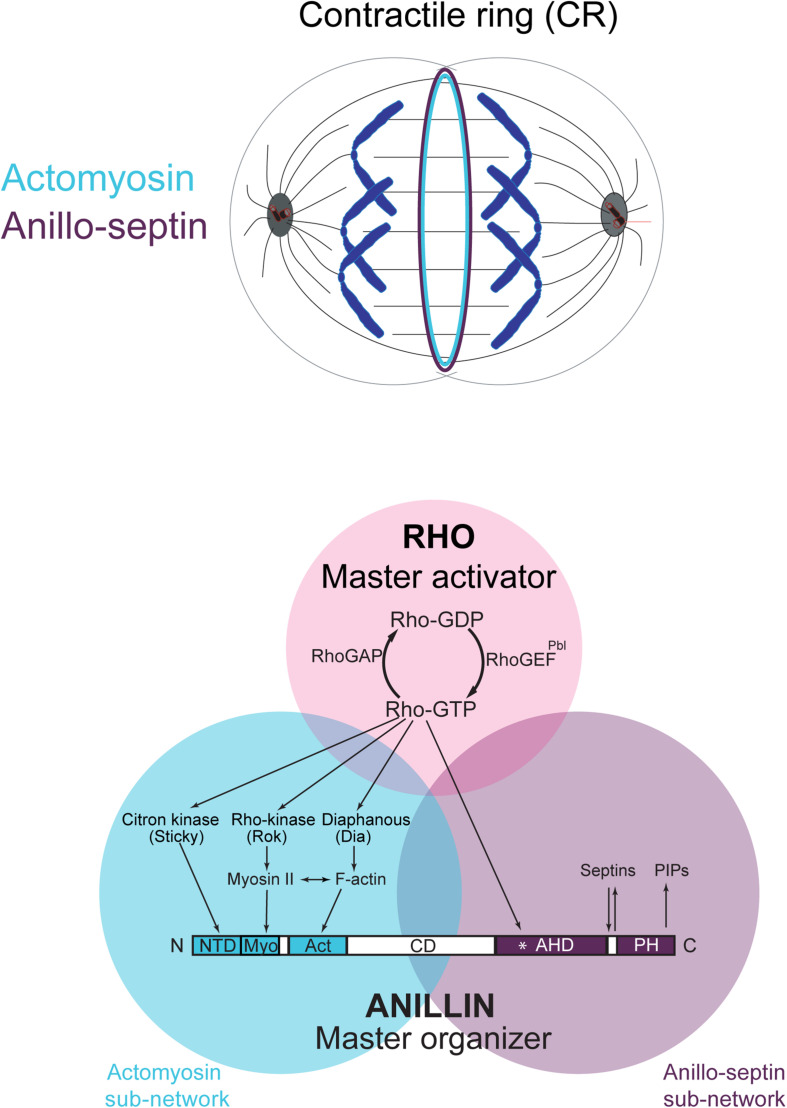
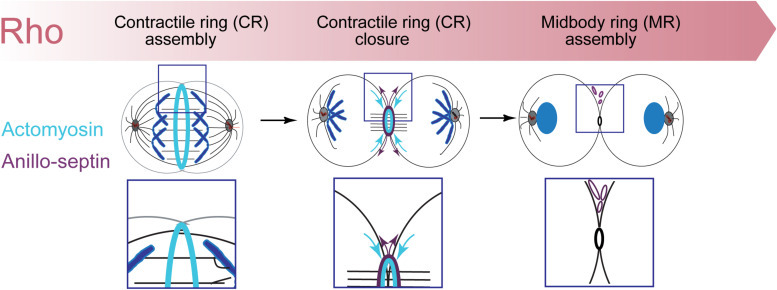
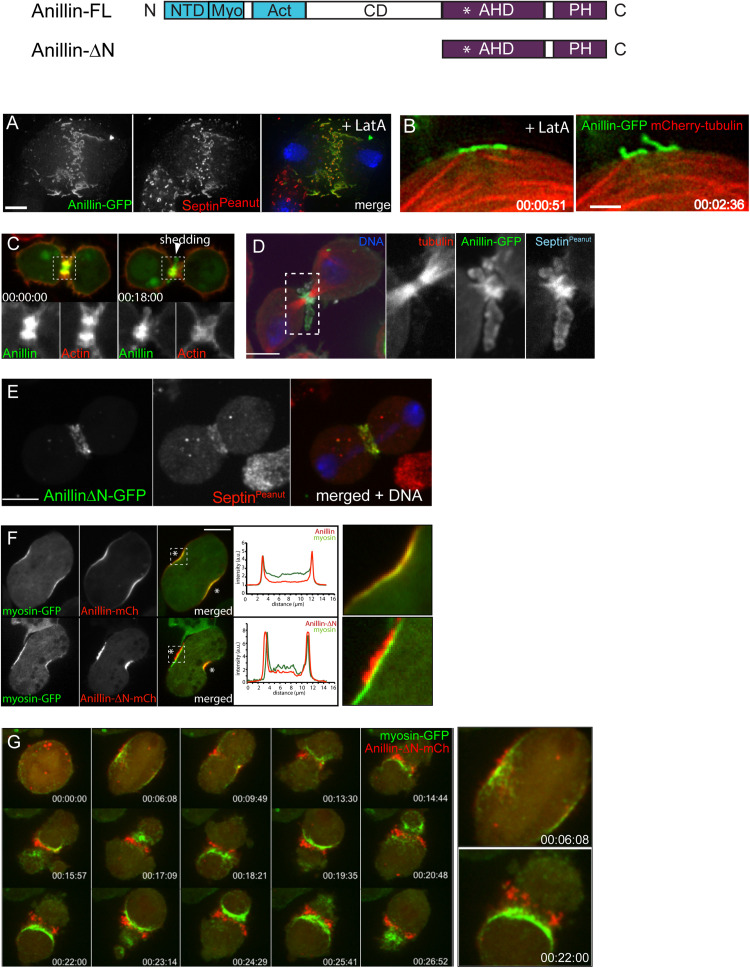
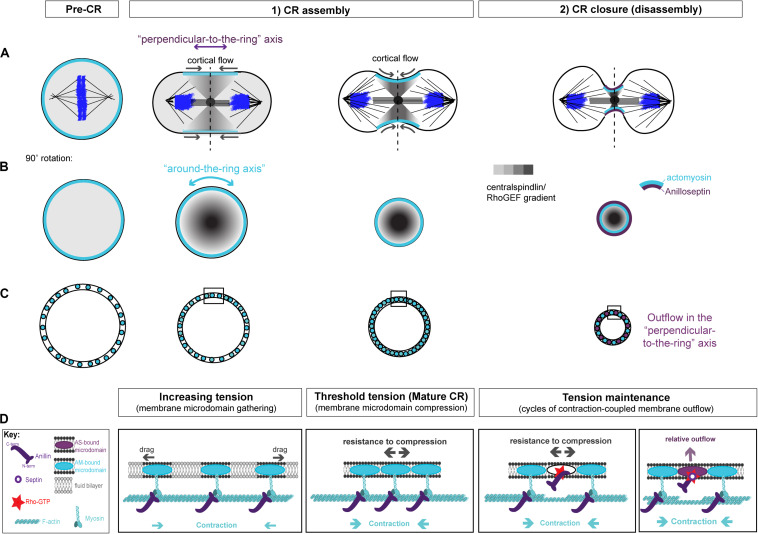
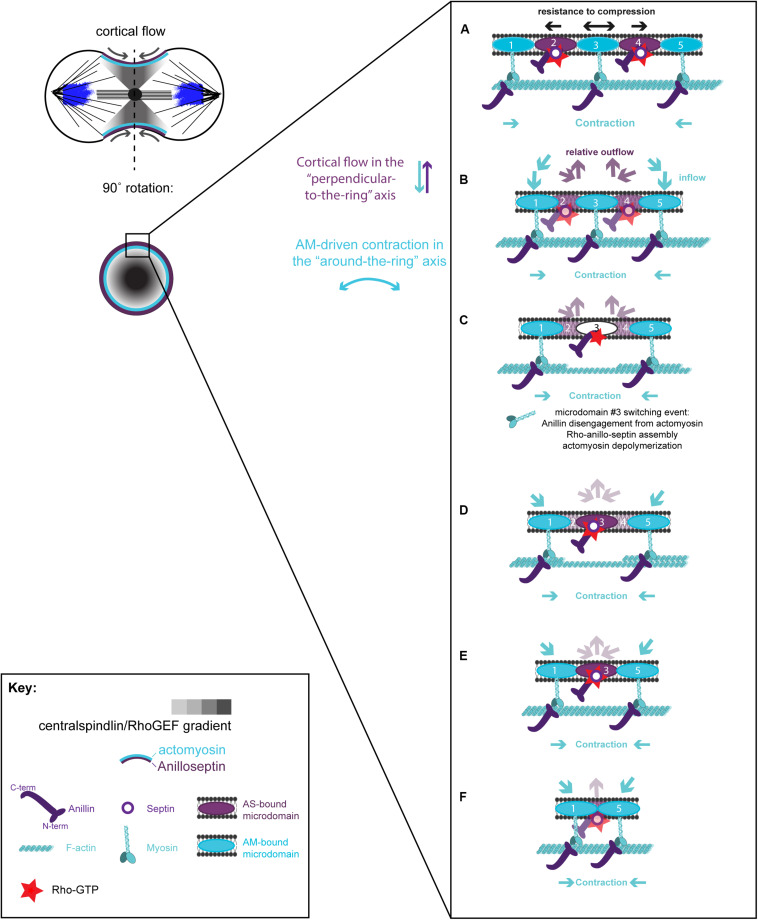
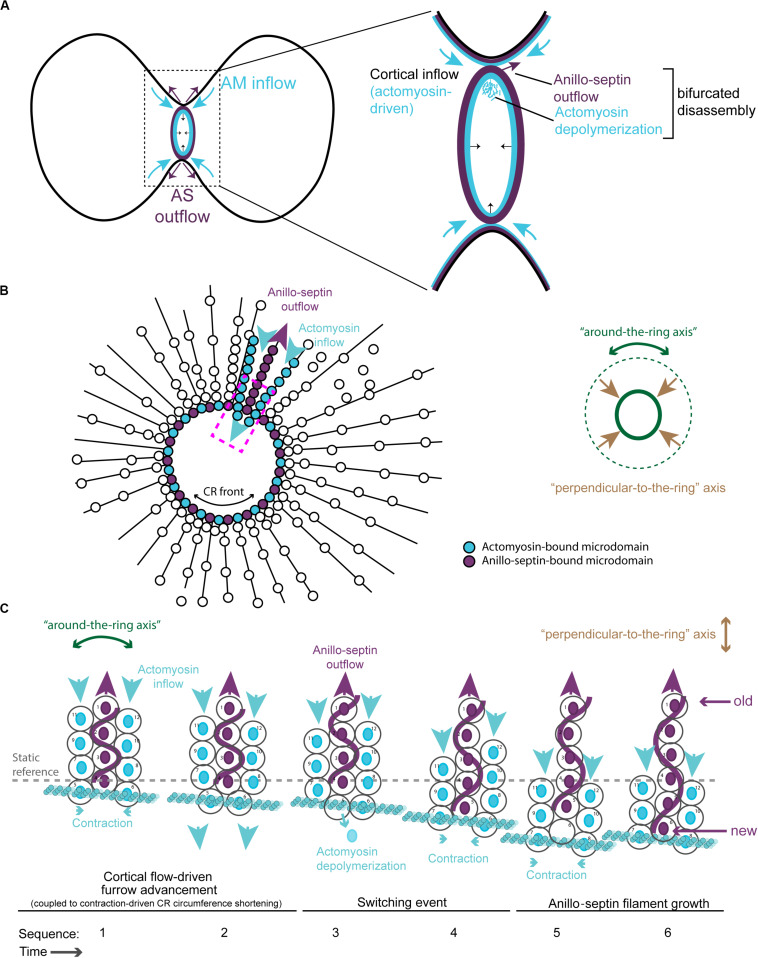
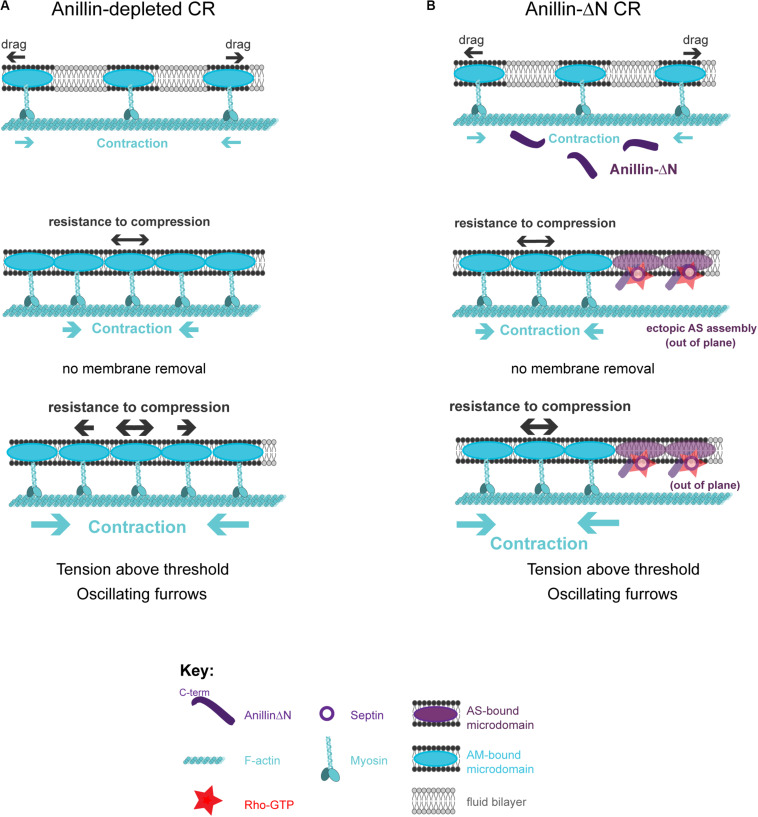
Cytokinesis is the last step of cell division that partitions the cellular organelles and cytoplasm of one cell into two. In animal cells, cytokinesis requires Rho-GTPase-dependent assembly of F-actin and myosin II (actomyosin) to form an equatorial contractile ring (CR) that bisects the cell. Despite 50 years of research, the precise mechanisms of CR assembly, tension generation and closure remain elusive. This hypothesis article considers a holistic view of the CR that, in addition to actomyosin, includes another Rho-dependent cytoskeletal sub-network containing the scaffold protein, Anillin, and septin filaments (collectively termed anillo-septin). We synthesize evidence from our prior work in S2 cells that actomyosin and anillo-septin form separable networks that are independently anchored to the plasma membrane. This latter realization leads to a simple conceptual model in which CR assembly and closure depend upon the micro-management of the membrane microdomains to which actomyosin and anillo-septin sub-networks are attached. During CR assembly, actomyosin contractility gathers and compresses its underlying membrane microdomain attachment sites. These microdomains resist this compression, which builds tension. During CR closure, membrane microdomains are transferred from the actomyosin sub-network to the anillo-septin sub-network, with which they flow out of the CR as it advances. This relative outflow of membrane microdomains regulates tension, reduces the circumference of the CR and promotes actomyosin disassembly all at the same time. According to this hypothesis, the metazoan CR can be viewed as a membrane microdomain gathering, compressing and sorting machine that intrinsically buffers its own tension through coordination of actomyosin contractility and anillo-septin-membrane relative outflow, all controlled by Rho. Central to this model is the abandonment of the dogmatic view that the plasma membrane is always readily deformable by the underlying cytoskeleton. Rather, the membrane resists compression to build tension. The notion that the CR might generate tension through resistance to compression of its own membrane microdomain attachment sites, can account for numerous otherwise puzzling observations and warrants further investigation using multiple systems and methods.
胞质分裂是细胞分裂的最后一步,它将一个细胞的细胞器和细胞质分成两部分。在动物细胞中,胞质分裂需要Rho-GTP酶依赖的F-肌动蛋白和肌球蛋白II(肌动球蛋白)组装,形成一个将细胞一分为二的赤道收缩环(CR)。尽管经过了50年的研究,CR组装、张力产生和闭合的精确机制仍然难以捉摸。这篇假说文章考虑了CR的整体观点,除了肌动球蛋白外,还包括另一个Rho依赖的细胞骨架子网,其中包含支架蛋白Anillin和septin丝(统称为anillo-septin)。我们综合了之前在S2细胞中的研究证据,表明肌动球蛋白和anillo-septin形成了可分离的网络,它们独立地锚定在质膜上。这一最新认识导致了一个简单的概念模型,其中CR组装和闭合取决于肌动球蛋白和anillo-septin子网所附着的膜微区的微观管理。在CR组装过程中,肌动球蛋白收缩性聚集并压缩其下方的膜微区附着位点。这些微区抵抗这种压缩,从而产生张力。在CR闭合过程中,膜微区从肌动球蛋白子网转移到anillo-septin子网,随着CR的推进,它们与anillo-septin子网一起流出CR。膜微区的这种相对流出调节张力,减小CR的周长,并同时促进肌动球蛋白的解体。根据这一假说,后生动物的CR可以被视为一个膜微区聚集、压缩和分类机器,它通过协调肌动球蛋白收缩性和anillo-septin-膜相对流出,内在地缓冲自身的张力,所有这些都由Rho控制。该模型的核心是摒弃了细胞膜总是容易被其下方的细胞骨架变形的教条观点。相反,膜抵抗压缩以产生张力。CR可能通过抵抗其自身膜微区附着位点的压缩来产生张力这一观点,可以解释许多其他令人困惑的观察结果,值得使用多种系统和方法进行进一步研究。