Department of Biological Sciences, Carnegie Mellon University, Pittsburgh, Pennsylvania, United States of America.
Department of Respiratory Sciences, University of Leicester, Leicester, United Kingdom.
PLoS Pathog. 2020 Oct 29;16(10):e1008931. doi: 10.1371/journal.ppat.1008931. eCollection 2020 Oct.
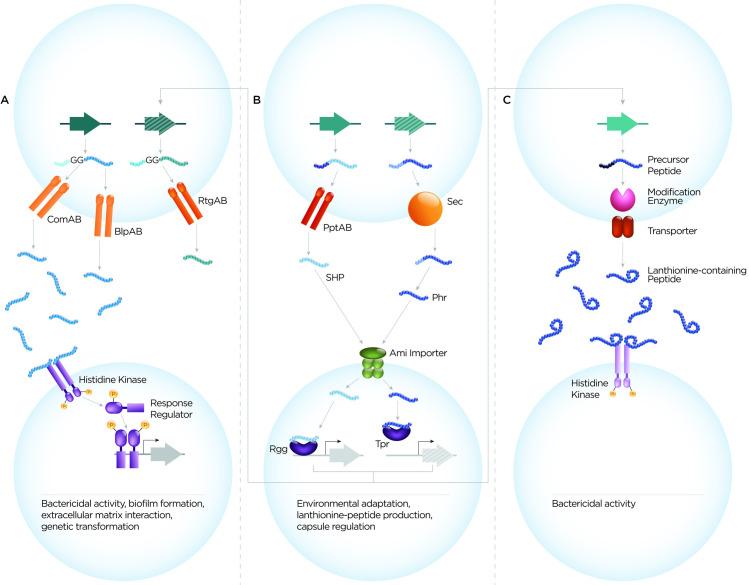
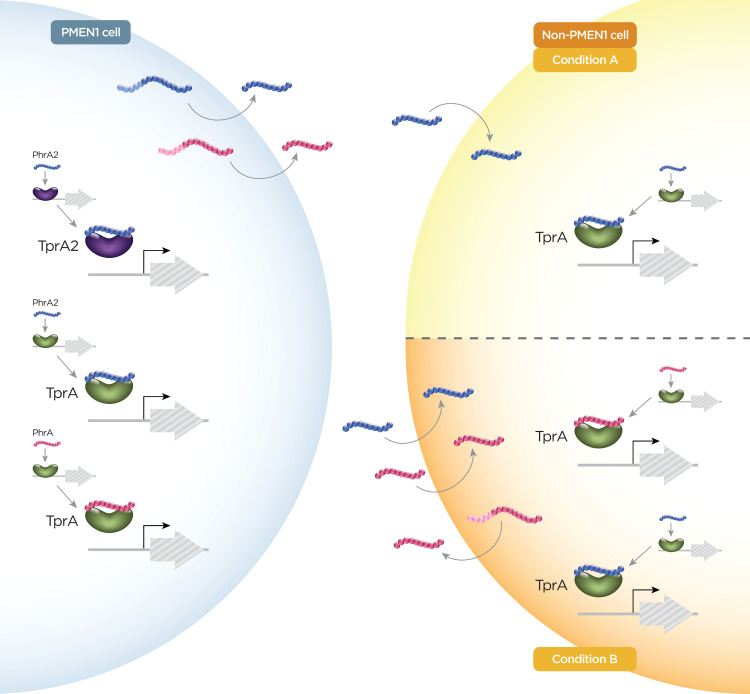
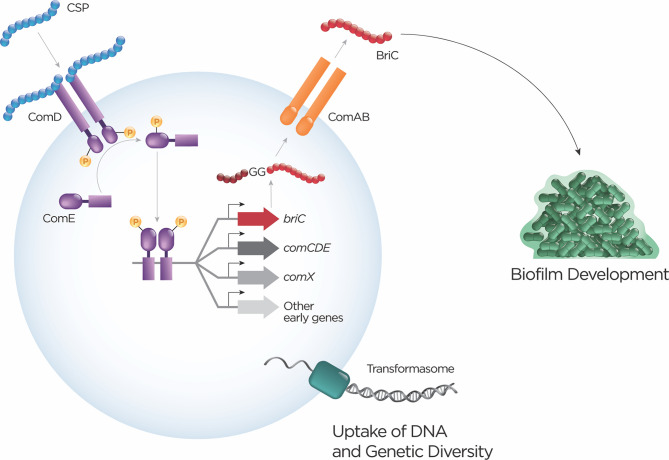
Gram-positive bacteria employ an array of secreted peptides to control population-level behaviors in response to environmental cues. We review mechanistic and functional features of secreted peptides produced by the human pathogen Streptococcus pneumoniae. We discuss sequence features, mechanisms of transport, and receptors for 3 major categories of small peptides: the double-glycine peptides, the Rap, Rgg, NprR, PlcR, and PrgX (RRNPP)-binding peptides, and the lanthionine-containing peptides. We highlight the impact of factors that contribute to carriage and pathogenesis, specifically genetic diversity, microbial competition, biofilm development, and environmental adaptation. A recent expansion in pneumococcal peptide studies reveals a complex network of interacting signaling systems where multiple peptides are integrated into the same signaling pathway, allowing multiple points of entry into the pathway and extending information content in new directions. In addition, since peptides are present in the extracellular milieu, there are opportunities for crosstalk, quorum sensing (QS), as well as intra- and interstrain and species interactions. Knowledge on the manner that population-level behaviors contribute to disease provides an avenue for the design and development of anti-infective strategies.
革兰氏阳性菌利用一系列分泌的肽来控制群体水平的行为,以响应环境线索。我们回顾了人类病原体肺炎链球菌产生的分泌肽的机制和功能特征。我们讨论了 3 种主要类型的小肽的序列特征、运输机制和受体:双甘氨酸肽、Rap、Rgg、NprR、PlcR 和 PrgX(RRNPP)结合肽和含硫氨酸肽。我们强调了导致携带和发病的因素的影响,特别是遗传多样性、微生物竞争、生物膜发育和环境适应。最近对肺炎球菌肽研究的扩展揭示了一个相互作用的信号系统的复杂网络,其中多个肽被整合到同一个信号通路中,允许在通路中进入多个点,并在新的方向上扩展信息内容。此外,由于肽存在于细胞外环境中,因此存在串扰、群体感应(QS)以及菌株内和菌株间以及物种间相互作用的机会。关于群体水平行为如何导致疾病的知识为设计和开发抗感染策略提供了途径。