Liu Qian, Mo Lin, Huang Xianqiao, Yu Lu, Liu Yang
Department of Nursing of Children's Hospital of Chongqing Medical University.
National Clinical Research Center for Child Health and Disorders.
Medicine (Baltimore). 2020 Oct 23;99(43):e22888. doi: 10.1097/MD.0000000000022888.
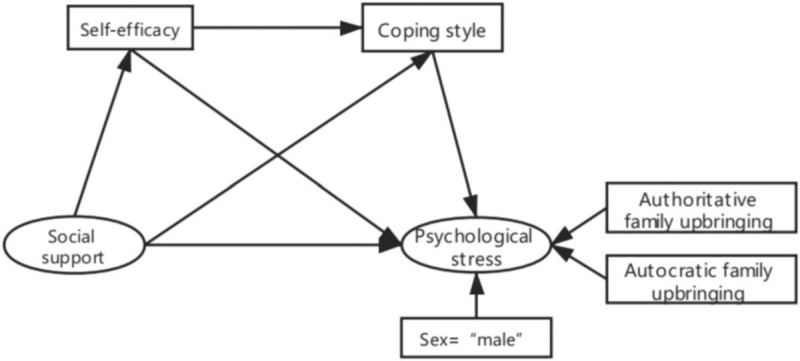
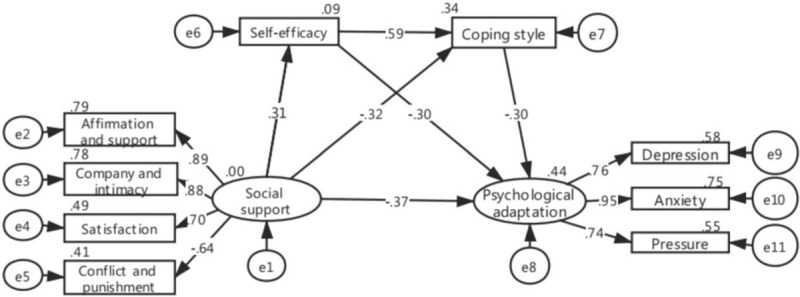
The aim of this study was to explore the relationship between social support, self-efficacy, coping style, and psychological stress in children with malignant tumors during the treatment, and to clarify the mediating effects.From May 2019 to August 2019, selected by convenience sampling method, 141 children with malignant tumors in the treatment period were evaluated using the Social Support Questionnaire, General Self-efficacy Scale, Simplified Coping Style Questionnaire, and Depression-Anxiety-Stress Scale.The results of correlation analysis showed that depression was negatively correlated with coping style, self-efficacy, affirmation and support, satisfaction, company, and intimacy, but positively correlated with conflict and punishment; both anxiety and stress were significantly negatively correlated with coping style, self-efficacy, affirmation and support, company, and intimacy. The results of the model indicated that gender, social support, self-efficacy, and coping style could directly predict the psychological stress of children with malignant tumors in the treatment period, social support and self-efficacy could indirectly predict the psychological stress of children with malignant tumors, and the total effect of self-efficacy on the psychological stress of children was the largest. Through 2000 bootstrap tests of mediating effect, it not only confirmed the mediating effect of self-efficacy and coping style but also had a chain-mediating effect.Appropriate social support can improve the self-efficacy of children with malignant tumors in the treatment period and encourage them to take a positive response to the disease, thereby effectively preventing or reducing the occurrence of psychological stress.
本研究旨在探讨恶性肿瘤患儿治疗期间社会支持、自我效能感、应对方式与心理应激之间的关系,并阐明中介效应。2019年5月至2019年8月,采用便利抽样法选取141例处于治疗期的恶性肿瘤患儿,使用社会支持问卷、一般自我效能感量表、简易应对方式问卷和抑郁-焦虑-压力量表进行测评。相关分析结果显示,抑郁与应对方式、自我效能感、肯定与支持、满意度、陪伴和亲密程度呈负相关,但与冲突和惩罚呈正相关;焦虑和压力均与应对方式、自我效能感、肯定与支持、陪伴和亲密程度显著负相关。模型结果表明,性别、社会支持、自我效能感和应对方式可直接预测恶性肿瘤患儿治疗期的心理应激,社会支持和自我效能感可间接预测恶性肿瘤患儿的心理应激,且自我效能感对患儿心理应激的总效应最大。通过2000次中介效应的Bootstrap检验,不仅证实了自我效能感和应对方式的中介效应,还存在链式中介效应。适当的社会支持可提高恶性肿瘤患儿治疗期的自我效能感,鼓励其对疾病采取积极应对方式,从而有效预防或减少心理应激的发生。