Division of Horticultural Biotechnology, School of Biotechnology, Hankyong National University, Anseong 17579, Korea.
National Institute of Agricultural Sciences, Rural Development Administration, Jeonju 54874, Korea.
Int J Mol Sci. 2020 Oct 27;21(21):7960. doi: 10.3390/ijms21217960.
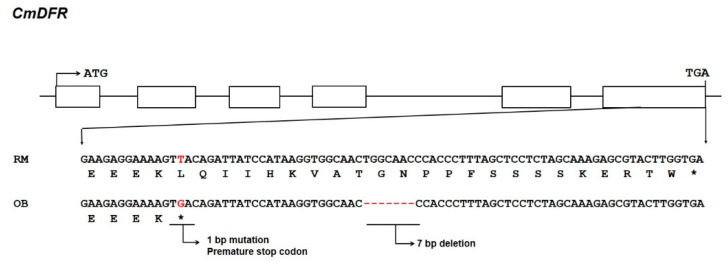
Dihydroflavonol 4-reductase (DFR) catalyzes a committed step in anthocyanin and proanthocyanidin biosynthesis by reducing dihydroflavonols to leucoanthocyanidins. However, the role of this enzyme in determining flower color in the economically important crop chrysanthemum ( Ramat.) is unknown. Here, we isolated cDNAs encoding DFR from two chrysanthemum cultivars, the white-flowered chrysanthemum "OhBlang" (CmDFR-OB) and the red-flowered chrysanthemum "RedMarble" (CmDFR-RM) and identified variations in the C-terminus between the two sequences. An enzyme assay using recombinant proteins revealed that both enzymes catalyzed the reduction of dihydroflavonol substrates, but CmDFR-OB showed significantly reduced DFR activity for dihydrokaempferol (DHK) substrate as compared with CmDFR-RM. Transcript levels of anthocyanin biosynthetic genes were consistent with the anthocyanin contents at different flower developmental stages of both cultivars. The complementation assay, using mutant (), revealed that but not transgenes restored defective anthocyanin biosynthesis of this mutant at the seedling stage, as well as proanthocyanidin biosynthesis in the seed. The difference in the flower color of two chrysanthemums can be explained by the C-terminal variation of CmDFR combined with the loss of expression during flower development.
二氢黄酮醇 4-还原酶(DFR)通过将二氢黄酮醇还原为无色花青素来催化花色苷和原花青素生物合成中的一个关键步骤。然而,该酶在经济上重要的作物菊花(Ramat.)中决定花色的作用尚不清楚。在这里,我们从两个菊花品种,白色菊花“ OhBlang”(CmDFR-OB)和红色菊花“ RedMarble”(CmDFR-RM)中分离出编码 DFR 的 cDNA,并鉴定出这两个序列之间 C 末端的差异。使用重组蛋白进行的酶分析表明,两种酶都催化二氢黄酮醇底物的还原,但与 CmDFR-RM 相比,CmDFR-OB 对二氢山奈酚(DHK)底物的 DFR 活性显著降低。花色苷生物合成基因的转录水平与两个品种在不同花发育阶段的花色苷含量一致。互补测定使用突变体()表明,而不是转基因在幼苗期恢复了该突变体缺陷的花色苷生物合成,以及种子中原花青素的生物合成。两个菊花花色的差异可以用 CmDFR 的 C 末端变异结合花色苷生物合成过程中基因表达的缺失来解释。