Ramlakhan Karishma P, Tobler Daniel, Greutmann Matthias, Schwerzmann Markus, Baris Lucia, Yetman Anji T, Nihoyannopoulos Petros, Manga Pravin, Boersma Eric, Maggioni Aldo P, Johnson Mark R, Hall Roger, Roos-Hesselink Jolien W
Department of Cardiology, Erasmus MC, Rotterdam, The Netherlands.
Department of Cardiology, University Hospital Basel, University of Basel, Basel, Switzerland.
Heart. 2020 Oct 29;107(4):290-8. doi: 10.1136/heartjnl-2020-317513.
Pregnancy in women with aortic coarctation (CoA) has an estimated moderately increased risk (mWHO II-III) of adverse cardiovascular, obstetric or fetal events, but prospective data to validate this risk classification are scarce. We examined pregnancy outcomes and identified associations with adverse outcomes.
Pregnancies in women with CoA were selected from the worldwide prospective Registry of Pregnancy and Cardiac Disease (ROPAC, n=303 out of 5739), part of the European Society of Cardiology EURObservational Research Programme. The frequency of and associations with major adverse cardiac events (MACE) and hypertensive disorders (pregnancy-induced hypertension, (pre-)eclampsia or haemolysis, elevated liver enzymes and low platelets syndrome) were analysed.
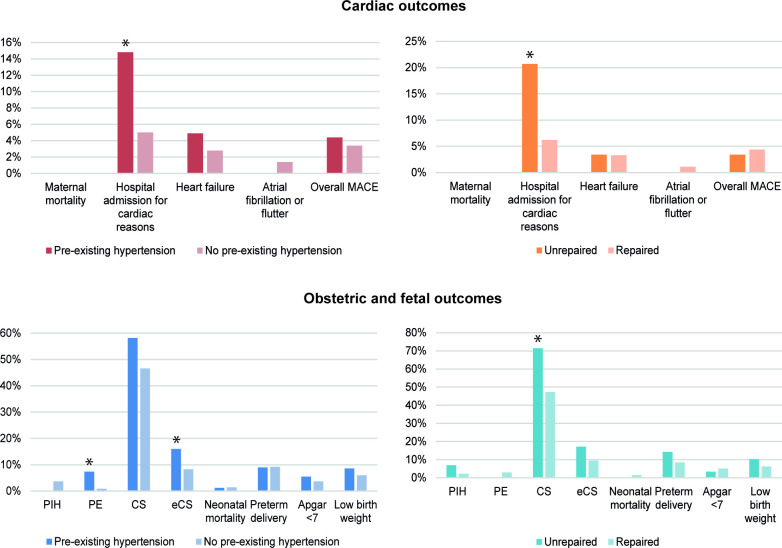
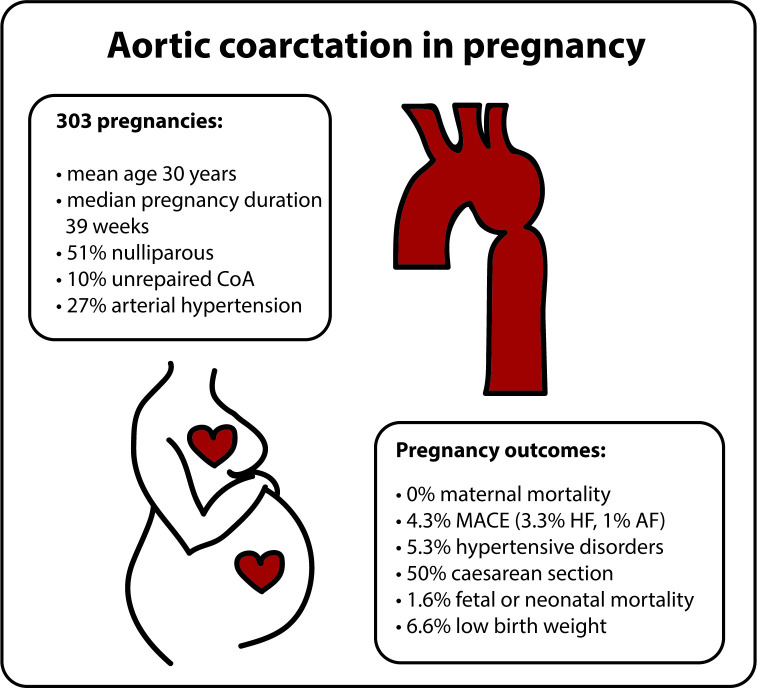
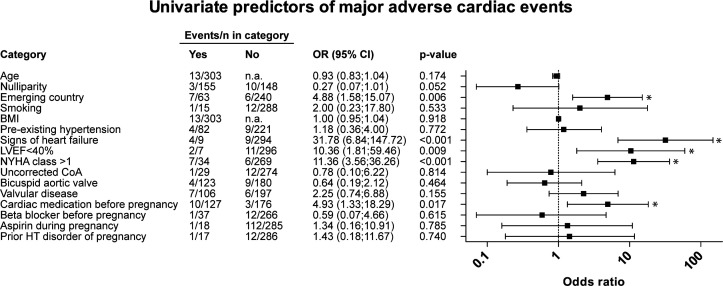
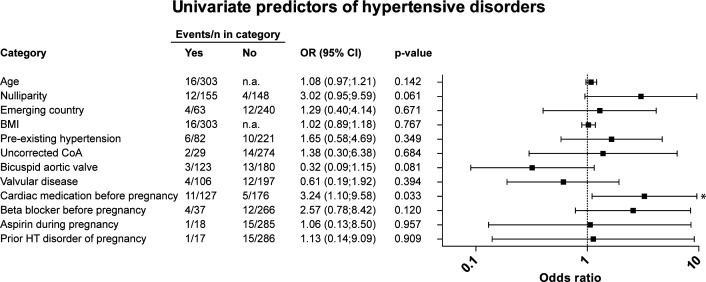
Of 303 pregnancies (mean age 30 years, pregnancy duration 39 weeks), 9.6% involved unrepaired CoA and 27.1% were in women with pre-existing hypertension. No maternal deaths or aortic dissections occurred. MACE occurred in 13 pregnancies (4.3%), of which 10 cases were of heart failure (3.3%). Univariable associations with MACE included prepregnancy clinical signs of heart failure (OR 31.8, 95% CI 6.8 to 147.7), left ventricular ejection fraction <40% (OR 10.4, 95% CI 1.8 to 59.5), New York Heart Association class >1 (OR 11.4, 95% CI 3.6 to 36.3) and cardiac medication use (OR 4.9, 95% CI 1.3 to 18.3). Hypertensive disorders of pregnancy occurred in 16 (5.3%), cardiac medication use being their only predictor (OR 3.2, 95% CI 1.1 to 9.6). Premature births were 9.1%, caesarean section was performed in 49.7% of pregnancies. Of 4 neonatal deaths, 3 were after spontaneous extreme preterm birth.
The ROPAC data show low MACE and hypertensive disorder rates during pregnancy in women with CoA, suggesting pregnancy to be more safe and better tolerated than previously appreciated.
患有主动脉缩窄(CoA)的女性怀孕时,发生不良心血管、产科或胎儿事件的风险估计中度增加(世界卫生组织II-III级),但缺乏前瞻性数据来验证这种风险分类。我们研究了妊娠结局,并确定了与不良结局的关联。
患有CoA的女性的妊娠数据选自全球前瞻性妊娠与心脏病登记处(ROPAC,5739例中的303例),该登记处是欧洲心脏病学会欧洲观察性研究项目的一部分。分析了主要不良心脏事件(MACE)和高血压疾病(妊娠高血压、(先兆)子痫或溶血、肝酶升高和血小板减少综合征)的发生频率及与之相关的因素。
在303例妊娠中(平均年龄30岁,妊娠持续时间39周),9.6%为未修复的CoA,27.1%的女性患有既往高血压。未发生孕产妇死亡或主动脉夹层。13例妊娠(4.3%)发生了MACE,其中10例为心力衰竭(3.3%)。与MACE的单因素关联包括孕前心力衰竭的临床体征(比值比31.8,95%可信区间6.8至147.7)、左心室射血分数<40%(比值比10.4,95%可信区间1.8至59.5)、纽约心脏协会分级>1级(比值比11.4,95%可信区间3.6至36.3)以及使用心脏药物(比值比4.9,95%可信区间1.3至18.3)。16例(5.3%)发生了妊娠高血压疾病,使用心脏药物是其唯一的预测因素(比值比3.2,95%可信区间1.1至9.6)。早产率为9.1%,49.7%的妊娠进行了剖宫产。4例新生儿死亡中,3例发生在自然极度早产之后。
ROPAC数据显示,患有CoA的女性在妊娠期间MACE和高血压疾病发生率较低,表明妊娠比以前认为的更安全,耐受性更好。