Yang Xiao-Jie, Zheng Hai-Long, Liu Ying-Yang, Li Hong-Wei, Jiang Yu-Hang, Lin Lian-Bing, Deng Xian-Yu, Zhang Qi-Lin
Faculty of Life Science and Technology, Kunming University of Science and Technology, Kunming, China.
Engineering Research Center for Replacement Technology of Feed Antibiotics of Yunnan College, Kunming, China.
Front Physiol. 2020 Oct 6;11:555233. doi: 10.3389/fphys.2020.555233. eCollection 2020.
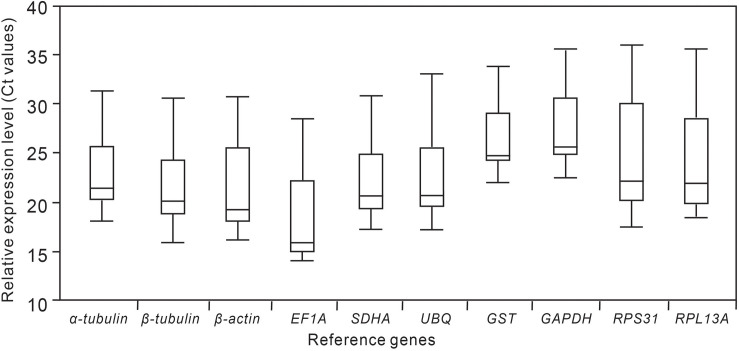
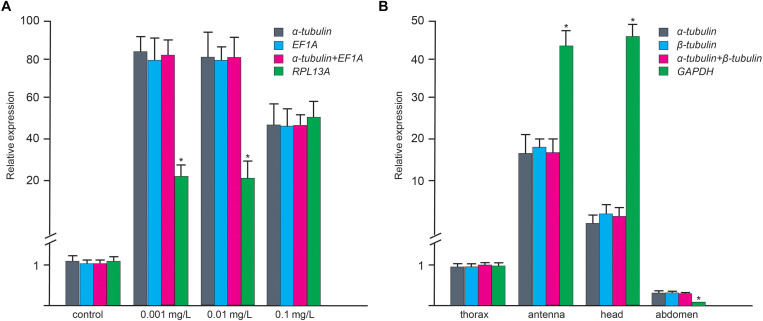
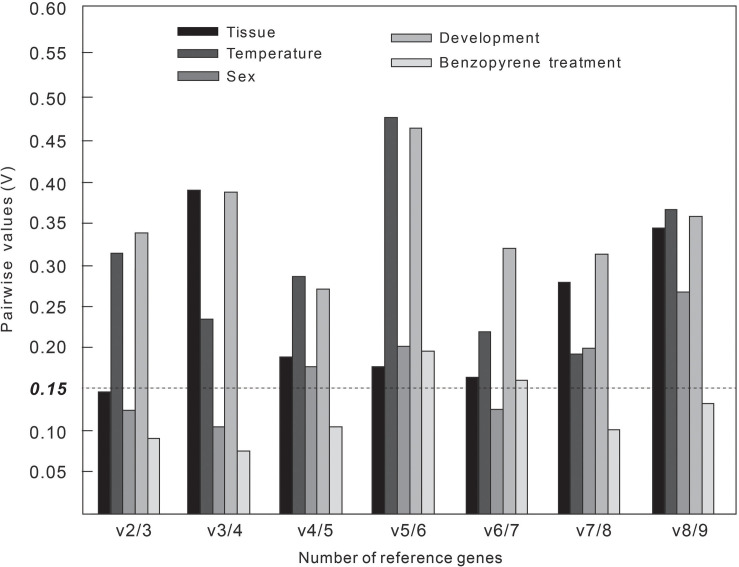
Aquatic fireflies are important indicators of the quality of freshwater environments and key models for research on insect adaptation to freshwater environments. For these investigations, gene expression analyses using quantitative real-time PCR are heavily dependent on reliable reference genes. In this study, based on a transcriptome assembly and annotation for the aquatic firefly at the adult and larval stages, 10 candidate reference genes (α-, β-, β-, , , , , , , and ) were identified for analyses of expression stability. Quantitative real-time PCR analyses for each candidate reference genes in was conducted for four developmental stages, four adult tissue types, two adult sexes, and two ecological stressors [adults exposed to five temperatures and larvae exposed to four concentrations of benzo(a)pyrene]. Results were evaluated by three independent algorithms (geNorm, NormFinder, and BestKeeper) and one comparative algorithm (RefFinder). The expression stability of candidate reference genes in differed under various conditions. Reference genes with the most stable expressions levels in different tissues, temperatures, sexes, developmental stages, and concentrations of benzo(a)pyrene were α-, , β-, β-, and α-, respectively. Furthermore, the optimal normalization factors (NFs) for the quantification of the expression levels of target genes by quantitative real-time PCR analyses of were identified for each experimental group. In particular, NF = 2 for different tissues (α- + β-), different sexes (β- + ), and larvae exposed to different concentrations of benzo(a)pyrene (α- + ); NF = 3 for developmental stages ( + + ) and adults exposed to different temperatures (β- + + ). In addition, we surveyed the expression profiles of two target genes ( and ) in larvae exposed to different concentrations of benzo(a)pyrene and in different adult tissues. The results further validated the reliability of the reference genes. The optimal reference genes for various experimental conditions identified in these analyses provide a useful tool for ecological studies of aquatic fireflies.
水生萤火虫是淡水环境质量的重要指标,也是昆虫适应淡水环境研究的关键模型。对于这些研究,使用定量实时PCR进行基因表达分析严重依赖于可靠的内参基因。在本研究中,基于水生萤火虫成虫和幼虫阶段的转录组组装和注释,鉴定了10个候选内参基因(α-、β-、β-、 、 、 、 、 、 、 )用于表达稳定性分析。对处于四个发育阶段、四种成虫组织类型、两种成虫性别以及两种生态应激源(成虫暴露于五种温度下,幼虫暴露于四种浓度的苯并[a]芘)的水生萤火虫,对每个候选内参基因进行了定量实时PCR分析。结果通过三种独立算法(geNorm、NormFinder和BestKeeper)和一种比较算法(RefFinder)进行评估。候选内参基因在水生萤火虫中的表达稳定性在不同条件下有所不同。在不同组织、温度、性别、发育阶段和苯并[a]芘浓度下表达水平最稳定的内参基因分别为α-、 、β-、β-和α-。此外,还为每个实验组确定了通过定量实时PCR分析水生萤火虫靶基因表达水平的最佳标准化因子(NFs)。具体而言,不同组织(α- + β-)、不同性别(β- + )以及暴露于不同浓度苯并[a]芘的幼虫(α- + )的NF = 2;发育阶段( + + )和暴露于不同温度的成虫(β- + + )的NF = 3。此外,我们还研究了暴露于不同浓度苯并[a]芘的幼虫和不同成虫组织中两个靶基因( 和 )的表达谱。结果进一步验证了内参基因的可靠性。这些分析中确定的适用于各种实验条件的最佳内参基因为水生萤火虫的生态学研究提供了有用的工具。