Department of Management Science, Makerere University Business School , Kampala, Uganda.
Department of Planning and Applied Statistics, Makerere University School of Statistics and Planning , Kampala, Uganda.
Glob Health Action. 2020 Dec 31;13(1):1830463. doi: 10.1080/16549716.2020.1830463.
Early medical checkups during and after delivery are key strategies to detect, prevent and treat maternal health concerns. Knowledge of interrelationships between early Antenatal Care (ANC), skilled delivery and early postnatal care (EPNC) is essential for focused and well-targeted interventions. This paper investigated the interconnectedness between maternal health services in Uganda.
This study examines the predictors of interrelationships between early antenatal care, health facility delivery and early postnatal care.
We used a sample of 10,152 women of reproductive ages (15-49), who delivered a child five years prior to the 2016 Uganda Demographic and Health Survey. A generalized Structural Equation Model and STATA 13.0 software were used.
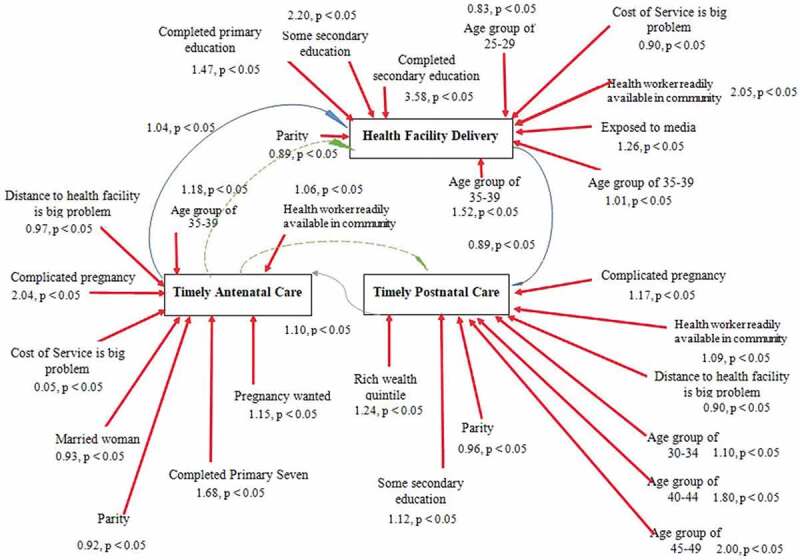
Early ANC was a mediating factor for health facility delivery (aOR=1.04; 95% CI=1.01-1.14) and EPNC (aOR=1.1; 95% CI=1.05-1.26). Increased odds of early ANC utilization was directly associated with: Adult women aged 35-49 (aOR=1.18; 95% CI=1.10-1.35), having completed primary seven (aOR=1.68; 95% CI=1.56-1.84); distance to a health facility (aOR=1.35; 95% CI=1.23-1.73) and costs (aOR=1.85; 95% CI=1.31-2.12) not being a problem, available community workers (aOR=1.06; 95% CI=1.04-1.17), pregnancy complications (aOR=2.04; 95% CI=1.85-2.26) and desire for pregnancy (aOR=1.15; 95% CI=1.07-1.36). Through early ANC utilization, being married (aOR=1.16; (=1.041.10)), no distance issues ((aOR=1.40; (=1.041.35)) and complications (aOR=2.12; (=1.042.04)) indirectly influenced utilization of health facility delivery. Women aged 20-34 (aOR=1.01; (=0.921.1)), completing primary seven (aOR=1.85; (=1.691.1)) and no cost problems (aOR=2.04; (=1.851.1)) indirectly influenced EPNC.
Early antenatal care was a mediating factor for health facility delivery and EPNC; and hence, there is need for more focus on factors for increased early antenatal care utilization. Women with higher education and those with no cost problems were more likely to have early ANC utilization, skilled delivery and EPNC; therefore there is need to design and implement policies targeting social and economically disadvantaged women.
分娩期间和之后的早期医疗检查是发现、预防和治疗产妇健康问题的关键策略。了解产前护理(ANC)、熟练分娩和产后早期护理(EPNC)之间的相互关系对于有针对性和目标明确的干预措施至关重要。本文调查了乌干达产妇保健服务之间的相互关系。
本研究探讨了早期产前护理、医疗机构分娩和产后早期护理之间相互关系的预测因素。
我们使用了一个由 10152 名育龄妇女(15-49 岁)组成的样本,她们在 2016 年乌干达人口与健康调查前五年分娩了一个孩子。使用广义结构方程模型和 STATA 13.0 软件。
早期 ANC 是医疗机构分娩(优势比[aOR]=1.04;95%置信区间[CI]=1.01-1.14)和 EPNC(aOR=1.1;95% CI=1.05-1.26)的中介因素。早期 ANC 利用率增加与以下因素直接相关:35-49 岁的成年女性(aOR=1.18;95% CI=1.10-1.35)、完成七年级(aOR=1.68;95% CI=1.56-1.84);距离医疗机构(aOR=1.35;95% CI=1.23-1.73)和费用(aOR=1.85;95% CI=1.31-2.12)不是问题,有社区工作人员(aOR=1.06;95% CI=1.04-1.17),妊娠并发症(aOR=2.04;95% CI=1.85-2.26)和怀孕意愿(aOR=1.15;95% CI=1.07-1.36)。通过早期 ANC 的利用,已婚(aOR=1.16;(=1.041.10))、没有距离问题((aOR=1.40;(=1.041.35))和并发症(aOR=2.12;(=1.042.04))间接影响了医疗机构分娩的利用。20-34 岁的女性(aOR=1.01;(=0.921.1))、完成七年级(aOR=1.85;(=1.691.1))和没有费用问题(aOR=2.04;(=1.851.1))间接影响了 EPNC。
早期 ANC 是医疗机构分娩和 EPNC 的中介因素;因此,需要更加关注增加早期 ANC 利用率的因素。教育程度较高和没有费用问题的妇女更有可能进行早期 ANC 利用、熟练分娩和 EPNC;因此,有必要设计和实施针对社会和经济处于不利地位的妇女的政策。