Kim Ju-Wan, Stewart Robert, Kang Seung-Ji, Jung Sook-In, Kim Sung-Wan, Kim Jae-Min
Department of Psychiatry, Chonnam National University Medical School, Gwangju, Korea.
King's College London, Institute of Psychiatry, Psychology and Neuroscience, London, UK.
Clin Psychopharmacol Neurosci. 2020 Nov 30;18(4):616-620. doi: 10.9758/cpn.2020.18.4.616.
: The COVID-19 is overwhelming health care systems globally. Hospital isolation may generate considerable psychological stress. However, there has been scarce evidence on psychological interventions for these patients due to maintain staff safety. We investigated the feasibility and effectiveness of telephone based interventions for psychological problems in hospital isolated patients with COVID-19.
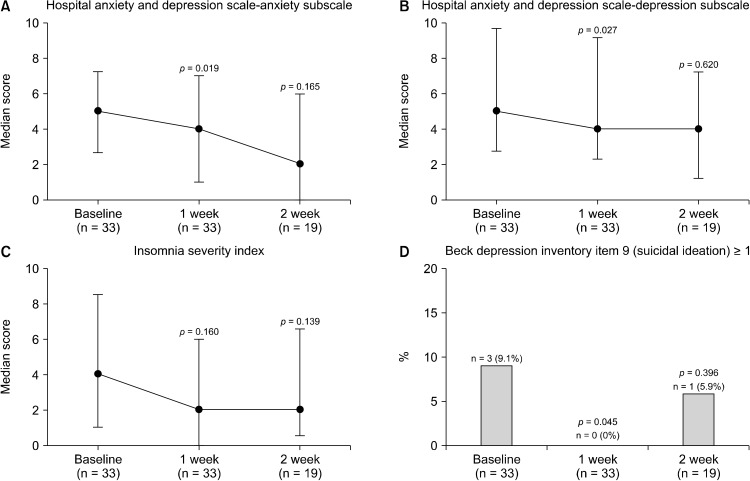
Psychiatrists visited the ward where the patients were hospitalized and interventions were given by using a ward telephone for 30 minutes. All patients were approached to receive a two-week psychological intervention program and/or pharmacotherapy whenever needed. Psychological problems were assessed at baseline, one, and two weeks. For the assessment of anxiety and depressive symptoms, the Hospital Anxiety and Depression Scale was administered to patients once a week. Insomnia severity index and Beck Depression Inventory 9 item were checked weekly to assess insomnia and suicide idea.
Of 33 enrolled, clinically meaningful psychological symptoms were found in 6 (18%) patients for anxiety; 13 (39%) for depression; 10 (30%) for insomnia; and 3 (9%) for suicidal ideation. In 9 patients (27%), psychotropic medications were prescribed to manage anxiety, agitation, depressed mood, insomnia, impulsivity, and suicide idea. Compared to baseline, significant improvements were found in anxiety, depression, and suicidal ideation at one week. There were no statistical differences between the values evaluated at baseline and at two weeks.
Our report at least indicates potential usefulness of telephone based interventions in hospital isolated patients with COVID-19, and will hopefully form the basis for future randomized clinical trials.
新型冠状病毒肺炎(COVID-19)正在使全球医疗系统不堪重负。医院隔离可能会产生相当大的心理压力。然而,由于要维护工作人员安全,针对这些患者的心理干预措施的证据很少。我们调查了针对医院隔离的COVID-19患者心理问题的电话干预措施的可行性和有效性。
精神科医生前往患者住院的病房,使用病房电话进行30分钟的干预。所有患者都被要求接受为期两周的心理干预计划和/或必要时的药物治疗。在基线、第1周和第2周评估心理问题。为评估焦虑和抑郁症状,每周对患者进行一次医院焦虑抑郁量表测试。每周检查失眠严重程度指数和贝克抑郁量表9项,以评估失眠和自杀念头。
在33名登记患者中,6名(18%)患者存在具有临床意义的焦虑心理症状;13名(39%)患者存在抑郁症状;10名(30%)患者存在失眠症状;3名(9%)患者存在自杀念头。9名(27%)患者被开具了精神药物来处理焦虑、激动、情绪低落、失眠、冲动和自杀念头。与基线相比,第1周时焦虑、抑郁和自杀念头有显著改善。基线和第2周评估的值之间没有统计学差异。
我们的报告至少表明了针对医院隔离的COVID-19患者的电话干预措施的潜在有用性,并有望为未来的随机临床试验奠定基础。