Inail, Department of Occupational and Environmental Medicine, Epidemiology and Hygiene, Monte Porzio Catone, Roma.
Med Lav. 2020 Oct 31;111(5):335-350. doi: 10.23749/mdl.v111i5.10679.
Psychosocial risk management represents a current challenge in Occupational Health and Safety (OSH) due to their impacts of such risks on work stress and the rapid changes of the world of work. An effective psychosocial risk management can be carried out on the basis of an integrated multidisciplinary model founded on the risk management paradigm. Over years, the occupational medicine has played an important role at national level in this area, contributing to the creation of an integrated and participatory approach.
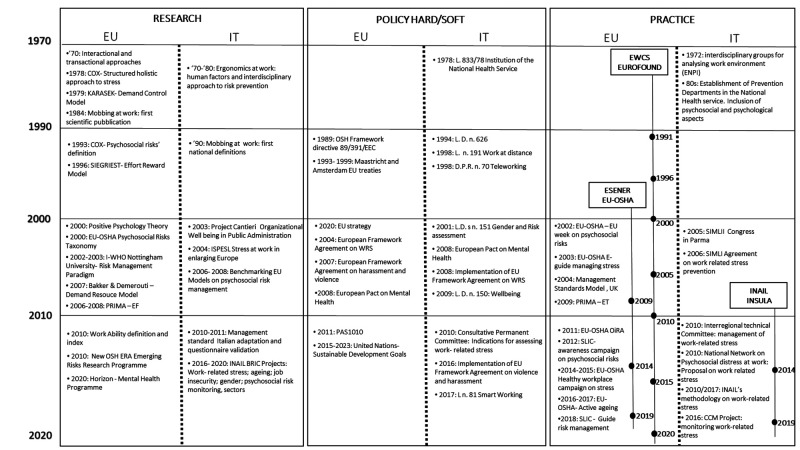
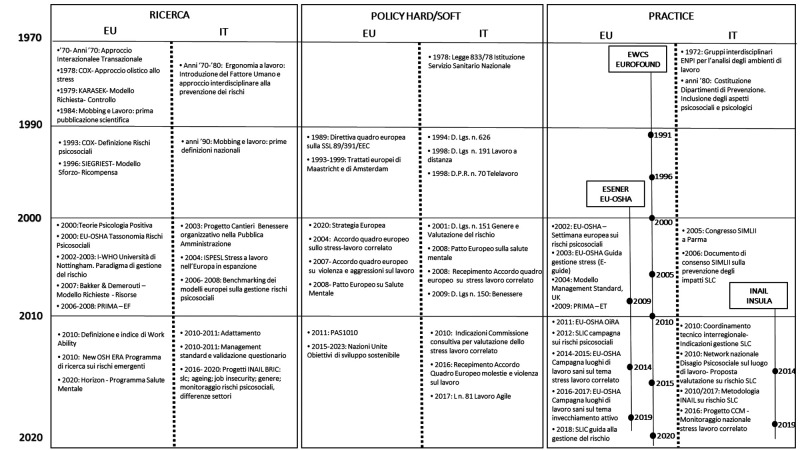
This study explores the developmental process of psychosocial risk management over time in Europe and Italy, to offer an update on the state of the art at a national level and insights on future perspectives.
Through a reflection on research developments, in Europe and in Italy, we outline how the knowledge obtained has been translated into policies, which have encouraged the implementation at international and national level of consolidated practices for the management of psychosocial risks.
An overview of some key steps of the inclusion of psychosocial aspects in OSH is presented, highlighting the positive impact of the multidisciplinary approach. Moreover, the driving role played by policies for implementation in organizational practice is also highlighted, with particular reference to the Italian example.
Starting from the existing knowledge, it is necessary to tackle emerging risks by continuing to translate the knowledge obtained from research into policies that have a driving role in the identification and implementation of actions and practical tools.
由于工作压力和工作世界的快速变化等风险的影响,心理社会风险管理是职业健康与安全(OSH)领域当前面临的挑战。基于风险管理范式的综合多学科模型,可以有效地进行心理社会风险管理。多年来,职业医学在这一领域在国家层面发挥了重要作用,为创建综合和参与性方法做出了贡献。
本研究探讨了欧洲和意大利心理社会风险管理随时间的发展过程,旨在提供国家层面的最新现状,并深入了解未来的发展方向。
通过对欧洲和意大利研究进展的反思,我们概述了如何将所获得的知识转化为政策,这些政策鼓励在国际和国家层面实施针对心理社会风险的综合管理实践。
本文介绍了职业健康与安全中纳入心理社会因素的一些关键步骤,强调了多学科方法的积极影响。此外,还强调了政策在组织实践中的推动作用,特别是意大利的例子。
从现有知识出发,需要通过继续将从研究中获得的知识转化为具有推动作用的政策来应对新出现的风险,以确定和实施行动和实用工具。