Department of Molecular and Cellular Biology, Harvard University, Cambridge, MA 02138, USA.
Department of Molecular and Cellular Biology, Harvard University, Cambridge, MA 02138, USA.
Cell. 2020 Oct 29;183(3):594-604.e14. doi: 10.1016/j.cell.2020.09.008.
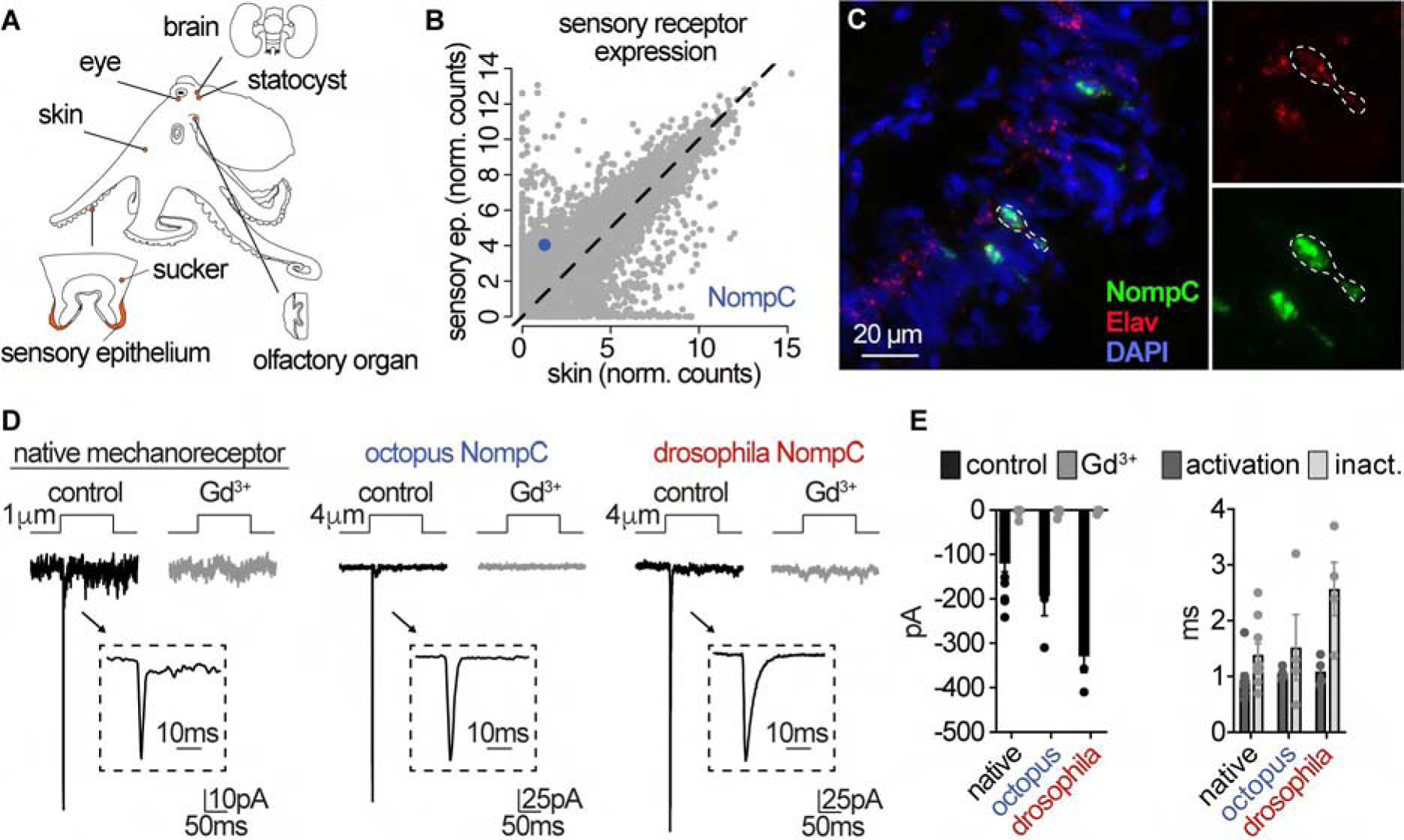
Animals display wide-ranging evolutionary adaptations based on their ecological niche. Octopuses explore the seafloor with their flexible arms using a specialized "taste by touch" system to locally sense and respond to prey-derived chemicals and movement. How the peripherally distributed octopus nervous system mediates relatively autonomous arm behavior is unknown. Here, we report that octopus arms use a family of cephalopod-specific chemotactile receptors (CRs) to detect poorly soluble natural products, thereby defining a form of contact-dependent, aquatic chemosensation. CRs form discrete ion channel complexes that mediate the detection of diverse stimuli and transduction of specific ionic signals. Furthermore, distinct chemo- and mechanosensory cells exhibit specific receptor expression and electrical activities to support peripheral information coding and complex chemotactile behaviors. These findings demonstrate that the peripherally distributed octopus nervous system is a key site for signal processing and highlight how molecular and anatomical features synergistically evolve to suit an animal's environmental context.
动物根据其生态位表现出广泛的进化适应。章鱼通过其灵活的手臂在海底探索,使用专门的“触摸尝味”系统来局部感知和响应猎物衍生的化学物质和运动。外周分布的章鱼神经系统如何介导相对自主的手臂行为尚不清楚。在这里,我们报告章鱼手臂使用一组章鱼特有的化学感觉受体(CR)来检测溶解度差的天然产物,从而定义了一种接触依赖的水生化学感觉形式。CR 形成离散的离子通道复合物,介导对各种刺激的检测和特定离子信号的转导。此外,不同的化学感觉和机械感觉细胞表现出特定的受体表达和电活动,以支持外围信息编码和复杂的化学感觉行为。这些发现表明,外周分布的章鱼神经系统是信号处理的关键部位,并强调了分子和解剖特征如何协同进化以适应动物的环境背景。