Kirmasha Yasir Khaleel, Sharba Mohaiman J, Leman Zulkiflle, Sultan Mohamed Thariq Hameed
Department of Mechanical and Manufacturing Engineering, Faculty of Engineering, Universiti Putra Malaysia, Serdang 43400, Malaysia.
Power Mechanics Department, AL-Suwayrah Technical Institute, Middle Technical University, Baghdad 10074, Iraq.
Materials (Basel). 2020 Oct 28;13(21):4801. doi: 10.3390/ma13214801.
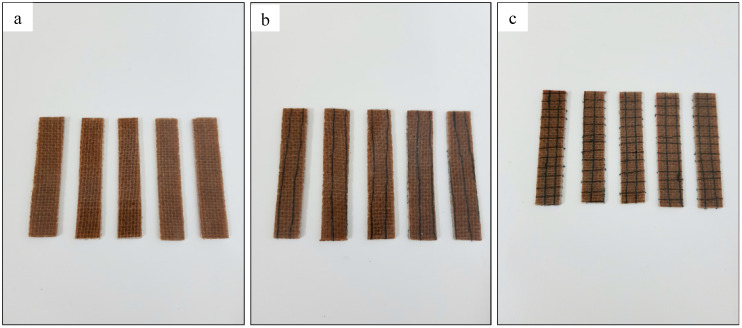
Fiber composites are known to have poor through-thickness mechanical properties due to the absence of a Z-direction binder. This issue is more critical with the use of natural fibers due to their low strength compared to synthetic fibers. Stitching is a through-thickness toughening method that is used to introduce fibers in the Z-direction, which will result in better through-thickness mechanical properties. This research was carried out to determine the mechanical properties of unstitched and silk fiber-stitched woven kenaf-reinforced epoxy composites. The woven kenaf mat was stitched with silk fiber using a commercial sewing machine. The specimens were fabricated using a hand lay-up method. Three specimens were fabricated, one unstitched and two silk-stitched with deferent stitching orientations. The results show that the stitched specimens have comparable in-plane mechanical properties to the unstitched specimens. For the tensile mechanical test, stitched specimens show similar and 17.1% higher tensile strength compared to the unstitched specimens. The flexural mechanical test results show around a 9% decrease in the flexural strength for the stitched specimens. On the other hand, the Izod impact mechanical test results show a significant improvement of 33% for the stitched specimens, which means that stitching has successfully improved the out-of-plane mechanical properties. The outcome of this research indicates that the stitched specimens have better mechanical performance compared to the unstitched specimens and that the decrease in the flexural strength is insignificant in contrast with the remarkable enhancement in the impact strength.
由于缺乏Z方向的粘结剂,纤维复合材料的厚度方向机械性能较差。由于天然纤维与合成纤维相比强度较低,在使用天然纤维时,这个问题更为关键。缝合是一种厚度方向增韧方法,用于在Z方向引入纤维,这将导致更好的厚度方向机械性能。本研究旨在确定未缝合和丝纤维缝合的编织红麻增强环氧复合材料的机械性能。使用商用缝纫机用丝纤维对编织红麻毡进行缝合。采用手糊法制备试样。制备了三个试样,一个未缝合,两个丝缝合且缝合方向不同。结果表明,缝合试样的面内机械性能与未缝合试样相当。在拉伸力学试验中,缝合试样的拉伸强度与未缝合试样相似且高出17.1%。弯曲力学试验结果表明,缝合试样的弯曲强度下降了约9%。另一方面,悬臂梁冲击力学试验结果表明,缝合试样有显著改善,提高了33%,这意味着缝合成功地改善了面外机械性能。本研究结果表明,与未缝合试样相比,缝合试样具有更好的机械性能,并且弯曲强度的下降与冲击强度的显著提高相比并不显著。