Ranucci Marco, Sitzia Clementina, Baryshnikova Ekaterina, Di Dedda Umberto, Cardani Rosanna, Martelli Fabio, Corsi Romanelli Massimiliano
Department of Cardiovascular Anesthesia and Intensive Care, IRCCS Policlinico San Donato, I-20097 San Donato Milanese, Milan, Italy.
Department of Biomedical Sciences for Health, Chair of Clinical Pathology, University of Milan, I-20133 Milan, Italy.
J Clin Med. 2020 Oct 28;9(11):3487. doi: 10.3390/jcm9113487.
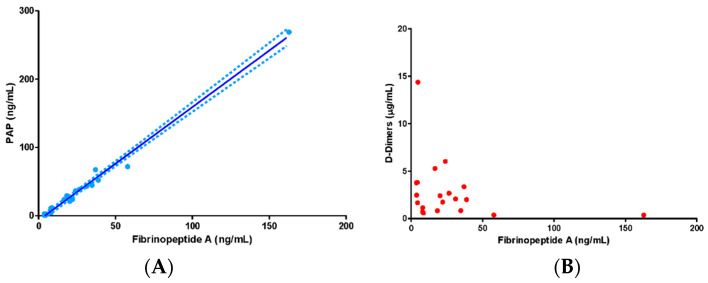
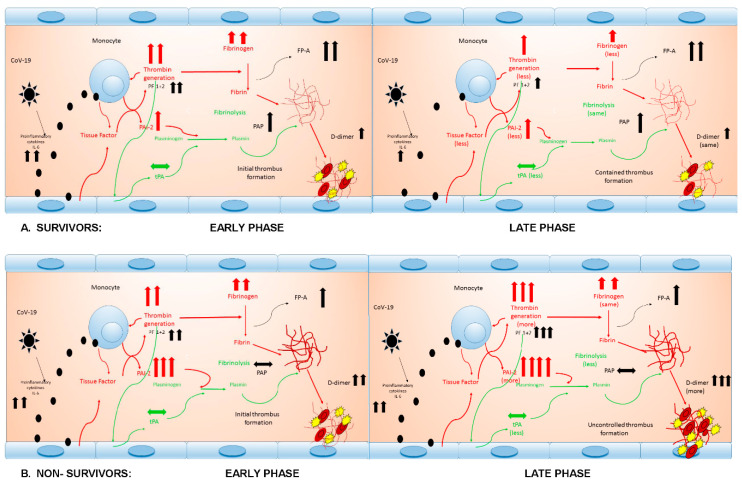
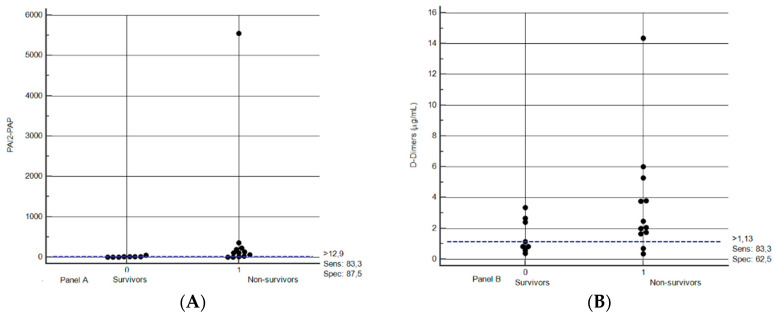
Coronavirus Disease 2019 (COVID-19)-associated coagulopathy is characterized by a prothrombotic state not yet comprehensively studied. We investigated the coagulation pattern of patients with COVID-19 acute respiratory distress syndrome (ARDS), comparing patients who survived to those who did not. In this prospective cohort study on 20 COVID-19 ARDS patients, the following biomarkers were measured: thrombin generation (prothrombin fragment 1 + 2 (PF 1 + 2)), fibrinolysis activation (tissue plasminogen activator (tPA)) and inhibition (plasminogen activator inhibitor 2 (PAI-2)), fibrin synthesis (fibrinopeptide A) and fibrinolysis magnitude (plasmin-antiplasmin complex (PAP) and D-dimers). Measurements were done upon intensive care unit (ICU) admission and after 10-14 days. There was increased thrombin generation; modest or null release of t-PA; and increased levels of PAI-2, fibrinopeptide A, PAP and D-dimers. At baseline, nonsurvivors had a significantly ( = 0.014) higher PAI-2/PAP ratio than survivors (109, interquartile range (IQR) 18.1-216, vs. 8.7, IQR 2.9-12.6). At follow-up, thrombin generation was significantly ( = 0.025) reduced in survivors (PF 1 + 2 from 396 pg/mL, IQR 185-585 to 237 pg/mL, IQR 120-393), whereas it increased in nonsurvivors. Fibrinolysis inhibition at follow-up remained stable in survivors and increased in nonsurvivors, leading to a significant ( = 0.026) difference in PAI-2 levels (161 pg/mL, IQR 50-334, vs. 1088 pg/mL, IQR 177-1565). Severe patterns of COVID-19 ARDS are characterized by a thrombin burst and the consequent coagulation activation. Mechanisms of fibrinolysis regulation appear unbalanced toward fibrinolysis inhibition. This pattern ameliorates in survivors, whereas it worsens in nonsurvivors.
2019冠状病毒病(COVID-19)相关凝血病的特征是处于一种尚未得到全面研究的血栓前状态。我们调查了COVID-19急性呼吸窘迫综合征(ARDS)患者的凝血模式,比较了存活患者和未存活患者。在这项针对20例COVID-19 ARDS患者的前瞻性队列研究中,测量了以下生物标志物:凝血酶生成(凝血酶原片段1 + 2(PF 1 + 2))、纤溶激活(组织纤溶酶原激活物(tPA))和抑制(纤溶酶原激活物抑制剂2(PAI-2))、纤维蛋白合成(纤维蛋白肽A)以及纤溶程度(纤溶酶-抗纤溶酶复合物(PAP)和D-二聚体)。在重症监护病房(ICU)入院时及10 - 14天后进行测量。结果显示凝血酶生成增加;t-PA释放适度或无释放;PAI-2、纤维蛋白肽A、PAP和D-二聚体水平升高。基线时,非存活者的PAI-2/PAP比值显著( = 0.014)高于存活者(109,四分位间距(IQR)18.1 - 216,对比8.7,IQR 2.9 - 12.6)。随访时,存活者的凝血酶生成显著( = 0.025)降低(PF 1 + 2从396 pg/mL,IQR 185 - 585降至237 pg/mL,IQR 120 - 393),而非存活者则升高。存活者随访时的纤溶抑制保持稳定,非存活者则升高,导致PAI-2水平出现显著( = 0.026)差异(161 pg/mL,IQR 50 - 334,对比1088 pg/mL,IQR 177 - 1565)。COVID-19 ARDS的严重模式以凝血酶爆发及随之的凝血激活为特征。纤溶调节机制似乎在纤溶抑制方向失衡。这种模式在存活者中改善,而在非存活者中恶化。