Deng Zhengbin, Moynier Frédéric, Villeneuve Johan, Jensen Ninna K, Liu Deze, Cartigny Pierre, Mikouchi Takashi, Siebert Julien, Agranier Arnaud, Chaussidon Marc, Bizzarro Martin
Université de Paris, Institut de physique du globe de Paris, CNRS, 75005 Paris, France.
CRPG (UMR 7350) Université de Lorraine, CNRS, 7358 Vandoeuvre-lès-Nancy, France.
Sci Adv. 2020 Oct 30;6(44). doi: 10.1126/sciadv.abc4941. Print 2020 Oct.
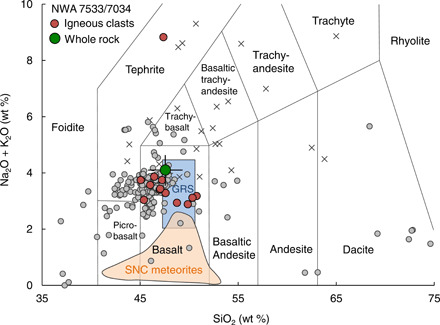
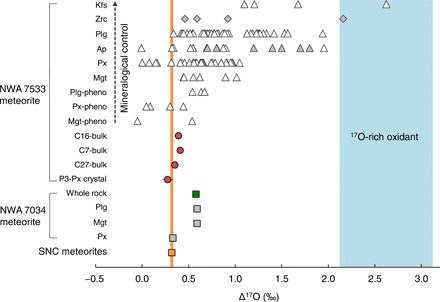
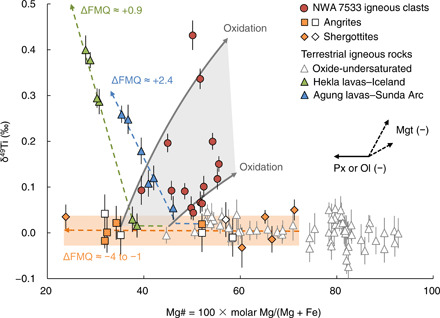
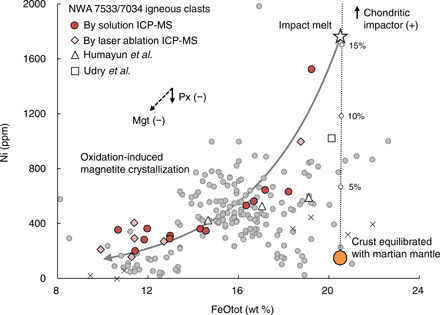
Despite the abundant geomorphological evidence for surface liquid water on Mars during the Noachian epoch (>3.7 billion years ago), attaining a warm climate to sustain liquid water on Mars at the period of the faint young Sun is a long-standing question. Here, we show that melts of ancient mafic clasts from a martian regolith meteorite, NWA 7533, experienced substantial Fe-Ti oxide fractionation. This implies early, impact-induced, oxidation events that increased by five to six orders of magnitude the oxygen fugacity of impact melts from remelting of the crust. Oxygen isotopic compositions of sequentially crystallized phases from the clasts show that progressive oxidation was due to interaction with an O-rich water reservoir. Such an early oxidation of the crust by impacts in the presence of water may have supplied greenhouse gas H that caused an increase in surface temperature in a CO-thick atmosphere.
尽管有大量地貌学证据表明在诺亚纪时期(超过37亿年前)火星表面存在液态水,但在年轻太阳微弱时期的火星上实现温暖气候以维持液态水一直是个长期存在的问题。在此,我们表明,来自火星风化层陨石NWA 7533的古老镁铁质碎屑的熔体经历了显著的铁钛氧化物分馏。这意味着早期由撞击引起的氧化事件,使地壳重熔产生的撞击熔体的氧逸度增加了五到六个数量级。碎屑中依次结晶相的氧同位素组成表明,渐进氧化是由于与富含氧的水库相互作用所致。在有水存在的情况下,撞击导致的地壳早期氧化可能提供了温室气体H,从而在富含二氧化碳的大气中导致表面温度升高。