Department of Disaster Management, Begum Rokeya University, Rangpur 5400, Bangladesh.
Department of Disaster Management, Begum Rokeya University, Rangpur 5400, Bangladesh.
Sci Total Environ. 2021 Mar 25;762:143161. doi: 10.1016/j.scitotenv.2020.143161. Epub 2020 Oct 21.
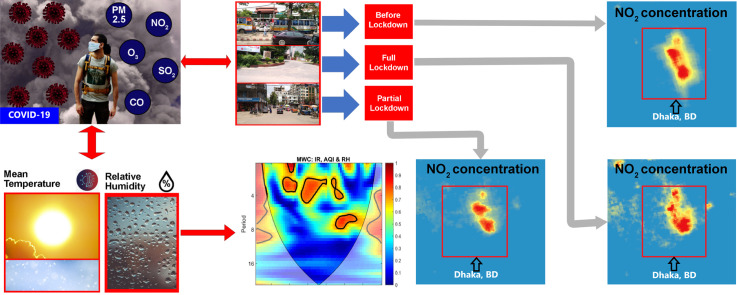
The transmission of novel coronavirus (COVID-19) can be reduced by implementing a lockdown policy, which has also been proven as an effective control measure for air pollution in the urban cities. In this study, we applied ground- and satellite-based data of five criteria air pollutants (PM2.5, NO, SO, O, and CO) and meteorological factors from March 8 to May 15, 2020 (before, partial-, and full-lockdown). The generalized additive models (GAMs), wavelet coherence, and random forest (RF) model were employed to explore the relationship between air quality indicators and COVID-19 transmission in Dhaka city. Results show that overall, 26, 20.4, 17.5, 9.7 and 8.8% declined in PM 2.5, NO, SO, O, and CO concentrations, respectively, in Dhaka City during the partial and full lockdown compared to the period before the lockdown. The implementation of lockdown policy for containing COVID-19 transmission played a crucial role in reducing air pollution. The findings of wavelet coherence and partial wavelet coherence demonstrate no standalone coherence, but interestingly, multiple wavelet coherence indicated a strong short-term coherence among air pollutants and meteorological factors with the COVID-19 outbreak. Outcomes of GAMs indicated that an increase of 1-unit in long-term exposure to O and CO (lag1) was associated with a 2.9% (95% CI: -0.3%, -5.6%), and 53.9% (95% CI: 0.2%, -107.9%) decreased risk of COVID-19 infection rate during the full-lockdown period. Whereas, COVID-19 infection and MT (mean temperature) are modulated by a peak during full-lockdown, which is mostly attributed to contact transmission in Dhaka city. RF model revealed among the parameters being studied, MT, RH (relative humidity), and O were the dominant factors that could be associated with COVID-19 cases during the study period. The outcomes reported here could elucidate the effectiveness of lockdown scenarios for COVID-19 containment and air pollution control in Dhaka city.
新型冠状病毒(COVID-19)的传播可以通过实施封锁政策来减少,这也被证明是城市空气污染的有效控制措施。在这项研究中,我们应用了地面和卫星数据的五个空气质量指标(PM2.5、NO、SO、O 和 CO)和气象因素,从 2020 年 3 月 8 日至 5 月 15 日(封锁前、部分封锁和完全封锁期间)。我们采用广义加性模型(GAMs)、小波相干和随机森林(RF)模型来探讨空气质量指标与达卡市 COVID-19 传播之间的关系。结果表明,在部分和完全封锁期间,与封锁前相比,达卡市 PM2.5、NO、SO、O 和 CO 浓度分别整体下降了 26%、20.4%、17.5%、9.7%和 8.8%。控制 COVID-19 传播的封锁政策在减少空气污染方面发挥了关键作用。小波相干和部分小波相干的结果表明没有独立的相干性,但有趣的是,多个小波相干表明在空气污染和气象因素与 COVID-19 爆发之间存在强烈的短期相干性。GAMs 的结果表明,在完全封锁期间,长期暴露于 O 和 CO(lag1)增加 1 个单位与 COVID-19 感染率降低 2.9%(95%置信区间:-0.3%,-5.6%)和 53.9%(95%置信区间:0.2%,-107.9%)有关。然而,COVID-19 感染和 MT(平均温度)在完全封锁期间受到峰值的调节,这主要归因于达卡市的接触传播。RF 模型表明,在所研究的参数中,MT、RH(相对湿度)和 O 是与研究期间 COVID-19 病例相关的主要因素。这里报告的结果可以阐明封锁情景对 COVID-19 控制和达卡市空气污染控制的有效性。