
抗精神病药物戒断症状:一项系统评价与荟萃分析
Antipsychotic Withdrawal Symptoms: A Systematic Review and Meta-Analysis.
作者信息
Brandt Lasse, Bschor Tom, Henssler Jonathan, Müller Martin, Hasan Alkomiet, Heinz Andreas, Gutwinski Stefan
机构信息
Department of Psychiatry and Psychotherapy, Charité Campus Mitte, Charité Universitätsmedizin Berlin, Corporate Member of Freie Universität Berlin, Humboldt-Universität zu Berlin, and Berlin Institute of Health, Berlin, Germany.
Department of Psychiatry and Psychotherapy, Technical University of Dresden, Dresden, Germany.
出版信息
Front Psychiatry. 2020 Sep 29;11:569912. doi: 10.3389/fpsyt.2020.569912. eCollection 2020.
OBJECTIVE
Avoiding withdrawal symptoms following antipsychotic discontinuation is an important factor when planning a safe therapy. We performed a systematic review and meta-analysis concerning occurrence of withdrawal symptoms after discontinuation of antipsychotics.
DATA SOURCES
We searched the databases CENTRAL, Pubmed, and EMBASE with no restriction to the beginning of the searched time period and until October 1, 2019 (PROSPERO registration no. CRD42019119148).
STUDY SELECTION
Of the 18,043 screened studies, controlled and cohort trials that assessed withdrawal symptoms after discontinuation of oral antipsychotics were included in the random-effects model. Studies that did not implement placebo substitution were excluded from analyses. The primary outcome was the proportion of individuals with withdrawal symptoms after antipsychotic discontinuation. We compared a control group with continued antipsychotic treatment in the assessment of odds ratio and number needed to harm (NNH).
DATA EXTRACTION
We followed guidelines by the Cochrane Collaboration, PRISMA, and MOOSE.
RESULTS
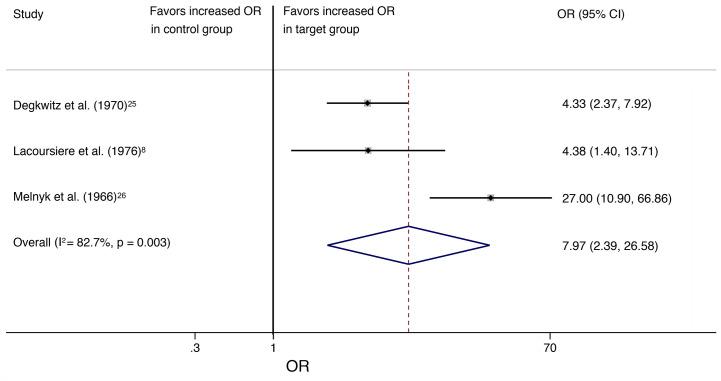
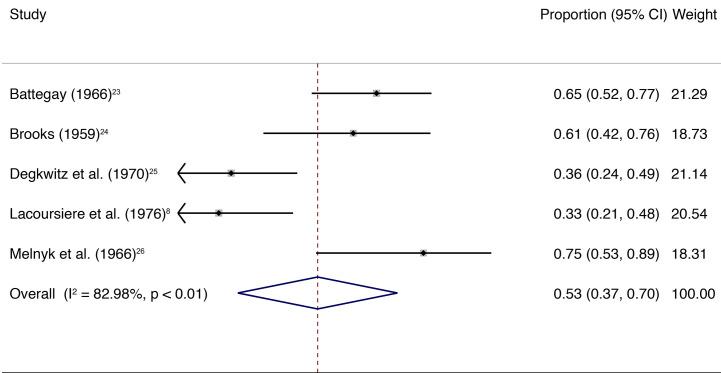
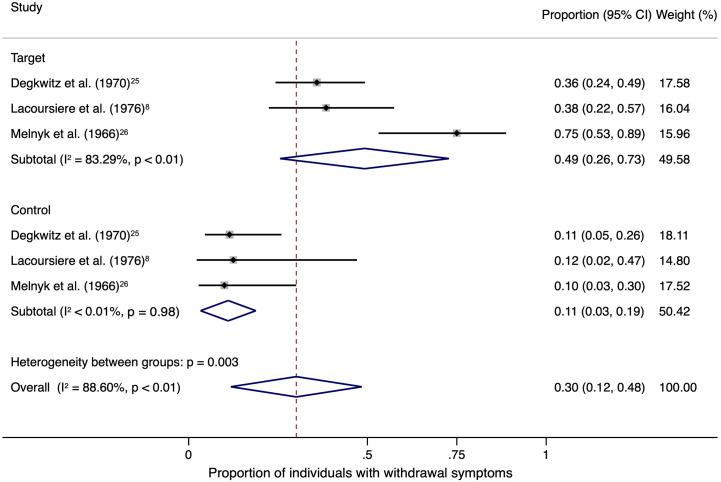
Five studies with a total of 261 individuals were included. The primary outcome, proportion of individuals with withdrawal symptoms after antipsychotic discontinuation, was 0.53 (95% CI, 0.37-0.70; = 82.98%, < 0.01). An odds ratio of 7.97 (95% CI, 2.39-26.58; = 82.7%, = 0.003) and NNH of 3 was calculated for the occurrence of withdrawal symptoms after antipsychotic discontinuation.
CONCLUSION
Withdrawal symptoms appear to occur frequently after abrupt discontinuation of an oral antipsychotic. The lack of randomized controlled trials with low risk of bias on antipsychotic withdrawal symptoms highlights the need for further research.
目的
在规划安全治疗方案时,避免抗精神病药物停药后的戒断症状是一个重要因素。我们针对抗精神病药物停药后戒断症状的发生情况进行了一项系统评价和荟萃分析。
数据来源
我们检索了CENTRAL、Pubmed和EMBASE数据库,检索时间段无限制,截至2019年10月1日(PROSPERO注册号:CRD42019119148)。
研究选择
在18043项筛选出的研究中,评估口服抗精神病药物停药后戒断症状的对照试验和队列试验被纳入随机效应模型。未实施安慰剂替代的研究被排除在分析之外。主要结局是抗精神病药物停药后出现戒断症状的个体比例。在评估优势比和伤害所需人数(NNH)时,我们将对照组与继续使用抗精神病药物治疗的组进行了比较。
数据提取
我们遵循了Cochrane协作网、PRISMA和MOOSE的指南。
结果
纳入了5项研究,共261名个体。主要结局,即抗精神病药物停药后出现戒断症状的个体比例为0.53(95%CI,0.37 - 0.70;I² = 82.98%,P < 0.01)。抗精神病药物停药后出现戒断症状的优势比为7.97(95%CI,2.39 - 26.58;I² = 82.7%,P = 0.003),NNH为3。
结论
口服抗精神病药物突然停药后,戒断症状似乎经常出现。关于抗精神病药物戒断症状的低偏倚风险随机对照试验的缺乏凸显了进一步研究的必要性。
 Zotero 插件