Mansour Adhra R, Thobias Joseph Matobo, Yondu Emili, Philipo Erick G, Mikomangwa Wigilya P, Kilonzi Manase, Marealle Alphonce Ignace, Mutagonda Ritah F
Department of Clinical Pharmacy and Pharmacology, Muhimbili University of Health and Allied Sciences, Dar es Salaam, Tanzania.
School of Public Health and Social Sciences, Muhimbili University of Health and Allied Sciences, Dar es Salaam, Tanzania.
Adv Pharmacol Pharm Sci. 2025 Jun 3;2025:1404995. doi: 10.1155/adpp/1404995. eCollection 2025.
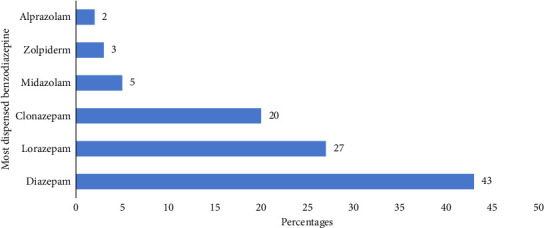
This cross-sectional study assessed determinants of benzodiazepine (BZP)-dispensing practices among community pharmacy dispensers in Dar es Salaam, Tanzania. A cross-sectional study involving 378 community pharmacy dispensers was conducted between March and June 2024. An adapted structured questionnaire was used to gather information on the sociodemographics, most dispensed BZPs, dispensers' knowledge, and dispensing practice of BZPs. Determinants of dispensing practice were determined by multivariable logistic regression analysis using SPSS Version 23. Of 378 dispensers, 232 (61.4%) were female, 263 (69.6%) had a college education level, and 193 (51.1%) were pharmaceutical technicians. Diazepam was the most dispensed BZP (163 (43%)), followed by lorazepam (102 (27%)). More than half, 203 (53.7%), of the dispensers had inadequate knowledge, and 240 (63.5%) of dispensers had good dispensing practices. Nonpharmaceutical dispensers were less likely to have good dispensing practice (AOR = 0.16, 95% CI (0.05-0.49)) whereas having adequate knowledge of BZPs (AOR = 2.64, 95% CI (1.64-4.25)) were significantly associated with the good dispensing practice of BZPs. Knowledge levels and the type of pharmaceutical professionals are determinants in ensuring proper BZP-dispensing practices. These indicate the need for continuous professional development and stricter enforcement of dispensing regulations to improve pharmacy practices and prevent unauthorized BZP dispensing.
这项横断面研究评估了坦桑尼亚达累斯萨拉姆社区药房药剂师苯二氮䓬(BZP)配药行为的决定因素。2024年3月至6月进行了一项涉及378名社区药房药剂师的横断面研究。使用一份经过改编的结构化问卷收集有关社会人口统计学、最常配发的BZP、药剂师的知识以及BZP配药行为的信息。使用SPSS 23版通过多变量逻辑回归分析确定配药行为的决定因素。在378名药剂师中,232名(61.4%)为女性,263名(69.6%)具有大专学历,193名(51.1%)为药剂技术员。地西泮是最常配发的BZP(163名(43%)),其次是劳拉西泮(102名(27%))。超过一半,即203名(53.7%)的药剂师知识不足,240名(63.5%)的药剂师有良好的配药行为。非药剂专业的药剂师有良好配药行为的可能性较小(调整后比值比[AOR]=0.16,95%置信区间[CI](0.05 - 0.49)),而对BZP有足够的了解(AOR = 2.64,95% CI(1.64 - 4.25))与良好的BZP配药行为显著相关。知识水平和药学专业人员类型是确保正确BZP配药行为的决定因素。这些表明需要持续的专业发展以及更严格地执行配药法规,以改善药房实践并防止未经授权的BZP配药。