Ciancia Marina, Fernández Paula Virginia, Leliaert Frederik
Universidad de Buenos Aires, Facultad de Agronomía, Departamento de Biología Aplicada y Alimentos, Cátedra de Química de Biomoléculas, CIHIDECAR-CONICET, UBA, Buenos Aires, Argentina.
Meise Botanic Garden, Meise, Belgium.
Front Plant Sci. 2020 Sep 29;11:554585. doi: 10.3389/fpls.2020.554585. eCollection 2020.
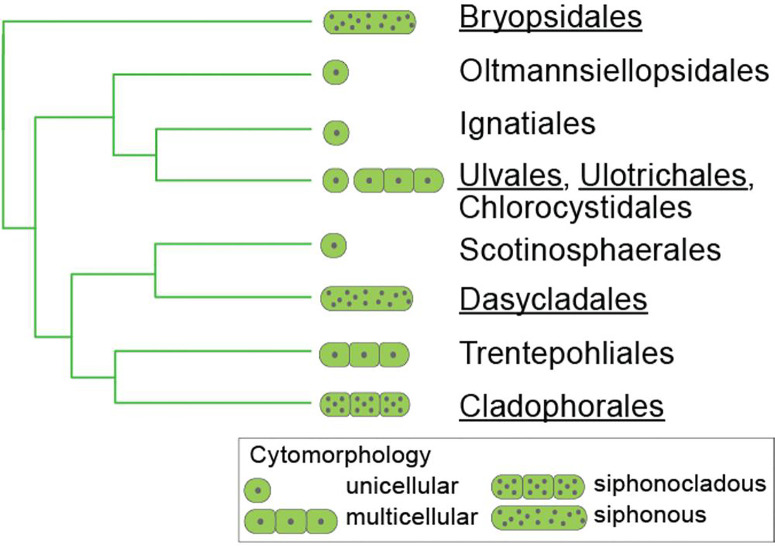
Seaweeds biosynthesize sulfated polysaccharides as key components of their cell walls. These polysaccharides are potentially interesting as biologically active compounds. Green macroalgae of the class Ulvophyceae comprise sulfated polysaccharides with great structural differences regarding the monosaccharide constituents, linearity of their backbones, and presence of other acidic substituents in their structure, including uronic acid residues and pyruvic acid. These structures have been thoroughly studied in the Ulvales and Ulotrichales, but only more recently have they been investigated with some detail in ulvophytes with giant multinucleate (coenocytic) cells, including the siphonous Bryopsidales and Dasycladales, and the siphonocladous Cladophorales. An early classification of these structurally heterogeneous polysaccharides was based on the presence of uronic acid residues in these molecules. In agreement with this classification based on chemical structures, sulfated polysaccharides of the orders Bryopsidales and Cladophorales fall in the same group, in which this acidic component is absent, or only present in very low quantities. The cell walls of Dasycladales have been less studied, and it remains unclear if they comprise sulfated polysaccharides of both types. Although in the Bryopsidales and Cladophorales the most important sulfated polysaccharides are arabinans and galactans (or arabinogalactans), their major structures are very different. The Bryopsidales produce sulfated pyruvylated 3-linked β-d-galactans, in most cases, with ramifications on C6. For some species, linear sulfated pyranosic β-l-arabinans have been described. In the Cladophorales, also sulfated pyranosic β-l-arabinans have been found, but 4-linked and highly substituted with side chains. These differences are consistent with recent molecular phylogenetic analyses, which indicate that the Bryopsidales and Cladophorales are distantly related. In addition, some of the Bryopsidales also biosynthesize other sulfated polysaccharides, i.e., sulfated mannans and sulfated rhamnans. The presence of sulfate groups as a distinctive characteristic of these biopolymers has been related to their adaptation to the marine environment. However, it has been shown that some freshwater algae from the Cladophorales also produce sulfated polysaccharides. In this review, structures of sulfated polysaccharides from bryopsidalean, dasycladalean, and cladophoralean green algae studied until now are described and analyzed based on current phylogenetic understanding, with the aim of unveiling the important knowledge gaps that still exist.
海藻生物合成硫酸化多糖作为其细胞壁的关键成分。这些多糖作为生物活性化合物具有潜在的吸引力。绿藻纲的绿藻含有硫酸化多糖,其在单糖组成、主链线性以及结构中其他酸性取代基(包括糖醛酸残基和丙酮酸)的存在方面存在很大的结构差异。这些结构在石莼目和丝藻目中已得到充分研究,但直到最近才对具有巨大多核(共质体)细胞的绿藻进行了一些详细研究,包括管藻目和伞藻目以及管枝藻目。这些结构异质多糖的早期分类是基于这些分子中糖醛酸残基的存在。与基于化学结构的这种分类一致,管藻目和管枝藻目的硫酸化多糖属于同一组,其中这种酸性成分不存在或仅以非常低的量存在。伞藻目的细胞壁研究较少,目前尚不清楚它们是否包含这两种类型的硫酸化多糖。尽管在管藻目和管枝藻目中,最重要的硫酸化多糖是阿拉伯聚糖和半乳聚糖(或阿拉伯半乳聚糖),但它们的主要结构非常不同。管藻目产生硫酸化的丙酮酸化3-连接的β-D-半乳聚糖,在大多数情况下,在C6处有分支。对于一些物种,已描述了线性硫酸化吡喃型β-L-阿拉伯聚糖。在管枝藻目中,也发现了硫酸化吡喃型β-L-阿拉伯聚糖,但为4-连接且侧链高度取代。这些差异与最近的分子系统发育分析一致,该分析表明管藻目和管枝藻目关系较远。此外,一些管藻目还生物合成其他硫酸化多糖,即硫酸化甘露聚糖和硫酸化鼠李聚糖。硫酸基团作为这些生物聚合物的一个显著特征,与它们对海洋环境的适应性有关。然而,已经表明一些来自管枝藻目的淡水藻类也产生硫酸化多糖。在这篇综述中,基于当前的系统发育理解,描述并分析了迄今为止研究的管藻目、伞藻目和管枝藻目绿藻的硫酸化多糖结构,目的是揭示仍然存在的重要知识空白。