Jemal Mohabaw, Deress Teshiwal, Belachew Teshome, Adem Yesuf
University of Gondar, College of Medicine and Health Sciences, School of Biomedical and Laboratory Sciences, Department of Medical Microbiology, Gondar, Ethiopia.
University of Gondar, College of Medicine and Health Sciences, School of Biomedical and Laboratory Sciences, Unit of Quality Assurance and Laboratory Management, Gondar, Ethiopia.
Int J Microbiol. 2020 Oct 19;2020:8893266. doi: 10.1155/2020/8893266. eCollection 2020.
The emergence and spread of antimicrobial resistance in bacteria is recognized as a global public health problem. Bloodstream infection with antimicrobial-resistant bacteria in HIV/AIDS patients makes the problem more challenging. So, regular and periodic diagnosis and use of the appropriate antimicrobial susceptibility pattern determination is the only option for decreasing the prevalence and development of drug-resistant bacteria.
An institution-based cross-sectional study was conducted among 384 HIV/AIDS patients. Sociodemographic data of patients were recorded using structured questionnaires. Blood cultures were collected with BACTEC aerobic blood culture bottles. A pair of samples was collected from each patient aseptically and incubated at 37°. If samples are positive for bacterial agents, they were subcultured to solid media such as blood agar plate, chocolate agar plate, and MacConkey agar plates. Identification was performed using colony characteristics and standard biochemical techniques. The antimicrobial susceptibility test was determined by the Kirby-Bauer disc diffusion method. Data entry and analysis were performed while using SPSS version 20. Descriptive statistics were performed to calculate frequencies.
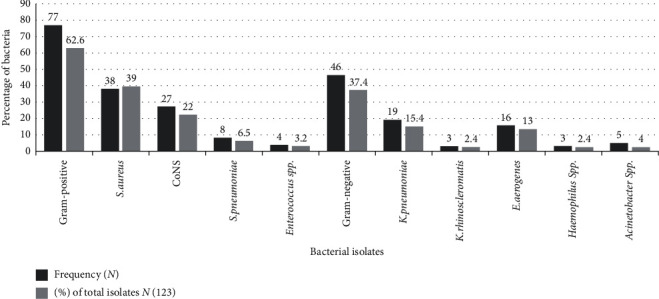
Altogether, 384 patients were included, and 123 blood cultures were positive, so that the yield was thus 32%. About 46 (37.4%) of Gram-negative and 77 (62.6%) of Gram-positive bacterial species were identified. Among Gram-negative bacterial isolates, was the leading pathogen, 19 (41.3%), whereas , 38 (49.4%), was predominant among Gram-positive isolates. In his study, the majority of Gram-positive isolates showed high level of resistance to penicillin, 72 (95.5%), tetracycline, 55 (71.4%), and cotrimoxazole, 45 (58.4%). About 28 (73.6%) of isolates were also methicillin-resistant. Gram-negative bacterial isolates also showed a high resistance to ampicillin (91.3%), tetracycline (91.3%), and gentamicin (47.8%). Overall, about 78% of multidrug resistance was observed.
Several pathogens were resistant to greater than five antimicrobial agents, so that proper management of patients with bacteremia is needed, and a careful selection of effective antibiotics should be practiced.
细菌中抗菌药物耐药性的出现和传播被认为是一个全球公共卫生问题。艾滋病毒/艾滋病患者发生耐抗菌药物细菌的血流感染使这一问题更具挑战性。因此,定期和周期性诊断以及确定适当的抗菌药物敏感性模式是降低耐药菌患病率和发展的唯一选择。
在384例艾滋病毒/艾滋病患者中开展了一项基于机构的横断面研究。使用结构化问卷记录患者的社会人口学数据。用BACTEC需氧血培养瓶采集血培养标本。从每位患者无菌采集一对样本并在37℃下培养。如果样本对细菌病原体呈阳性,则将其接种到血琼脂平板、巧克力琼脂平板和麦康凯琼脂平板等固体培养基上进行传代培养。使用菌落特征和标准生化技术进行鉴定。采用 Kirby-Bauer 纸片扩散法进行抗菌药物敏感性试验。使用SPSS 20版软件进行数据录入和分析。进行描述性统计以计算频率。
共纳入384例患者,123份血培养标本呈阳性,培养阳性率为32%。共鉴定出约46种(37.4%)革兰氏阴性菌和77种(62.6%)革兰氏阳性菌。在革兰氏阴性菌分离株中, 是主要病原体,占19例(41.3%),而在革兰氏阳性菌分离株中, 占38例(49.4%),最为常见。在本研究中,大多数革兰氏阳性菌分离株对青霉素耐药率较高,为72例(95.5%),对四环素耐药率为55例(71.4%),对复方新诺明耐药率为45例(58.4%)。约28例(73.6%) 分离株同时对甲氧西林耐药。革兰氏阴性菌分离株对氨苄西林(91.3%)、四环素(91.3%)和庆大霉素(47.8%)也表现出较高耐药性。总体而言,观察到约78%的多重耐药情况。
几种病原体对五种以上抗菌药物耐药,因此需要对菌血症患者进行适当管理,并谨慎选择有效的抗生素。