Krige Jake, Jonas Eduard, Kotze Urda, Kloppers Christo, Gandhi Karan, Allam Hisham, Bernon Marc, Burmeister Sean, Setshedi Mashiko
Departments of Surgery and Medicine, University of Cape Town Health Sciences Faculty, Cape Town 7925, South Africa.
World J Gastrointest Endosc. 2020 Oct 16;12(10):365-377. doi: 10.4253/wjge.v12.i10.365.
Bleeding esophageal varices (BEV) is a potentially life-threatening complication in patients with portal hypertension with mortality rates as high as 25% within six weeks of the index variceal bleed. After control of the initial bleeding episode patients should enter a long-term surveillance program with endoscopic intervention combined with non-selective β-blockers to prevent further bleeding and eradicate EV.
To assess the efficacy of endoscopic variceal ligation (EVL) in controlling acute variceal bleeding, preventing variceal recurrence and rebleeding and achieving complete eradication of esophageal varices (EV) in patients who present with BEV.
A prospectively documented single-center database was used to retrospectively identify all patients with BEV who were treated with EVL between 2000 and 2018. Control of acute bleeding, variceal recurrence, rebleeding, eradication and survival were analyzed using Baveno assessment criteria.
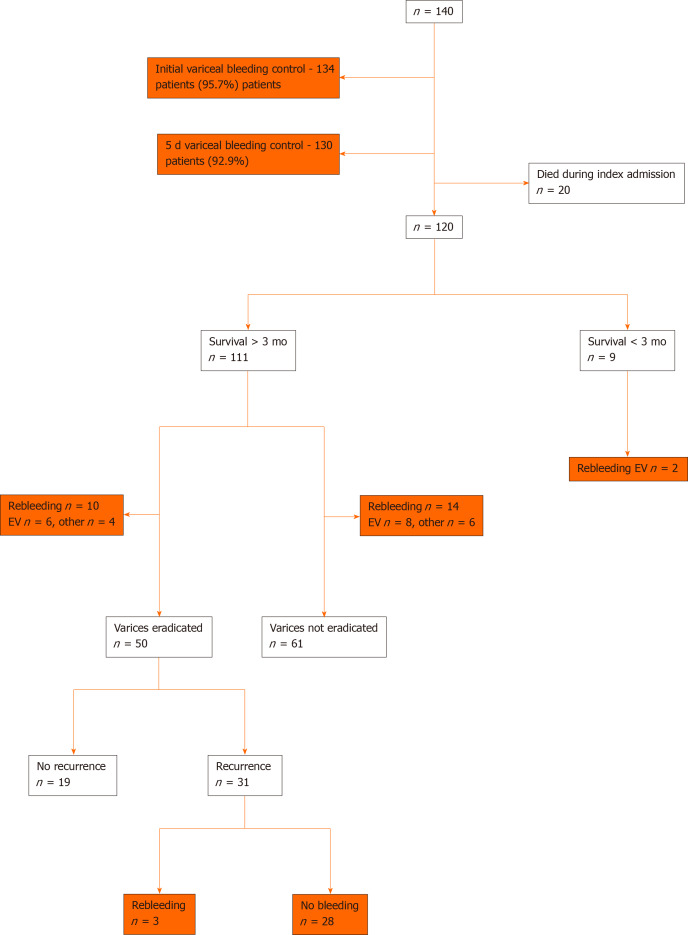
One hundred and forty patients (100 men, 40 women; mean age 50 years; range, 21-84 years; Child-Pugh grade A = 32; B = 48; C = 60) underwent 160 emergency and 298 elective EVL interventions during a total of 928 endoscopy sessions. One hundred and fourteen (81%) of the 140 patients had variceal bleeding that was effectively controlled during the index banding procedure and never bled again from EV, while 26 (19%) patients had complicated and refractory variceal bleeding. EVL controlled the acute sentinel variceal bleed during the first endoscopic intervention in 134 of 140 patients (95.7%). Six patients required balloon tamponade for control and 4 other patients rebled in hospital. Overall 5-d endoscopic failure to control variceal bleeding was 7.1% ( = 10) and four patients required a salvage transjugular intrahepatic portosystemic shunt. Index admission mortality was 14.2% ( = 20). EV were completely eradicated in 50 of 111 patients (45%) who survived > 3 mo of whom 31 recurred and 3 rebled. Sixteen (13.3%) of 120 surviving patients subsequently had 21 EV rebleeding episodes and 10 patients bled from other sources after discharge from hospital. Overall rebleeding from all sources after 2 years was 21.7% ( = 26). Sixty-nine (49.3%) of the 140 patients died, mainly due to liver failure ( = 46) during follow-up. Cumulative survival for the 140 patients was 71.4% at 1 year, 65% at 3 years, 60% at 5 years and 52.1% at 10 years.
EVL was highly effective in controlling the sentinel variceal bleed with an overall 5-day failure to control bleeding of 7.1%. Although repeated EVL achieved complete variceal eradication in less than half of patients with BEV, of whom 62% recurred, there was a significant reduction in subsequent rebleeding.
食管静脉曲张破裂出血(BEV)是门静脉高压患者潜在的危及生命的并发症,在首次静脉曲张破裂出血后的六周内死亡率高达25%。在控制初始出血事件后,患者应进入长期监测计划,采用内镜干预联合非选择性β受体阻滞剂,以预防进一步出血并消除食管静脉曲张(EV)。
评估内镜下静脉曲张套扎术(EVL)在控制急性静脉曲张出血、预防静脉曲张复发和再出血以及实现BEV患者食管静脉曲张完全消除方面的疗效。
使用前瞻性记录的单中心数据库回顾性识别2000年至2018年间接受EVL治疗的所有BEV患者。采用Baveno评估标准分析急性出血的控制、静脉曲张复发、再出血、消除及生存情况。
140例患者(100例男性,40例女性;平均年龄50岁;范围21 - 84岁;Child-Pugh A级 = 32例;B级 = 48例;C级 = 60例)在总共928次内镜检查中接受了160次急诊和298次择期EVL干预。140例患者中有114例(81%)在首次套扎手术期间静脉曲张出血得到有效控制,且此后未再发生EV出血,而26例(19%)患者出现复杂难治性静脉曲张出血。EVL在140例患者中的134例(95.7%)首次内镜干预期间控制了急性哨兵静脉曲张出血。6例患者需要气囊压迫止血,另有4例患者在住院期间再次出血。总体而言,5天内镜下未能控制静脉曲张出血的比例为7.1%(n = 10),4例患者需要进行挽救性经颈静脉肝内门体分流术。首次入院死亡率为14.2%(n = 20)。111例存活超过3个月的患者中有50例(45%)EV完全消除,其中31例复发,3例再次出血。120例存活患者中有16例(13.3%)随后发生21次EV再出血事件,10例患者出院后从其他部位出血。2年后所有来源的总体再出血率为21.7%(n = 26)。140例患者中有69例(49.3%)死亡,主要死于随访期间的肝功能衰竭(n = 46)。140例患者的1年累积生存率为71.4%,3年为65%,5年为60%,10年为52.1%。
EVL在控制哨兵静脉曲张出血方面非常有效,总体5天内控制出血失败率为7.1%。尽管重复EVL在不到一半的BEV患者中实现了静脉曲张的完全消除,其中62%复发,但随后的再出血显著减少。