Wang Tse-Yao, Huang Hsien-Hao, Hsieh Ming-Shun, Chen Chih-Yen
Department of Emergency Medicine, Taipei Veterans General Hospital, Taipei 112, Taiwan.
College of Medicine, National Yang-Ming University of Medicine, Taipei 112, Taiwan.
World J Diabetes. 2020 Oct 15;11(10):447-458. doi: 10.4239/wjd.v11.i10.447.
Bariatric surgery is one of most effective long-term treatments for morbid obesity. However, post-bariatric surgery anemia is identified as a common adverse effect and remains a challenge nowadays.
To estimate the risk of post-bariatric surgery anemia and to stratify the association between age, gender, and types of surgery.
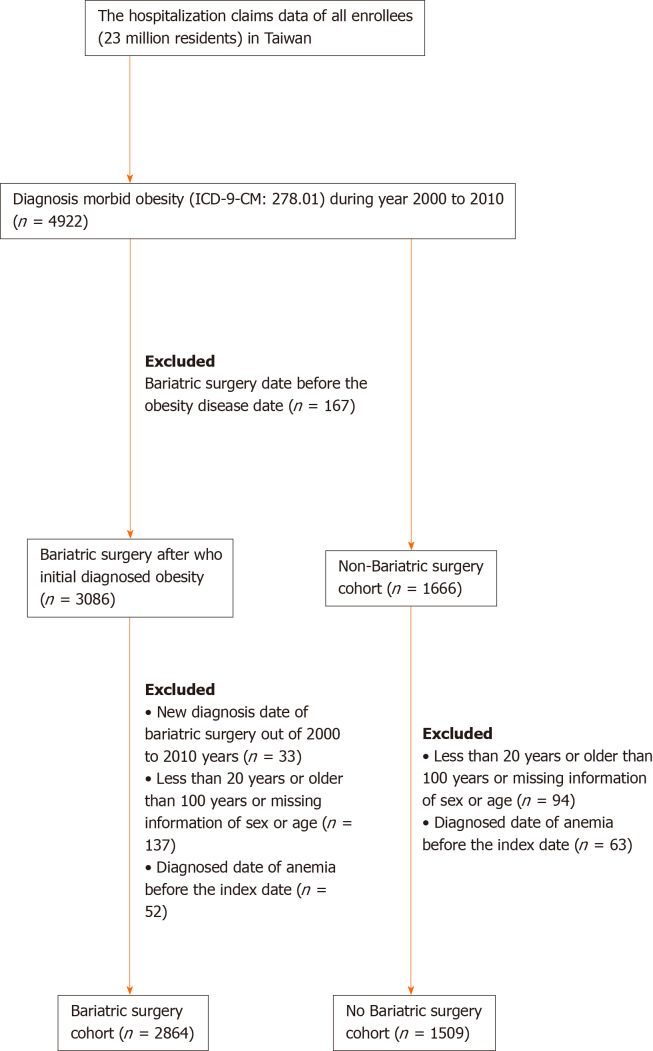
This study is a population-based cohort study. We conducted this nationwide study using claims data from National Health Insurance Research Database in Taiwan. There were 4373 morbidly obese patients in this study cohort.
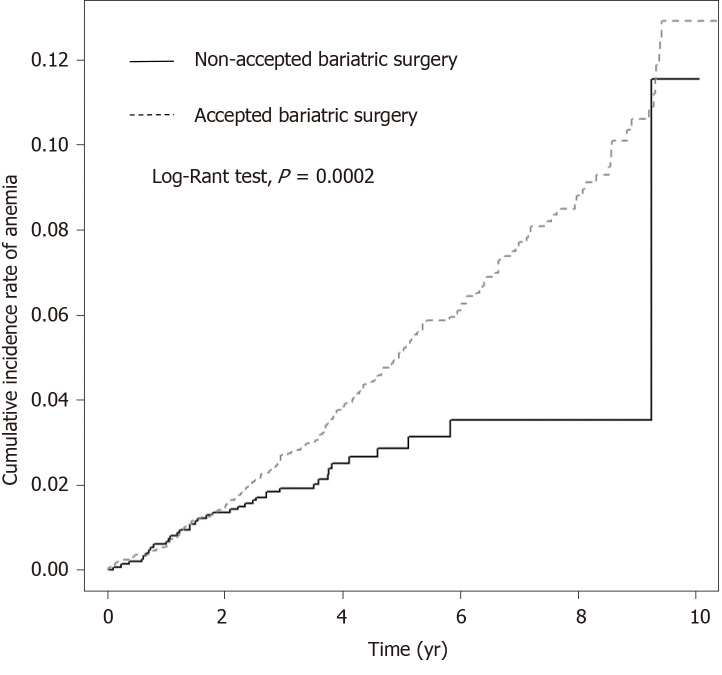
Among patients who were diagnosed with morbid obesity, 2864 received bariatric surgery. All obesity-associated comorbidities decreased in the surgical group. Increasing risk of post-bariatric surgery anemia among obese patients was found by Cox proportional hazards regression [adjusted hazard ratio (HR): 2.36]. Also, we found significantly increasing cumulative incidence rate of anemia among patients receiving bariatric surgery by log-rank test. After adjusting for age and gender, the increasing incidence of post-bariatric surgery anemia was found among women (adjusted HR: 2.48), patients in the 20-29-year-old group (adjusted HR: 3.83), and patients in the 30-64-year-old group (adjusted HR: 2.37). Moreover, malabsorptive and restrictive procedures had significantly higher adjusted HRs, 3.18 and 1.55, respectively.
Bariatric surgery give rise to anemia risk among obese patients, specifically in women, young- and middle-aged patients, and patients undergoing malabsorptive procedures in our population-based cohort study in Taiwan.
减重手术是治疗病态肥胖最有效的长期治疗方法之一。然而,减重手术后贫血被认为是一种常见的不良反应,至今仍是一个挑战。
评估减重手术后贫血的风险,并对年龄、性别和手术类型之间的关联进行分层。
本研究是一项基于人群的队列研究。我们使用台湾国民健康保险研究数据库的理赔数据进行了这项全国性研究。本研究队列中有4373名病态肥胖患者。
在被诊断为病态肥胖的患者中,2864人接受了减重手术。手术组中所有与肥胖相关的合并症都有所减少。通过Cox比例风险回归发现肥胖患者减重手术后贫血风险增加[调整后风险比(HR):2.36]。此外,通过对数秩检验我们发现接受减重手术的患者贫血累积发病率显著增加。在调整年龄和性别后,发现女性(调整后HR:2.48)、20 - 29岁组患者(调整后HR:3.83)和30 - 64岁组患者(调整后HR:2.37)减重手术后贫血发病率增加。此外,吸收不良和限制性手术的调整后HRs显著更高,分别为3.18和1.55。
在我们基于台湾人群的队列研究中,减重手术会增加肥胖患者的贫血风险,特别是女性、中青年患者以及接受吸收不良手术的患者。