Neekhra Aneesh, Tran Julia, Esfahani Parsa R, Schneider Kevin, Pham Khoa, Sharma Ashish, Chwa Marilyn, Luthra Saurabh, Gramajo Ana L, Mansoor Saffar, Kuppermann Baruch D, Kenney M Cristina
Gavin Herbert Eye Institute, University of California, Irvine, California.
Department of Pathology and Laboratory Medicine, University of California Irvine, Irvine, CA, USA.
J Ophthalmic Vis Res. 2020 Oct 25;15(4):470-480. doi: 10.18502/jovr.v15i4.7781. eCollection 2020 Oct-Dec.
7-ketocholesterol (7kCh), a natural byproduct of oxidation in lipoprotein deposits is implicated in the pathogenesis of diabetic retinopathy and age-related macular degeneration (AMD). This study was performed to investigate whether several clinical drugs can inhibit 7kCh-induced caspase activation and mitigate its apoptotic effects on retinal cells in vitro.
Two populations of retinal cells, human retinal pigment epithelial cells (ARPE-19) and rat neuroretinal cells (R28) were exposed to 7kCh in the presence of the following inhibitors: Z-VAD-FMK (pan-caspase inhibitor), simvastatin, memantine, epicatechin, and Z-IETD-FMK (caspase-8 inhibitor) or Z-ATAD-FMK (caspase-12 inhibitor). Caspase-3/7, -8, and -12 activity levels were measured by fluorochrome caspase assays to quantify cell death. IncuCyte live-cell microscopic images were obtained to quantify cell counts.
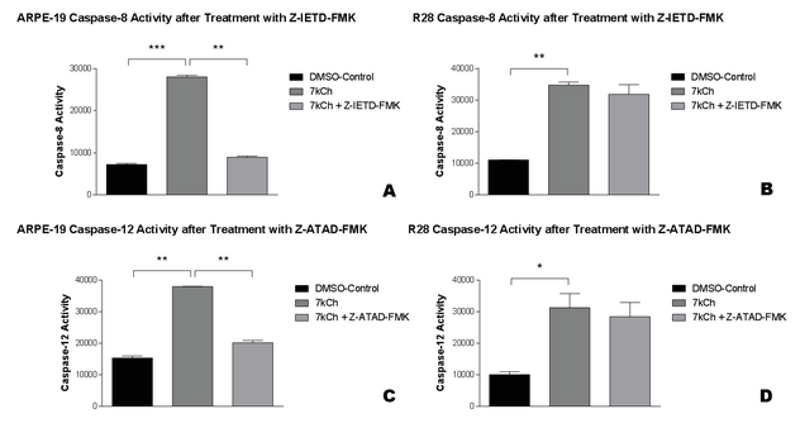
Exposure to 7kCh for 24 hours significantly increased caspase activities for both ARPE-19 and R28 cells ( 0.05). In ARPE cells, pretreatment with various drugs had significantly lower caspase-3/7, -8, and -12 activities, reported in % change in mean signal intensity (msi): Z-VAD-FMK (48% decrease, 0.01), memantine (decreased 47.8% at 1 µM, = 0.0039 and 81.9% at 1 mM, 0.001), simvastatin (decreased 85.3% at 0.01 µM, 0.001 and 84.8% at 0.05 µM, 0.001) or epicatechin (83.6% decrease, 0.05), Z-IETD-FMK (68.1% decrease, 0.01), and Z-ATAD-FMK (47.7% decrease, = 0.0017). In contrast, R28 cells exposed to 7kCh continued to have elevated caspase-3/7, -8, and -12 activities (between 25.7% decrease and 17.5% increase in msi, 0.05) regardless of the pretreatment.
Several current drugs protect ARPE-19 cells but not R28 cells from 7kCh-induced apoptosis, suggesting that a multiple-drug approach is needed to protect both cells types in various retinal diseases.
7-酮胆固醇(7kCh)是脂蛋白沉积物氧化的天然副产物,与糖尿病视网膜病变和年龄相关性黄斑变性(AMD)的发病机制有关。本研究旨在调查几种临床药物是否能抑制7kCh诱导的半胱天冬酶激活,并减轻其对视网膜细胞的体外凋亡作用。
将两种视网膜细胞群体,即人视网膜色素上皮细胞(ARPE-19)和大鼠神经视网膜细胞(R28),在以下抑制剂存在的情况下暴露于7kCh:Z-VAD-FMK(泛半胱天冬酶抑制剂)、辛伐他汀、美金刚、表儿茶素,以及Z-IETD-FMK(半胱天冬酶-8抑制剂)或Z-ATAD-FMK(半胱天冬酶-12抑制剂)。通过荧光半胱天冬酶测定法测量半胱天冬酶-3/7、-8和-12的活性水平,以量化细胞死亡。获取IncuCyte活细胞显微镜图像以量化细胞计数。
ARPE-19和R28细胞暴露于7kCh 24小时后,半胱天冬酶活性均显著增加(P<0.05)。在ARPE细胞中,用各种药物预处理后,半胱天冬酶-3/7、-8和-12的活性显著降低,以平均信号强度(msi)的变化百分比表示:Z-VAD-FMK(降低48%,P<0.01)、美金刚(1μM时降低47.8%,P = 0.0039;1mM时降低81.9%,P<0.001)、辛伐他汀(0.01μM时降低85.3%,P<0.001;0.05μM时降低84.8%,P<0.001)或表儿茶素(降低83.6%,P<0.05)、Z-IETD-FMK(降低68.1%,P<0.01)和Z-ATAD-FMK(降低47.7%,P = 0.0017)。相比之下,无论预处理如何,暴露于7kCh的R28细胞的半胱天冬酶-3/7、-8和-12活性持续升高(msi降低25.7%至升高17.5%之间,P>0.05)。
几种现有药物可保护ARPE-19细胞免受7kCh诱导的凋亡,但不能保护R28细胞,这表明需要采用多种药物方法来保护各种视网膜疾病中的两种细胞类型。