Liston Glen E, Itkin Polona, Stroeve Julienne, Tschudi Mark, Stewart J Scott, Pedersen Stine H, Reinking Adele K, Elder Kelly
Cooperative Institute for Research in the Atmosphere (CIRA) Colorado State University Fort Collins CO USA.
Department of Physics and Technology UiT The Arctic University of Norway Tromsø NORWAY.
J Geophys Res Oceans. 2020 Oct;125(10):e2019JC015913. doi: 10.1029/2019JC015913. Epub 2020 Oct 1.
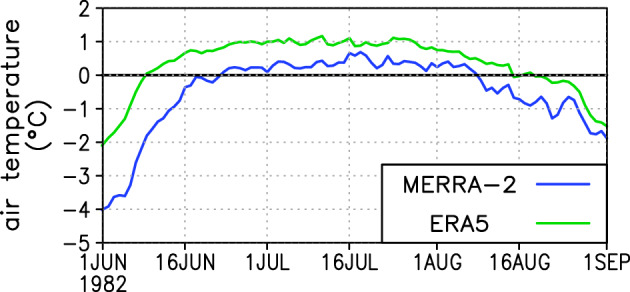
A Lagrangian snow-evolution model (SnowModel-LG) was used to produce daily, pan-Arctic, snow-on-sea-ice, snow property distributions on a 25 × 25-km grid, from 1 August 1980 through 31 July 2018 (38 years). The model was forced with NASA's Modern Era Retrospective-Analysis for Research and Applications-Version 2 (MERRA-2) and European Centre for Medium-Range Weather Forecasts (ECMWF) ReAnalysis-5th Generation (ERA5) atmospheric reanalyses, and National Snow and Ice Data Center (NSIDC) sea ice parcel concentration and trajectory data sets (approximately 61,000, 14 × 14-km parcels). The simulations performed full surface and internal energy and mass balances within a multilayer snowpack evolution system. Processes and features accounted for included rainfall, snowfall, sublimation from static-surfaces and blowing-snow, snow melt, snow density evolution, snow temperature profiles, energy and mass transfers within the snowpack, superimposed ice, and ice dynamics. The simulations produced horizontal snow spatial structures that likely exist in the natural system but have not been revealed in previous studies spanning these spatial and temporal domains. Blowing-snow sublimation made a significant contribution to the snowpack mass budget. The superimposed ice layer was minimal and decreased over the last four decades. Snow carryover to the next accumulation season was minimal and sensitive to the melt-season atmospheric forcing (e.g., the average summer melt period was 3 weeks or 50% longer with ERA5 forcing than MERRA-2 forcing). Observed ice dynamics controlled the ice parcel age (in days), and ice age exerted a first-order control on snow property evolution.
使用拉格朗日雪演变模型(SnowModel-LG),在1980年8月1日至2018年7月31日(38年)期间,以25×25公里的网格生成北极地区每日海冰上雪属性分布。该模型由美国国家航空航天局的现代时代回顾分析研究与应用版本2(MERRA-2)和欧洲中期天气预报中心(ECMWF)再分析第5代(ERA5)大气再分析数据,以及美国国家冰雪数据中心(NSIDC)海冰块浓度和轨迹数据集(约61000个14×14公里的冰块)驱动。模拟在多层积雪演变系统中进行了完整的地表和内部能量及质量平衡。考虑的过程和特征包括降雨、降雪、静态表面升华和吹雪、融雪、雪密度演变、雪温度剖面、积雪内的能量和质量转移、叠加冰和冰动力学。模拟产生的水平雪空间结构可能存在于自然系统中,但在以往跨越这些时空域的研究中尚未揭示。吹雪升华对积雪质量平衡有重大贡献。叠加冰层最小,且在过去四十年中有所减少。下一个积累季节的积雪残留量最小,且对融化季节的大气强迫敏感(例如,与MERRA-2强迫相比,ERA5强迫下夏季平均融化期长3周或长50%)。观测到的冰动力学控制着冰块年龄(以天为单位),而冰龄对雪属性演变有一级控制作用。