Hassan Quais N, Queen Nicholas J, Cao Lei
Department of Cancer Biology and Genetics, College of Medicine, The Ohio State University, Columbus, OH, USA.
The Ohio State University Comprehensive Cancer Center, Columbus, OH, USA.
Transl Cancer Res. 2020 Sep;9(9):5687-5699. doi: 10.21037/tcr.2020.02.39.
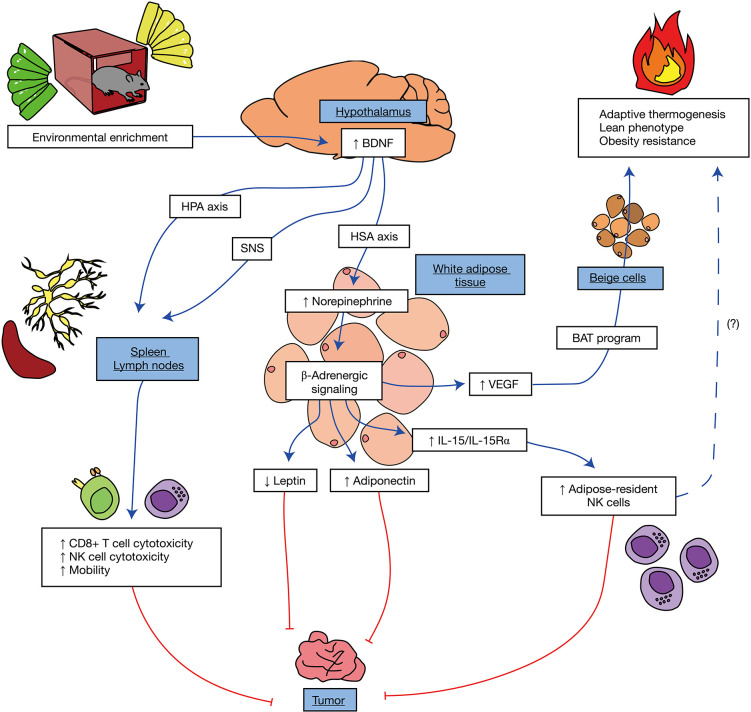
Social and environmental factors impact cancer and energy balance profoundly. Years ago, our lab established the existence of a novel brain-fat interaction we termed the "hypothalamic-sympathoneural-adipocyte (HSA) axis", through which complex environmental stimuli provided by an enriched environment regulate body composition, energy balance, and development of cancer. We have spent a significant portion of the past decade to further characterize the broad health benefits of an enriched environment (for example, leanness, enhanced immune function, and cancer resistance), and to identify mediators in the brain and periphery along the HSA axis. This review summarizes our recent work regarding the interface between endocrinology, immunology, cancer biology, aging, and neuroscience. We will discuss the interplay between these systemic phenomena and how the HSA axis can be targeted for regulation of cancer and aging.
社会和环境因素对癌症和能量平衡有着深远影响。多年前,我们的实验室证实了一种新型的脑-脂肪相互作用的存在,我们将其称为“下丘脑-交感神经-脂肪细胞(HSA)轴”,通过这一轴,丰富环境所提供的复杂环境刺激可调节身体组成、能量平衡和癌症发展。在过去十年的大部分时间里,我们致力于进一步阐明丰富环境的广泛健康益处(例如,瘦体重、增强的免疫功能和抗癌能力),并确定沿HSA轴在大脑和外周的介质。本综述总结了我们最近关于内分泌学、免疫学、癌症生物学、衰老和神经科学之间界面的研究工作。我们将讨论这些全身现象之间的相互作用,以及如何针对HSA轴来调节癌症和衰老。