Splinter Mona, Sachpazidis Ilias, Bostel Tilman, Fechter Tobias, Zamboglou Constantinos, Thieke Christian, Jäkel Oliver, Huber Peter E, Debus Jürgen, Baltas Dimos, Nicolay Nils H
Heidelberg Institute of Radiation Oncology (HIRO), National Center for Radiation Research in Oncology (NCRO), Heidelberg, Germany.
Medical Physics in Radiation Oncology, German Cancer Research Center, Heidelberg, Germany.
Front Oncol. 2020 Sep 29;10:564068. doi: 10.3389/fonc.2020.564068. eCollection 2020.
To investigate deviations between planned and applied treatment doses for hypofractionated prostate radiotherapy and to quantify dosimetric accuracy in dependence of the image guidance frequency.
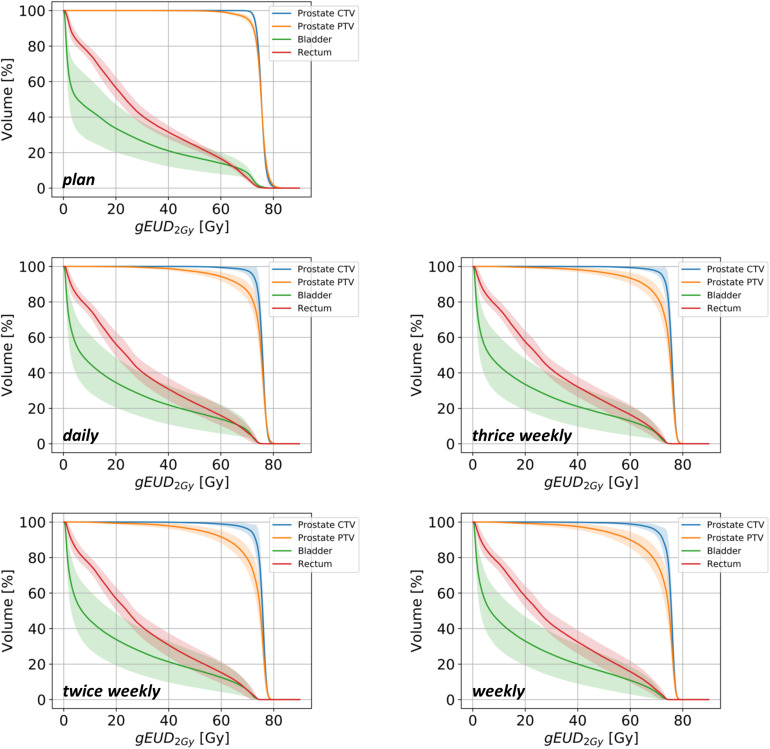
Daily diagnostic in-room CTs were carried out in 10 patients in treatment position as image guidance for hypofractionated prostate radiotherapy. Fraction doses were mapped to the planning CTs and recalculated, and applied doses were accumulated voxel-wise using deformable registration. Non-daily imaging schedules were simulated by deriving position correction vectors from individual scans and used to rigidly register the following scans until the next repositioning before dose recalculation and accumulation. Planned and applied doses were compared regarding dose-volume indices and TCP and NTCP values in dependence of the imaging and repositioning frequency.
Daily image-guided repositioning was associated with only negligible deviations of analyzed dose-volume parameters and conformity/homogeneity indices for the prostate, bladder and rectum. Average CTV T did not significantly deviate from the plan values, and rectum NTCPs were highly comparable, while bladder NTCPs were reduced. For non-daily image-guided repositioning, there were significant deviations in the high-dose range from the planned values. Similarly, CTV dose conformity and homogeneity were reduced. While TCPs and rectal NTCPs did not significantly deteriorate for non-daily repositioning, bladder NTCPs appeared falsely diminished in dependence of the imaging frequency.
Using voxel-by-voxel dose accumulation, we showed for the first time that daily image-guided repositioning resulted in only negligible dosimetric deviations for hypofractionated prostate radiotherapy. Regarding dosimetric aberrations for non-daily imaging, daily imaging is required to adequately deliver treatment.
研究大分割前列腺放疗计划剂量与实际应用剂量之间的偏差,并根据图像引导频率量化剂量准确性。
对10例处于治疗体位的患者进行每日室内诊断CT扫描,作为大分割前列腺放疗的图像引导。将分次剂量映射到计划CT上并重新计算,使用可变形配准逐体素累积应用剂量。通过从个体扫描中导出位置校正向量来模拟非每日成像计划,并用于对后续扫描进行刚性配准,直到下一次重新定位,然后进行剂量重新计算和累积。根据成像和重新定位频率,比较计划剂量和应用剂量的剂量体积指数、肿瘤控制概率(TCP)和正常组织并发症概率(NTCP)值。
每日图像引导下的重新定位与前列腺、膀胱和直肠的分析剂量体积参数以及适形度/均匀性指数的偏差可忽略不计。平均临床靶区T(CTV T)与计划值无显著偏差,直肠NTCPs高度可比,而膀胱NTCPs降低。对于非每日图像引导下的重新定位,高剂量范围内与计划值存在显著偏差。同样,CTV剂量适形度和均匀性降低。虽然非每日重新定位时TCPs和直肠NTCPs没有显著恶化,但膀胱NTCPs似乎因成像频率而被错误地降低。
通过逐体素剂量累积,我们首次表明,每日图像引导下的重新定位在大分割前列腺放疗中仅导致可忽略不计的剂量偏差。对于非每日成像的剂量畸变,需要每日成像以充分实施治疗。