Tice Caitlin, McDevitt Jane, Langford Dianne
Department of Neuroscience, Lewis Katz School of Medicine, Philadelphia, PA, United States.
Department of Kinesiology, College of Public Health at Temple University, Philadelphia, PA, United States.
Front Cell Infect Microbiol. 2020 Sep 29;10:523379. doi: 10.3389/fcimb.2020.523379. eCollection 2020.
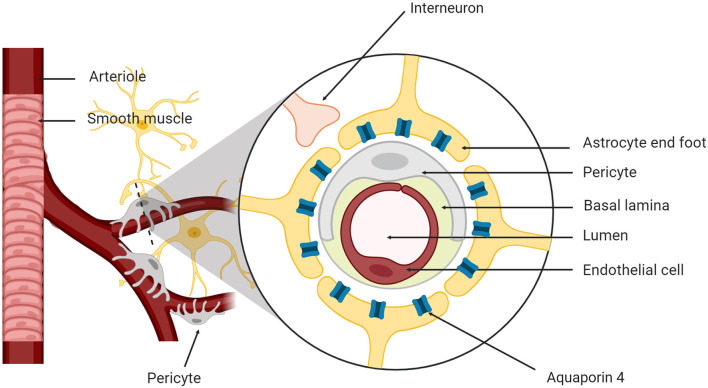
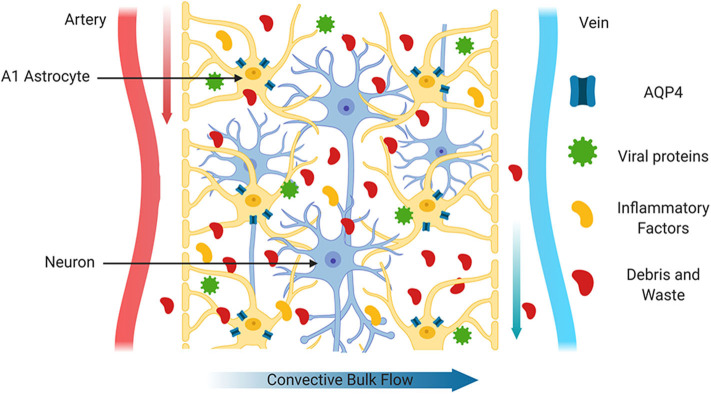
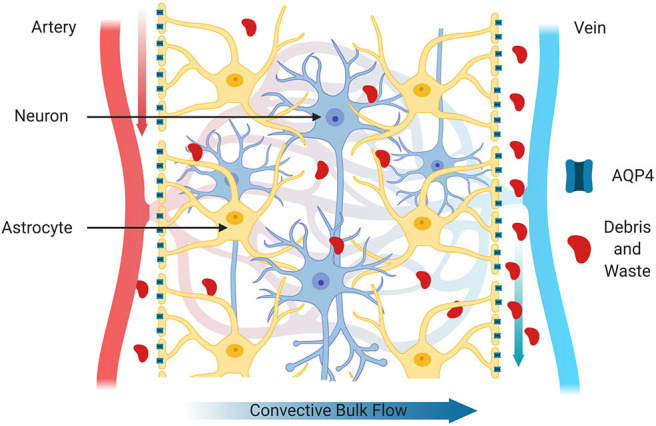
The discovery of the glial-lymphatic or glymphatic fluid clearance pathway in the rodent brain led researchers to search for a parallel system in humans and to question the implications of this pathway in neurodegenerative diseases. Magnetic resonance imaging studies revealed that several features of the glymphatic system may be present in humans. In both rodents and humans, this pathway promotes the exchange of interstitial fluid (ISF) and cerebrospinal fluid (CSF) through the arterial perivascular spaces into the brain parenchyma. This process is facilitated in part by aquaporin-4 (AQP4) water channels located primarily on astrocytic end feet that abut cerebral endothelial cells of the blood brain barrier. Decreased expression or mislocalization of AQP4 from astrocytic end feet results in decreased interstitial flow, thereby, promoting accumulation of extracellular waste products like hyperphosphorylated Tau (pTau). Accumulation of pTau is a neuropathological hallmark in Alzheimer's disease (AD) and is accompanied by mislocalization of APQ4 from astrocyte end feet to the cell body. HIV infection shares many neuropathological characteristics with AD. Similar to AD, HIV infection of the CNS contributes to abnormal aging with altered AQP4 localization, accumulation of pTau and chronic neuroinflammation. Up to 30% of people with HIV (PWH) suffer from HIV-associated neurocognitive disorders (HAND), and changes in AQP4 may be clinically important as a contributor to cognitive disturbances. In this review, we provide an overview and discussion of the potential contributions of NeuroHIV to glymphatic system functions by focusing on astrocytes and AQP4. Although HAND encompasses a wide range of neurocognitive impairments and levels of neuroinflammation vary among and within PWH, the potential contribution of disruption in AQP4 may be clinically important in some cases. In this review we discuss implications for possible AQP4 disruption on NeuroHIV disease trajectory and how HIV may influence AQP4 function.
啮齿动物大脑中胶质淋巴或类淋巴液清除途径的发现,促使研究人员在人类中寻找类似系统,并思考该途径在神经退行性疾病中的意义。磁共振成像研究表明,人类可能存在类淋巴系统的若干特征。在啮齿动物和人类中,该途径都能促进间质液(ISF)和脑脊液(CSF)通过动脉周围间隙进入脑实质。这一过程部分得益于主要位于星形胶质细胞终足上的水通道蛋白4(AQP4)水通道,这些终足毗邻血脑屏障的脑内皮细胞。AQP4从星形胶质细胞终足的表达减少或定位错误会导致间质液流动减少,从而促使细胞外废物如过度磷酸化的 Tau(pTau)积累。pTau的积累是阿尔茨海默病(AD)的神经病理学标志,同时伴有APQ4从星形胶质细胞终足向细胞体的定位错误。HIV感染与AD具有许多神经病理学特征。与AD类似,HIV感染中枢神经系统会导致异常衰老,伴有AQP4定位改变、pTau积累和慢性神经炎症。高达30%的HIV感染者(PWH)患有HIV相关神经认知障碍(HAND),AQP4的变化作为认知障碍的一个促成因素可能具有临床重要性。在本综述中,我们通过聚焦星形胶质细胞和AQP4,概述并讨论了神经HIV对类淋巴系统功能的潜在影响。尽管HAND涵盖了广泛的神经认知障碍,且PWH个体之间以及个体内部的神经炎症水平各不相同,但AQP4破坏在某些情况下的潜在影响可能具有临床重要性。在本综述中,我们讨论了AQP4破坏对神经HIV疾病轨迹的可能影响,以及HIV如何影响AQP4功能。