Lin Kai-Peng, Feng Guo-Jian, Pu Fu-Long, Hou Xue-Dan, Cao Shi-Lin
Department of Bioengineering, School of Biomedical and Pharmaceutical Sciences, Guangdong University of Technology, Guangzhou, China.
School of Food Science and Engineering, Foshan University, Foshan, China.
Front Bioeng Biotechnol. 2020 Oct 2;8:576266. doi: 10.3389/fbioe.2020.576266. eCollection 2020.
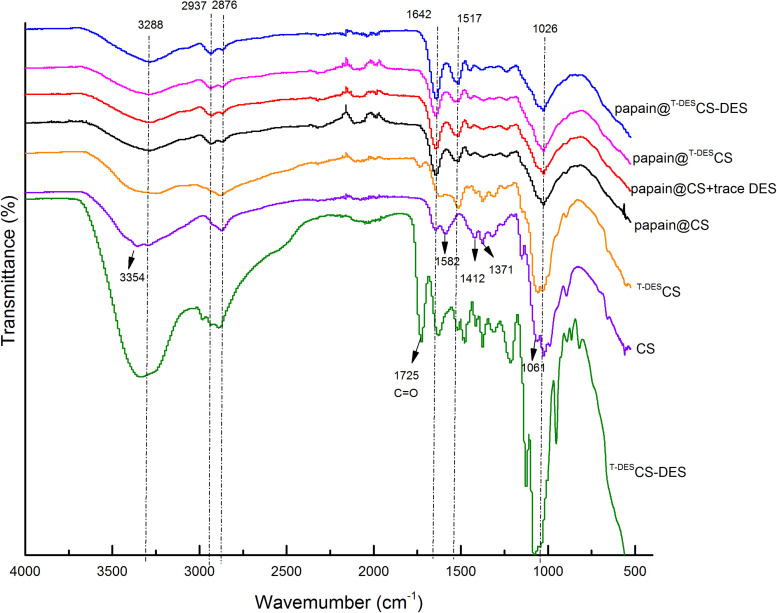
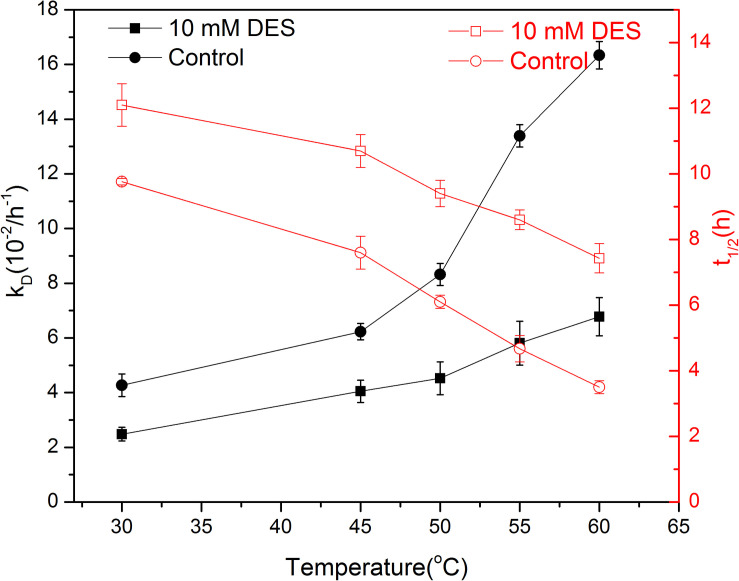
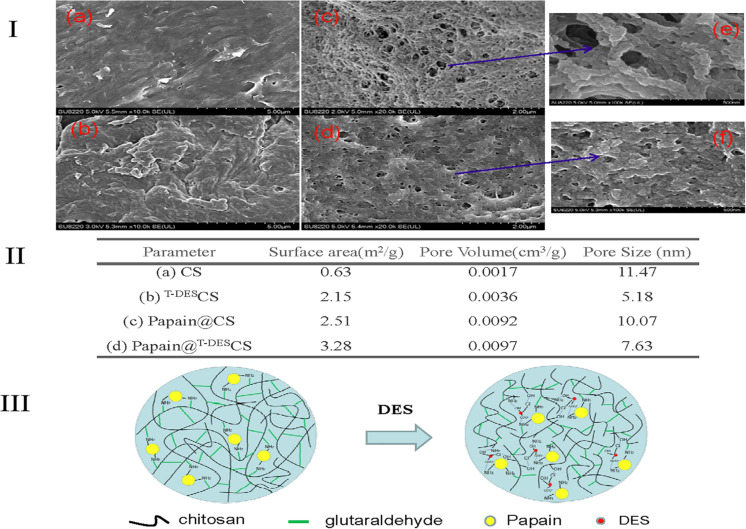
Deep eutectic solvents (DESs) have attracted an increasing attention in the fields of biocatalysis and biopolymer processing. In this study, papain immobilized on choline chloride- lactic acid (ChCl-Lac) DES-treated chitosan exhibited excellent thermostability as compared to the free enzyme. The properties of native or DES-treated chitosan and immobilized enzyme were characterized by FT-IR, SEM, surface area and pore property analysis. Like the common enzyme immobilization, papain immobilized on DES-treated chitosan resulted in a lower catalytic efficiency and a higher thermostability than the free enzyme due to the restricted diffusion. The results also revealed that DES could control the active group content, thus achieving the appropriate microporous structure of immobilized enzyme. Meanwhile, it could also help to construct the optimal microenvironment by hydrogen-bonding interaction between enzyme, chitosan, and residual DES, which are benefit for maintaining an active conformation and subsequently a high thermostability of papain. Moreover, it was found that trace DES (10 mM) significantly promoted the activity of free papain (145%). Deactivation thermodynamics study showed that the DES could enhance the thermostability of papain especially at high temperature (half-life of 7.4 vs. 3.5 h) because of the increased Gibbs free energy of denaturation. Secondary structure analysis by circular dichroism spectroscopy (CD) agreed well with the activity and thermostability data, further confirming the formation of rigid conformation induced by a specific amount of DES. This work provides a new way of enzyme immobilization synergistically intensified by solvents and supporting materials to achieve better microporous structure and catalytic microenvironment.
深共熔溶剂(DESs)在生物催化和生物聚合物加工领域受到了越来越多的关注。在本研究中,与游离酶相比,固定在氯化胆碱-乳酸(ChCl-Lac)DES处理的壳聚糖上的木瓜蛋白酶表现出优异的热稳定性。通过傅里叶变换红外光谱(FT-IR)、扫描电子显微镜(SEM)、比表面积和孔隙性质分析对天然或DES处理的壳聚糖以及固定化酶的性质进行了表征。与普通的酶固定化一样,由于扩散受限,固定在DES处理的壳聚糖上的木瓜蛋白酶比游离酶具有更低的催化效率和更高的热稳定性。结果还表明,DES可以控制活性基团含量,从而实现固定化酶的适当微孔结构。同时,它还可以通过酶、壳聚糖和残留DES之间的氢键相互作用,有助于构建最佳的微环境,这有利于维持活性构象并随后保持木瓜蛋白酶的高热稳定性。此外,发现痕量DES(10 mM)显著促进了游离木瓜蛋白酶的活性(提高了145%)。失活热力学研究表明,由于变性吉布斯自由能的增加,DES可以提高木瓜蛋白酶的热稳定性,特别是在高温下(半衰期分别为7.4小时和3.5小时)。通过圆二色光谱(CD)进行的二级结构分析与活性和热稳定性数据吻合良好,进一步证实了特定量的DES诱导形成刚性构象。这项工作提供了一种通过溶剂和载体材料协同强化酶固定化的新方法,以实现更好的微孔结构和催化微环境。