Hunan University of Chinese Medicine, Changsha, China.
Department of Traditional Chinese Medicine, Shenzhen Luohu People's Hospital, Shenzhen, China.
Biomed Res Int. 2020 Oct 17;2020:8260703. doi: 10.1155/2020/8260703. eCollection 2020.
To explore the effects of the Maxim.- compound (Huangqi-Danshen Compound (HDC)) on oxidative capacity and cardiomyocyte apoptosis in rats with diabetic cardiomyopathy by a network pharmacology-based strategy.
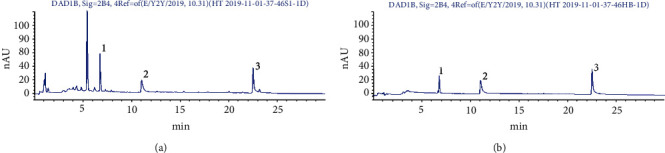
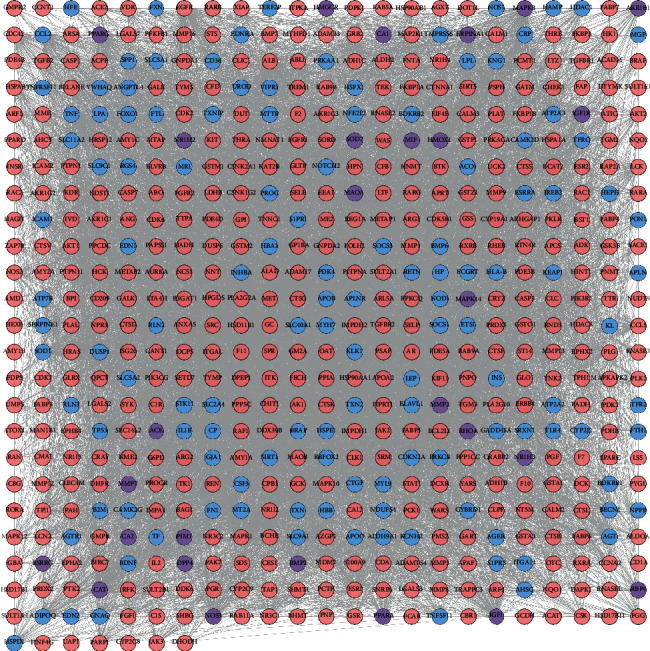
Traditional Chinese Medicine (TCM)@Taiwan, TCM Systems Pharmacology Database and Analysis Platform (TCMSP), TCM Integrated Database (TCMID), and High-Performance Liquid Chromatography (HPLC) technology were used to obtain and screen HDC's active components, and the PharmMapper database was used to predict HDC human target protein targets. The DCM genes were collected from the GeneCards and OMIM databases, and the network was constructed and analyzed by Cytoscape 3.7.1 and the Database for Annotation, Visualization, and Integrated Discovery (DAVID). Finally, HDC was used to intervene in diabetic cardiomyopathy (DCM) model rats, and important biological processes and signaling pathways were verified using techniques such as immunohistochemistry.
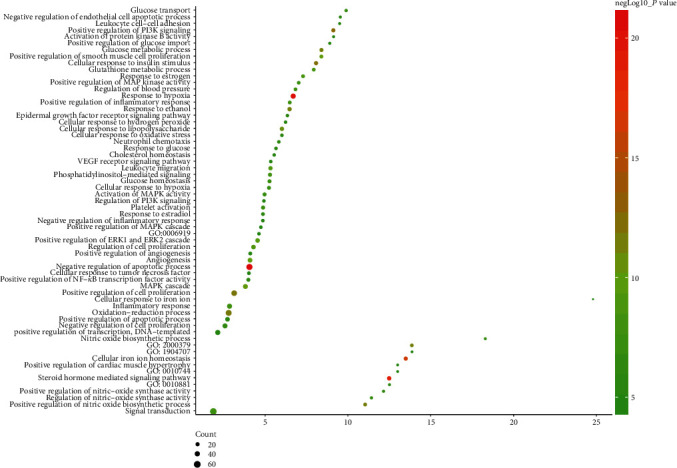
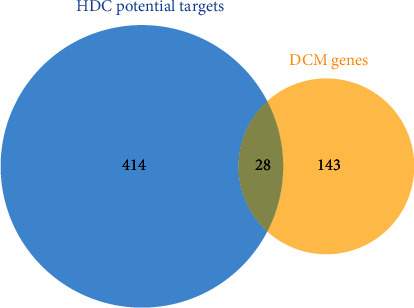
A total of 176 of HDC's active components and 442 potential targets were obtained. The results of network analysis show that HDC can regulate DCM-related biological processes (such as negative regulation of the apoptotic process, response to hypoxia, the steroid hormone-mediated signaling pathway, cellular iron ion homeostasis, and positive regulation of phosphatidylinositol 3-kinase signaling) and signaling pathways (such as the HIF-1 signaling pathway, the estrogen signaling pathway, insulin resistance, the PPAR signaling pathway, the VEGF signaling pathway, and the PI3K-Akt signaling pathway). Animal experiments show that HDC can reduce fasting plasma glucose (FPG), HbA1c, and malondialdehyde (MDA) and increase superoxide dismutase (SOD) and glutathione peroxidase (GSH-Px) ( < 0.05). The results of immunohistochemistry showed that HDC can regulate the protein expression of apoptosis-related signaling pathways in DCM rats ( < 0.05).
It was initially revealed that HDC improves DCM through its antiapoptotic and anti-inflammatory effects. HDC may play a therapeutic role by improving cardiomyocyte apoptosis in DCM rats.
采用网络药理学策略探讨复方黄芪丹参(HDC)对糖尿病心肌病大鼠氧化应激能力和心肌细胞凋亡的影响。
利用中药系统药理学数据库和分析平台(TCMSP)、中药综合数据库(TCMID)和高效液相色谱(HPLC)技术获取和筛选 HDC 的活性成分,利用 PharmMapper 数据库预测 HDC 的人靶点蛋白。从基因数据库(GeneCards 和 OMIM)中收集 DCM 基因,采用 Cytoscape 3.7.1 和数据库检索分析工具(DAVID)构建和分析网络。最后,采用 HDC 干预糖尿病心肌病(DCM)模型大鼠,免疫组化等技术验证重要的生物学过程和信号通路。
共获得 HDC 的 176 个活性成分和 442 个潜在靶点。网络分析结果显示,HDC 可调控 DCM 相关的生物学过程(如细胞凋亡过程的负调控、缺氧反应、类固醇激素介导的信号通路、细胞内铁离子稳态和磷脂酰肌醇 3-激酶信号通路的正调控)和信号通路(如缺氧诱导因子 1 信号通路、雌激素信号通路、胰岛素抵抗、过氧化物酶体增殖物激活受体信号通路、血管内皮生长因子信号通路和磷脂酰肌醇 3-激酶-蛋白激酶 B 信号通路)。动物实验表明,HDC 可降低空腹血糖(FPG)、糖化血红蛋白(HbA1c)和丙二醛(MDA),提高超氧化物歧化酶(SOD)和谷胱甘肽过氧化物酶(GSH-Px)( < 0.05)。免疫组化结果显示,HDC 可调节 DCM 大鼠凋亡相关信号通路的蛋白表达( < 0.05)。
初步揭示 HDC 通过抗凋亡和抗炎作用改善 DCM,可能通过改善 DCM 大鼠心肌细胞凋亡发挥治疗作用。