Wu Yen-Jung J, Harding Brian J, Triplett Colin C, Makela Jonathan J, Marr Kenneth D, Englert Christoph R, Harlander John M, Immel Thomas J
Space Sciences Laboratory University of California Berkeley CA USA.
Department of Electrical and Computer Engineering University of Illinois at Urbana-Champaign Urbana IL USA.
Earth Space Sci. 2020 Oct;7(10):e2020EA001164. doi: 10.1029/2020EA001164. Epub 2020 Oct 7.
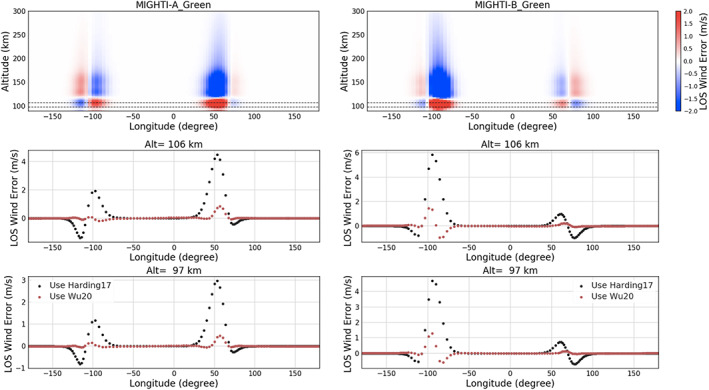
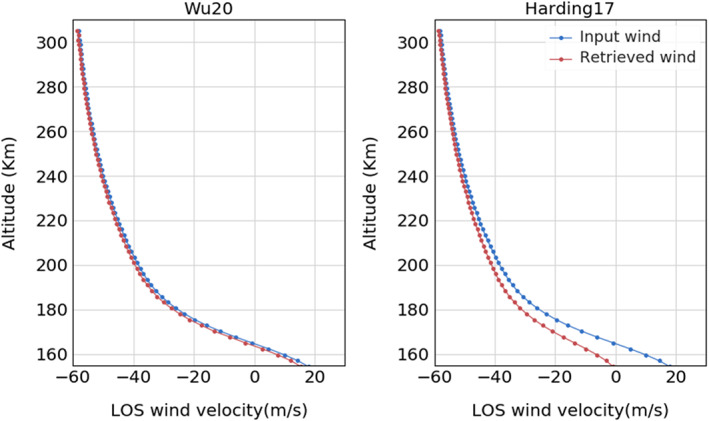
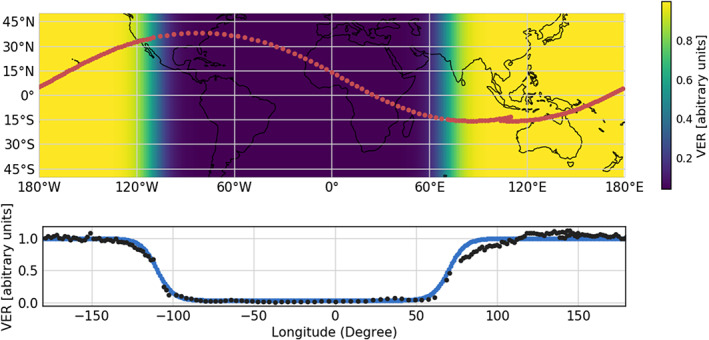
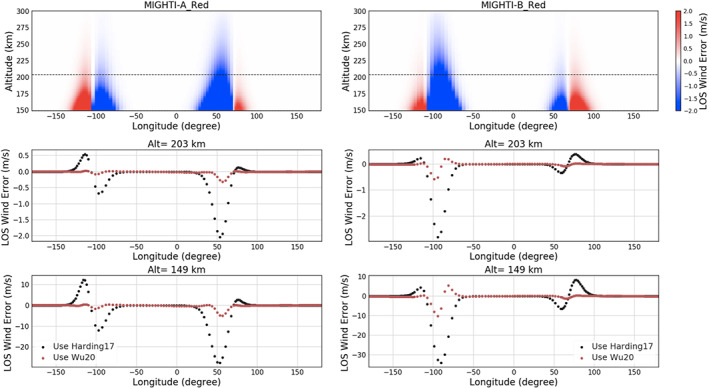
The Michelson Interferometer for Global High-resolution Thermospheric Imaging (MIGHTI) on NASA's Ionospheric Connection Explorer (ICON) mission is designed to measure the neutral wind and temperature between 90 and ∼300 km altitude. Using the Doppler Asymmetric Spatial Heterodyne (DASH) spectroscopy technique, observations from MIGHTI can be used to derive thermospheric winds by measuring Doppler shifts of the atomic oxygen red line (630.0 nm) and green line (557.7 nm). Harding et al. (2017, https://doi.org/10.1007/s11214-017-0359-3) (Harding17) describe the wind retrieval algorithm in detail and point out the large uncertainties that result near the solar terminators and equatorial arcs, regions of large spatial gradients in airglow volume emission rates (VER). The uncertainties originate from the assumption of a constant VER at every given altitude, resulting in errors where the assumption is not valid when limb sounders, such as MIGHTI, observe regions with significant VER gradients. In this work, we introduce a new wind retrieval algorithm (Wu20) with the ability to account for VER that is asymmetric along the line of sight with respect to the tangent point. Using the predicted ICON orbit and simulated global VER variation, the greatest impact of the symmetric airglow assumption to the ICON vector wind product is found within 30° from the terminator when the spacecraft is in the dayside, causing an error of at least 10 m/s. The new algorithm developed in this study reduces the error near the terminator by a factor of 10. Although Wu20 improves the accuracy of the retrievals, it loses precision by 75% compared to Harding17.
美国国家航空航天局(NASA)电离层连接探测器(ICON)任务搭载的用于全球高分辨率热层成像的迈克尔逊干涉仪(MIGHTI),旨在测量90至约300千米高度之间的中性风及温度。利用多普勒非对称空间外差(DASH)光谱技术,MIGHTI的观测数据可通过测量原子氧红线(630.0纳米)和绿线(557.7纳米)的多普勒频移来推导热层风。哈丁等人(2017年,https://doi.org/10.1007/s11214-017-0359-3)(哈丁17)详细描述了风场反演算法,并指出在太阳边缘和赤道弧附近会产生较大不确定性,这些区域的气辉体发射率(VER)存在较大空间梯度。这些不确定性源于在每个给定高度假设VER恒定,当像MIGHTI这样的临边探测器观测VER梯度显著的区域时,该假设不成立就会导致误差。在这项工作中,我们引入了一种新的风场反演算法(吴20),该算法能够考虑视线方向相对于切点不对称的VER。利用预测的ICON轨道和模拟的全球VER变化,发现当航天器处于昼侧时,对称气辉假设对ICON矢量风产品的最大影响出现在距离边缘30°范围内,导致至少10米/秒的误差。本研究开发的新算法将边缘附近的误差降低了10倍。尽管吴20提高了反演的准确性,但与哈丁17相比,精度降低了75%。