• 文献检索
  • 文档翻译
  • 深度研究
  • 学术资讯
  • Suppr Zotero 插件Zotero 插件
  • 邀请有礼
  • 套餐&价格
  • 历史记录
应用&插件
Suppr Zotero 插件Zotero 插件浏览器插件Mac 客户端Windows 客户端微信小程序
定价
高级版会员购买积分包购买API积分包
服务
文献检索文档翻译深度研究API 文档MCP 服务
关于我们
关于 Suppr公司介绍联系我们用户协议隐私条款
关注我们

Suppr 超能文献

核心技术专利:CN118964589B侵权必究
粤ICP备2023148730 号-1Suppr @ 2026

文献检索

告别复杂PubMed语法,用中文像聊天一样搜索,搜遍4000万医学文献。AI智能推荐,让科研检索更轻松。

立即免费搜索

文件翻译

保留排版,准确专业,支持PDF/Word/PPT等文件格式,支持 12+语言互译。

免费翻译文档

深度研究

AI帮你快速写综述,25分钟生成高质量综述,智能提取关键信息,辅助科研写作。

立即免费体验

儿童阑尾炎管理的标准化方案可减少资源利用。

A Standardized Protocol for the Management of Appendicitis in Children Reduces Resource Utilization.

作者信息

Pennell Christopher, Meckmongkol Teerin, Arthur L Grier, Ciullo Sean, Prasad Rajeev, Lindholm Erika, Grewal Harsh

机构信息

St. Christopher's Hospital for Children, Department of Pediatric General, Thoracic, and Minimally Invasive Pediatric Surgery, Philadelphia, Pa.

Department of Surgery, Drexel University College of Medicine, Philadelphia, Pa.

出版信息

Pediatr Qual Saf. 2020 Oct 26;5(6):e357. doi: 10.1097/pq9.0000000000000357. eCollection 2020 Nov-Dec.

DOI:10.1097/pq9.0000000000000357
PMID:33134759
原文链接:https://pmc.ncbi.nlm.nih.gov/articles/PMC7591119/
Abstract

UNLABELLED

Appendicitis is the most common condition requiring emergency surgery in children. We implemented a standardized protocol (SP) for treating children with appendicitis to provide more uniform care and reduce resource utilization.

METHODS

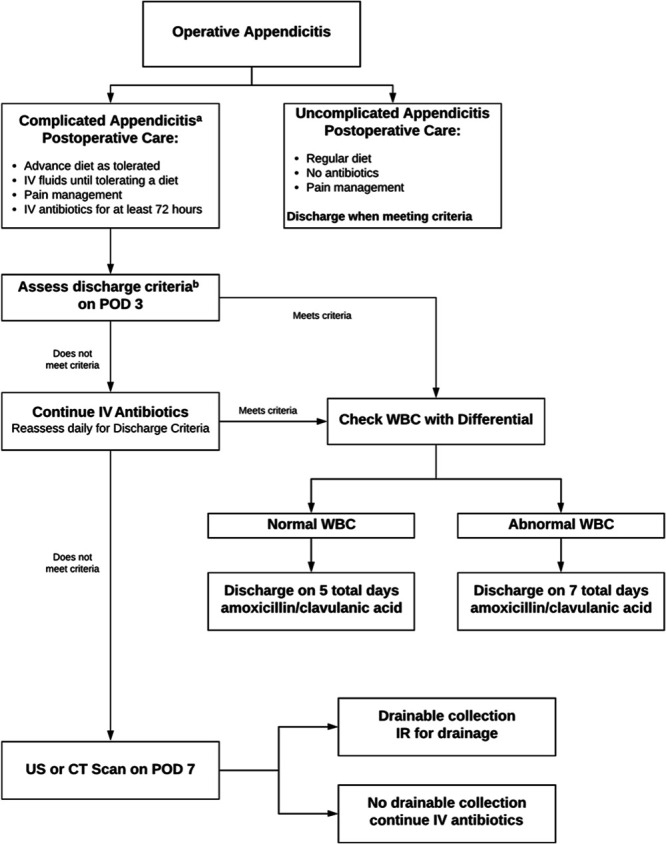
All patients younger than 21 years were managed with the SP beginning in January 2017. We compared data from 22 months before and after implementation. The primary outcomes included the length of stay (LOS), antibiotic days, discharge on intravenous antibiotics, utilization of peripherally inserted central catheters lines, and postoperative imaging. Secondary outcomes were protocol adherence and the rates adverse events, including postoperative abscess, return to emergency department or operating room, surgical site infection, and readmission.

RESULTS

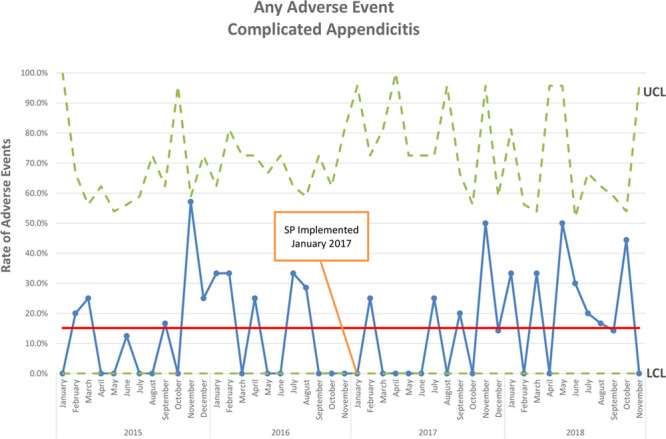
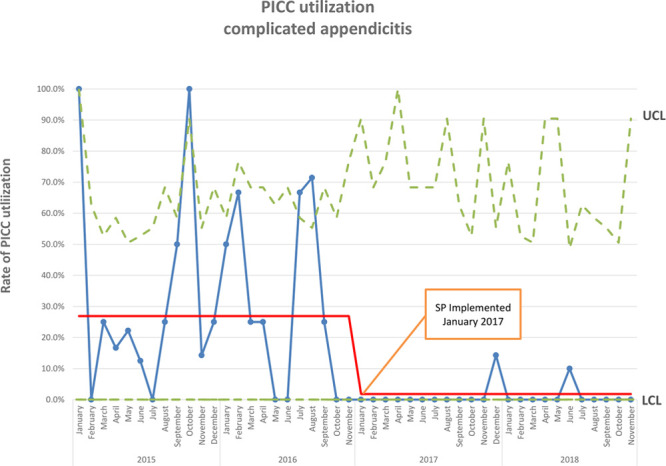
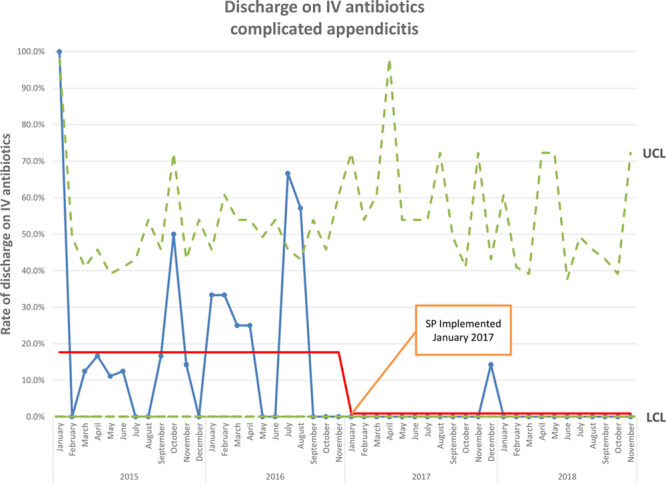
Protocol adherence was 92.3%. For uncomplicated cases (n = 412), LOS ( = 0.010) and postoperative antibiotic days ( < 0.001) were significantly reduced. There was no difference in the rates of any adverse event (6.7% versus 2.7%; = 0.058), postoperative abscess (0.4% versus 0.0%; = 0.544), return to emergency department (6.3% versus 2.7%; = 0.084), readmission (1.8% versus 0.5%; = 0.245), or postoperative ultrasound (0.4% versus 0.5%; = 0.705) and computed tomography (0.0% versus 0.5%; = 0.456). For complicated cases (n = 229), the post-SP cohort had a shorter LOS ( = 0.015), fewer peripherally inserted central catheters lines (26.9% versus 2.7%; < 0.001), fewer postoperative ultrasounds (8.4% versus 1.8%; = 0.027), and fewer discharges on intravenous antibiotics (17.6% versus 0.9%; < 0.001). There were no differences in adverse events before and after the SP (16.0% versus 18.3%; = 0.633).

CONCLUSION

Implementing an SP for appendicitis in children reduced resource utilization, and by inference healthcare costs, for both uncomplicated and complicated cases without adversely affecting clinical outcomes.

摘要

未标注

阑尾炎是儿童最常见的需要急诊手术的疾病。我们实施了一项治疗儿童阑尾炎的标准化方案(SP),以提供更统一的护理并减少资源利用。

方法

自2017年1月起,所有21岁以下的患者均采用SP进行管理。我们比较了实施前后22个月的数据。主要结局包括住院时间(LOS)、抗生素使用天数、静脉使用抗生素出院情况、外周静脉穿刺中心静脉导管的使用情况以及术后影像学检查。次要结局是方案依从性和不良事件发生率,包括术后脓肿、返回急诊科或手术室、手术部位感染和再次入院。

结果

方案依从率为92.3%。对于非复杂病例(n = 412),住院时间( = 0.010)和术后抗生素使用天数( < 0.001)显著缩短。任何不良事件发生率(6.7%对2.7%; = 0.058)、术后脓肿发生率(0.4%对0.0%; = 0.544)、返回急诊科发生率(6.3%对2.7%; = 0.084)、再次入院发生率(1.8%对0.5%; = 0.245)、术后超声检查发生率(0.4%对0.5%; = 0.705)和计算机断层扫描发生率(0.0%对0.5%; = 0.456)均无差异。对于复杂病例(n = 229),SP实施后队列的住院时间更短( = 0.015),外周静脉穿刺中心静脉导管使用更少(26.9%对2.7%; < 0.001),术后超声检查更少(8.4%对1.8%; = 0.027),静脉使用抗生素出院更少(从17.6%降至0.9%; < 0.001)。SP实施前后不良事件发生率无差异(16.0%对18.3%; = 0.633)。

结论

在儿童阑尾炎治疗中实施SP可降低非复杂和复杂病例的资源利用,进而推断可降低医疗成本,且不会对临床结局产生不利影响。
https://cdn.ncbi.nlm.nih.gov/pmc/blobs/bff6/7591119/a13245652e6a/pqs-5-e357-g004.jpg
https://cdn.ncbi.nlm.nih.gov/pmc/blobs/bff6/7591119/b89d40488a6c/pqs-5-e357-g001.jpg
https://cdn.ncbi.nlm.nih.gov/pmc/blobs/bff6/7591119/b991a9e2b90d/pqs-5-e357-g002.jpg
https://cdn.ncbi.nlm.nih.gov/pmc/blobs/bff6/7591119/0f1dfb7f7619/pqs-5-e357-g003.jpg
https://cdn.ncbi.nlm.nih.gov/pmc/blobs/bff6/7591119/a13245652e6a/pqs-5-e357-g004.jpg
https://cdn.ncbi.nlm.nih.gov/pmc/blobs/bff6/7591119/b89d40488a6c/pqs-5-e357-g001.jpg
https://cdn.ncbi.nlm.nih.gov/pmc/blobs/bff6/7591119/b991a9e2b90d/pqs-5-e357-g002.jpg
https://cdn.ncbi.nlm.nih.gov/pmc/blobs/bff6/7591119/0f1dfb7f7619/pqs-5-e357-g003.jpg
https://cdn.ncbi.nlm.nih.gov/pmc/blobs/bff6/7591119/a13245652e6a/pqs-5-e357-g004.jpg

相似文献

1
A Standardized Protocol for the Management of Appendicitis in Children Reduces Resource Utilization.儿童阑尾炎管理的标准化方案可减少资源利用。
Pediatr Qual Saf. 2020 Oct 26;5(6):e357. doi: 10.1097/pq9.0000000000000357. eCollection 2020 Nov-Dec.
2
A Standardized Protocol for Nonoperative Management of Complicated Appendicitis in Children Reduces Resource Utilization.儿童复杂性阑尾炎非手术治疗的标准化方案可减少资源利用。
Eur J Pediatr Surg. 2021 Feb;31(1):14-19. doi: 10.1055/s-0040-1715439. Epub 2020 Aug 23.
3
Intravenous Versus Oral Antibiotics for the Prevention of Treatment Failure in Children With Complicated Appendicitis: Has the Abandonment of Peripherally Inserted Catheters Been Justified?静脉用与口服抗生素用于预防复杂性阑尾炎患儿治疗失败:是否有理由放弃外周静脉置入中心静脉导管?
Ann Surg. 2017 Aug;266(2):361-368. doi: 10.1097/SLA.0000000000001923.
4
Reducing resource utilization for patients with uncomplicated appendicitis through use of same-day discharge and elimination of postoperative antibiotics.通过实施当日出院和取消术后抗生素,减少单纯性阑尾炎患者的资源利用。
J Pediatr Surg. 2020 Dec;55(12):2591-2595. doi: 10.1016/j.jpedsurg.2020.04.003. Epub 2020 Apr 17.
5
Effect of a Clinical Practice Guideline for Pediatric Complicated Appendicitis.儿童复杂性阑尾炎临床实践指南的效果
JAMA Surg. 2016 May 18;151(5):e160194. doi: 10.1001/jamasurg.2016.0194.
6
Implementation of an evidence-based protocol after appendectomy reduces unnecessary antibiotics.实施阑尾切除术后的基于证据的方案可减少不必要的抗生素使用。
J Pediatr Surg. 2020 Nov;55(11):2379-2386. doi: 10.1016/j.jpedsurg.2020.07.001. Epub 2020 Jul 9.
7
Impact of implementing a fast-track protocol and standardized guideline for the management of pediatric appendicitis.实施小儿阑尾炎快速通道方案和标准化指南管理的影响。
Can J Surg. 2021 Jul 5;64(4):E364-E370. doi: 10.1503/cjs.005420.
8
Two versus five days of antibiotics after appendectomy for complex acute appendicitis (APPIC): study protocol for a randomized controlled trial.复杂急性阑尾炎阑尾切除术后使用抗生素2天与5天的疗效比较(APPIC):一项随机对照试验的研究方案
Trials. 2018 May 2;19(1):263. doi: 10.1186/s13063-018-2629-0.
9
Duration of postoperative intravenous antibiotics in childhood complicated appendicitis: a propensity score-matched comparison study.儿童复杂性阑尾炎术后静脉使用抗生素的持续时间:一项倾向评分匹配的比较研究。
Eur J Pediatr Surg. 2014 Aug;24(4):341-9. doi: 10.1055/s-0033-1349055. Epub 2013 Jun 25.
10
Optimal Timing of Postoperative Imaging for Complicated Appendicitis.复杂阑尾炎术后影像学检查的最佳时机
J Laparoendosc Adv Surg Tech A. 2018 Oct;28(10):1248-1252. doi: 10.1089/lap.2018.0121. Epub 2018 Jun 5.

引用本文的文献

1
Using NSQIP to improve perforated appendicitis protocol and better resource allocation.利用美国国立外科质量改进计划(NSQIP)改进穿孔性阑尾炎治疗方案并优化资源配置。
Surg Pract Sci. 2022 Mar 26;9:100074. doi: 10.1016/j.sipas.2022.100074. eCollection 2022 Jun.
2
Clinical management and complications of acute appendicitis in 3 children with SARS-CoV-2 infection: Case report.3 例 SARS-CoV-2 感染儿童急性阑尾炎的临床处理及并发症:病例报告。
Medicine (Baltimore). 2024 Oct 25;103(43):e40105. doi: 10.1097/MD.0000000000040105.
3
Reducing Post-Operative Hospital Length of Stay following Uncomplicated Appendectomy in Pediatric Patients: A Prospective Clinical Study.

本文引用的文献

1
Gangrenous appendicitis: No longer complicated.坏疽性阑尾炎:不再复杂。
J Pediatr Surg. 2019 Apr;54(4):718-722. doi: 10.1016/j.jpedsurg.2018.10.064. Epub 2018 Nov 6.
2
Prospective evaluation of a clinical response directed pathway for complicated appendicitis.针对复杂性阑尾炎的临床反应导向路径的前瞻性评估。
J Pediatr Surg. 2019 Feb;54(2):272-275. doi: 10.1016/j.jpedsurg.2018.10.082. Epub 2018 Nov 7.
3
A primer on PDSA: executing plan-do-study-act cycles in practice, not just in name.PDSA入门:在实践中执行计划-执行-研究-行动循环,而不仅仅是在名义上。
降低小儿患者单纯性阑尾切除术后的住院时间:一项前瞻性临床研究
Healthcare (Basel). 2024 Feb 14;12(4):474. doi: 10.3390/healthcare12040474.
4
Association between bacterial resistance profile and the development of intra-abdominal abscesses in pediatric patients with perforated appendicitis: cohort study.阑尾穿孔患儿细菌耐药谱与腹腔脓肿发生的相关性:队列研究。
Pediatr Surg Int. 2023 Dec 11;40(1):18. doi: 10.1007/s00383-023-05570-3.
5
Value Added from Same-day Discharge after Appendectomy for Children with Simple Appendicitis.单纯性阑尾炎患儿阑尾切除术后当日出院的附加值
Pediatr Qual Saf. 2023 Jan 16;8(1):e629. doi: 10.1097/pq9.0000000000000629. eCollection 2023 Jan-Feb.
BMJ Qual Saf. 2017 Jul;26(7):572-577. doi: 10.1136/bmjqs-2016-006245. Epub 2016 Dec 16.
4
Extended- Versus Narrower-Spectrum Antibiotics for Appendicitis.阑尾炎的广谱抗生素与窄谱抗生素比较。
Pediatrics. 2016 Jul;138(1). doi: 10.1542/peds.2015-4547.
5
Effect of a Clinical Practice Guideline for Pediatric Complicated Appendicitis.儿童复杂性阑尾炎临床实践指南的效果
JAMA Surg. 2016 May 18;151(5):e160194. doi: 10.1001/jamasurg.2016.0194.
6
Standardization and improvement of care for pediatric patients with perforated appendicitis.小儿穿孔性阑尾炎护理的标准化与改进
J Pediatr Surg. 2014 Jun;49(6):1020-4; discussion 1024-5. doi: 10.1016/j.jpedsurg.2014.01.045. Epub 2014 Feb 3.
7
Prioritization of comparative effectiveness research topics in hospital pediatrics.医院儿科比较效果研究主题的优先排序
Arch Pediatr Adolesc Med. 2012 Dec;166(12):1155-64. doi: 10.1001/archpediatrics.2012.1266.
8
A complete course of intravenous antibiotics vs a combination of intravenous and oral antibiotics for perforated appendicitis in children: a prospective, randomized trial.儿童穿孔性阑尾炎行静脉用抗生素全程治疗与静脉用和口服抗生素联合治疗的前瞻性随机试验。
J Pediatr Surg. 2010 Jun;45(6):1198-202. doi: 10.1016/j.jpedsurg.2010.02.090.
9
An evidence-based definition for perforated appendicitis derived from a prospective randomized trial.一项基于前瞻性随机试验得出的穿孔性阑尾炎的循证定义。
J Pediatr Surg. 2008 Dec;43(12):2242-5. doi: 10.1016/j.jpedsurg.2008.08.051.
10
Single daily dosing ceftriaxone and metronidazole vs standard triple antibiotic regimen for perforated appendicitis in children: a prospective randomized trial.儿童穿孔性阑尾炎每日单次剂量头孢曲松和甲硝唑与标准三联抗生素方案的比较:一项前瞻性随机试验
J Pediatr Surg. 2008 Jun;43(6):981-5. doi: 10.1016/j.jpedsurg.2008.02.018.