Fernández-Barrena Maite G, Arechederra María, Colyn Leticia, Berasain Carmen, Avila Matias A
Hepatology Program CIMA, University of Navarra, Pamplona, Spain.
National Institute for the Study of Liver and Gastrointestinal Diseases (CIBERehd, Carlos III Health Institute), Madrid, Spain.
JHEP Rep. 2020 Aug 7;2(6):100167. doi: 10.1016/j.jhepr.2020.100167. eCollection 2020 Dec.
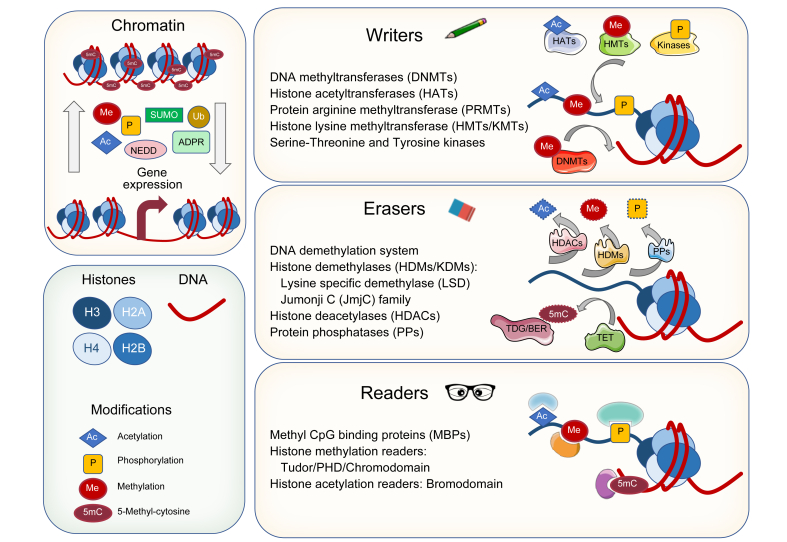
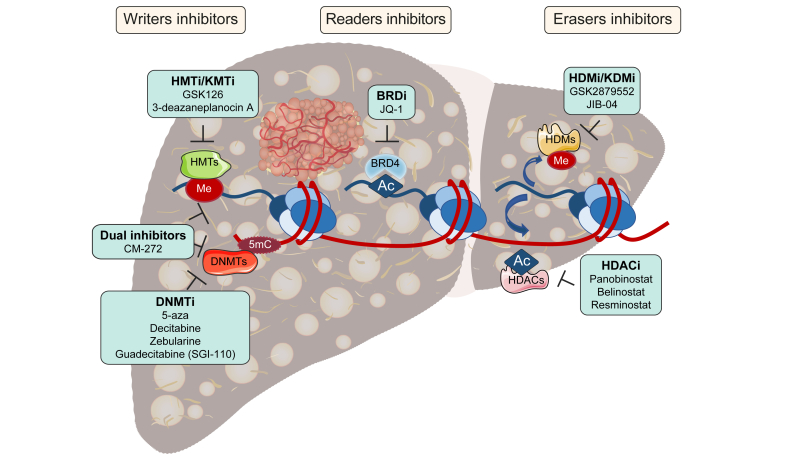
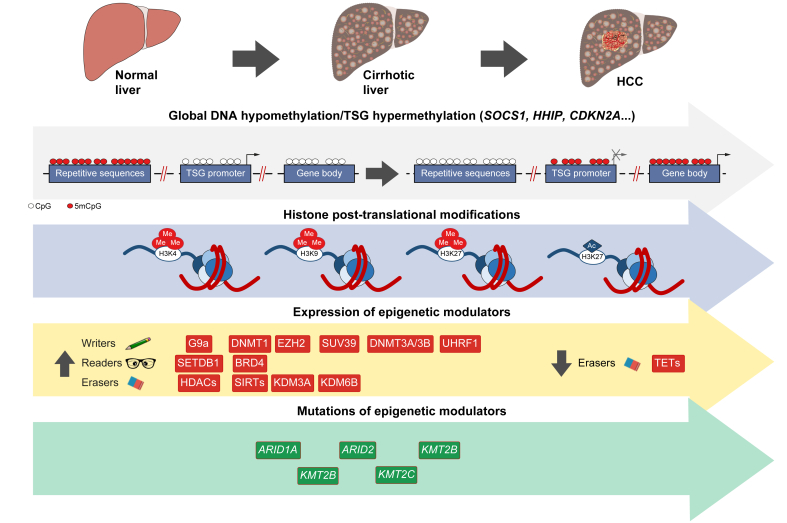
Hepatocellular carcinoma (HCC) is a deadly tumour whose causative agents are generally well known, but whose pathogenesis remains poorly understood. Nevertheless, key genetic alterations are emerging from a heterogeneous molecular landscape, providing information on the tumorigenic process from initiation to progression. Among these molecular alterations, those that affect epigenetic processes are increasingly recognised as contributing to carcinogenesis from preneoplastic stages. The epigenetic machinery regulates gene expression through intertwined and partially characterised circuits involving chromatin remodelers, covalent DNA and histone modifications, and dedicated proteins reading these modifications. In this review, we summarise recent findings on HCC epigenetics, focusing mainly on changes in DNA and histone modifications and their carcinogenic implications. We also discuss the potential drugs that target epigenetic mechanisms for HCC treatment, either alone or in combination with current therapies, including immunotherapies.
肝细胞癌(HCC)是一种致命的肿瘤,其致病因素通常广为人知,但其发病机制仍知之甚少。然而,关键的基因改变正从异质性分子格局中显现出来,为从肿瘤发生起始到进展的致瘤过程提供了信息。在这些分子改变中,那些影响表观遗传过程的改变越来越被认为在肿瘤发生的癌前阶段就发挥了作用。表观遗传机制通过涉及染色质重塑因子、DNA和组蛋白共价修饰以及解读这些修饰的特定蛋白质的相互交织且部分特征明确的回路来调节基因表达。在本综述中,我们总结了肝细胞癌表观遗传学的最新研究发现,主要关注DNA和组蛋白修饰的变化及其致癌意义。我们还讨论了单独或与包括免疫疗法在内的现有疗法联合用于肝细胞癌治疗的靶向表观遗传机制的潜在药物。