Demyelinating Diseases Unit, 1st Department of Neurology, School of Medicine, Eginition Hospital, National and Kapodistrian University of Athens, Athens, Greece.
Research Unit of Radiology - 2nd Department of Radiology, National and Kapodistrian University of Athens, Athens, Greece.
BMC Neurol. 2020 Nov 2;20(1):400. doi: 10.1186/s12883-020-01971-2.
Baló's Concentric Sclerosis (BCS) is a rare heterogeneous demyelinating disease with a variety of phenotypes on Magnetic Resonance Imaging (MRI). Existing literature lacks data especially on the therapeutic approach of the disease which we intended to elucidate by means of suggesting a new possible BCS classification and introducing different therapeutic concepts based on each BCS-subgroup characteristics.
We present a retrospective study of eight treated patients with BCS-type lesions, emphasizing on MRI characteristics and differences on therapeutic maneuvers.
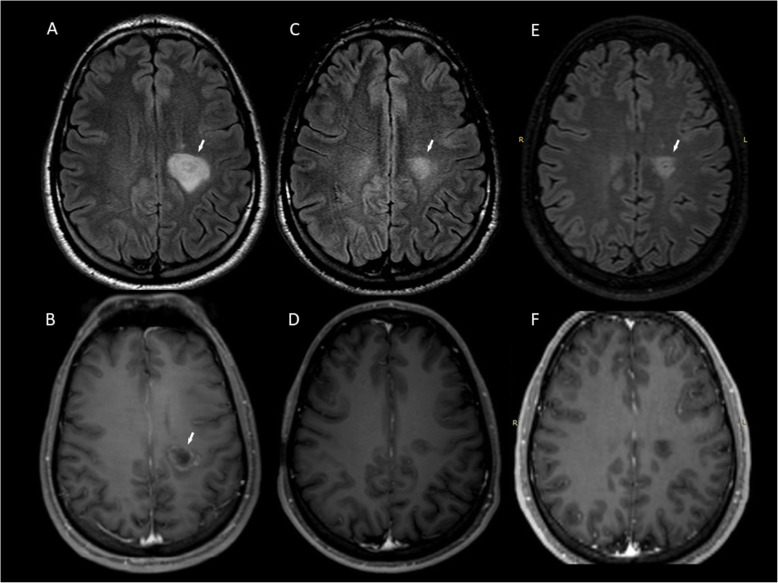
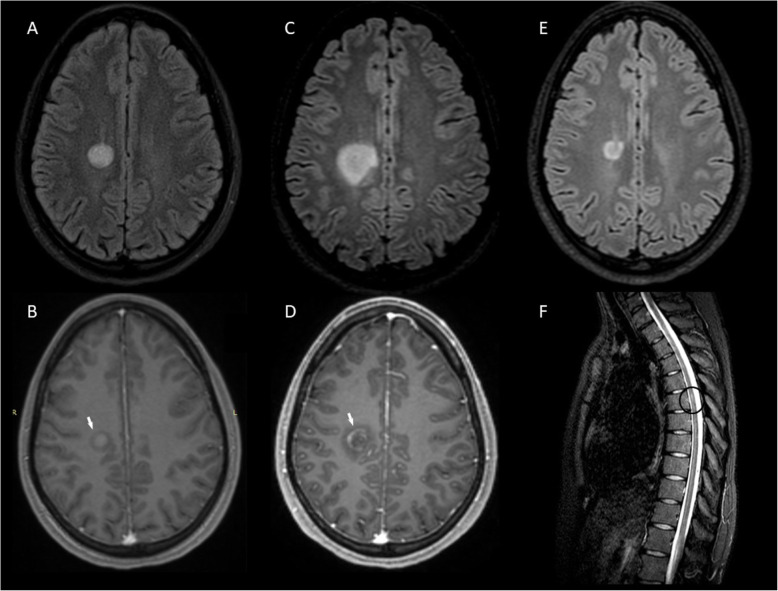
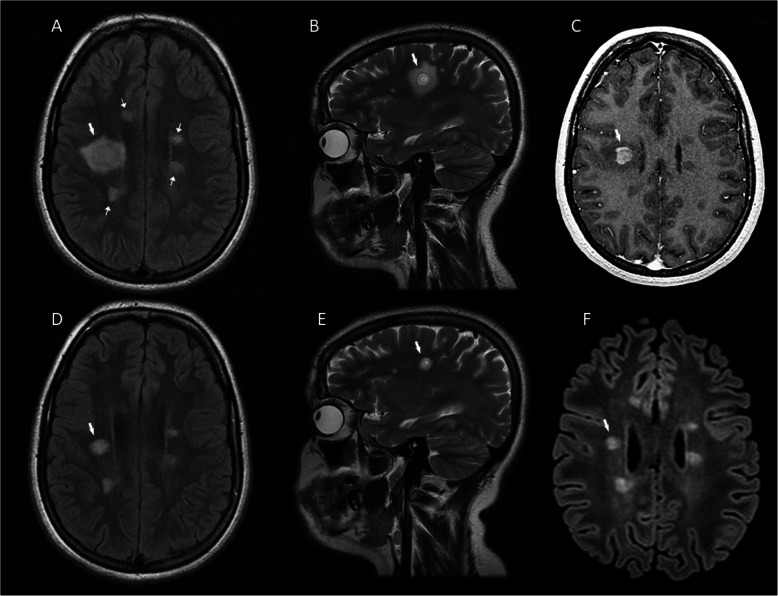
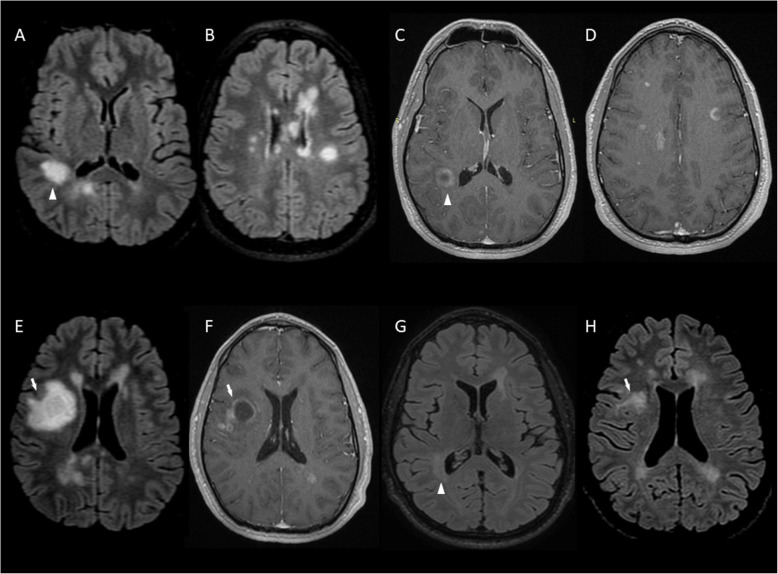
Data analysis showed: at disease onset the BCS-type lesion was tumefactive (size ≥2 cm) in 6 patients, with a mean size of 2.7 cm (± 0.80 SD); a coexistence of MS-like plaques on brain MRI was identified in 7 patients of our cohort. The mean age was 26.3 years (±7.3 SD) at disease onset and the mean follow-up period was 56.8 months (range 9-132 months). According to radiological characteristics and response to therapies, we further categorized them into 3 subgroups: a) Group-1; BCS with or without coexisting nonspecific white matter lesions; poor response to intravenous methylprednisolone (IVMP); treated with high doses of immunosuppressive agents (4 patients), b) Group-2; BCS with typical MS lesions; good response to IVMP; treated with MS-disease modifying therapies (2 patients), c) Group-3; BCS with typical MS lesions; poor response to IVMP; treated with rituximab (2 patients).
Our study introduces a new insight regarding the categorization of BCS into three subgroups depending on radiological features at onset and during the course of the disease, in combination with the response to different immunotherapies. Immunosuppressive agents such as cyclophosphamide are usually effective in BCS. However, therapeutic alternatives like anti-CD20 monoclonal antibodies or more classical disease-modifying MS therapies can be considered when BCS has also mixed lesions similar to MS. Future studies with a larger sample size are necessary to further establish these findings, thus leading to better treatment algorithms and improved clinical outcomes.
巴洛氏同心性硬化症(BCS)是一种罕见的异质性脱髓鞘疾病,在磁共振成像(MRI)上具有多种表型。现有文献缺乏关于该病治疗方法的资料,我们旨在通过提出一种新的可能的 BCS 分类,并根据每个 BCS 亚组的特征引入不同的治疗概念来阐明这一点。
我们对 8 例接受 BCS 型病变治疗的患者进行了回顾性研究,重点介绍了 MRI 特征和治疗方法的差异。
数据分析显示:在疾病发作时,6 例患者的 BCS 型病变为肿块样(大小≥2cm),平均大小为 2.7cm(±0.80 SD);我们队列中的 7 例患者脑 MRI 上存在类似 MS 的斑块共存。发病时的平均年龄为 26.3 岁(±7.3 SD),平均随访时间为 56.8 个月(9-132 个月)。根据影像学特征和治疗反应,我们进一步将其分为 3 个亚组:a)组 1;BCS 伴或不伴非特异性脑白质病变;静脉注射甲基强的松龙(IVMP)反应不佳;用高剂量免疫抑制剂治疗(4 例),b)组 2;BCS 伴典型 MS 病变;IVMP 反应良好;用 MS 疾病修正治疗(2 例),c)组 3;BCS 伴典型 MS 病变;IVMP 反应不佳;用利妥昔单抗治疗(2 例)。
我们的研究根据疾病发作时和病程中的影像学特征以及对不同免疫治疗的反应,将 BCS 分为 3 个亚组,这是一个新的认识。环磷酰胺等免疫抑制剂通常对 BCS 有效。然而,当 BCS 还伴有类似于 MS 的混合病变时,可以考虑使用抗 CD20 单克隆抗体或更经典的疾病修正 MS 治疗。未来需要更大样本量的研究进一步确定这些发现,从而制定更好的治疗方案,改善临床结局。