Department of Crystallography, Max Delbrück Center for Molecular Medicine, 13125, Berlin, Germany.
Institute of Chemistry and Biochemistry, Freie Universität Berlin, 14195, Berlin, Germany.
Nat Commun. 2020 Nov 2;11(1):5506. doi: 10.1038/s41467-020-19321-8.
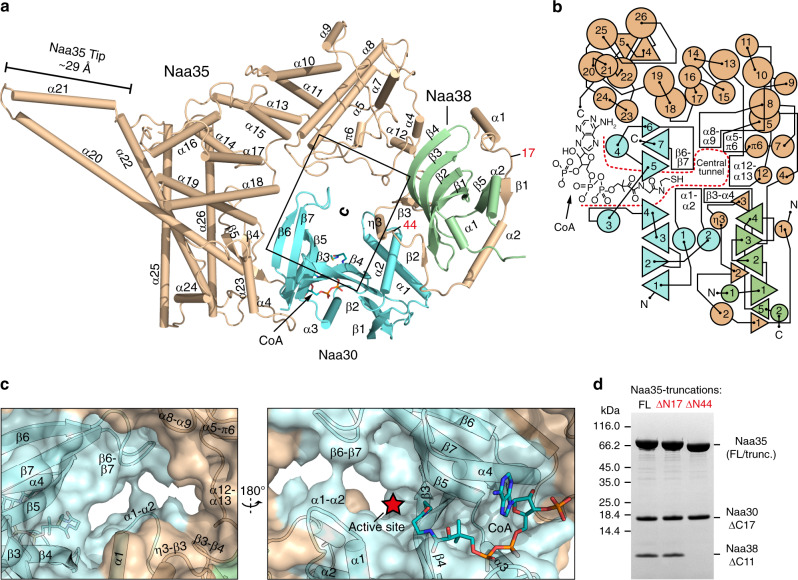
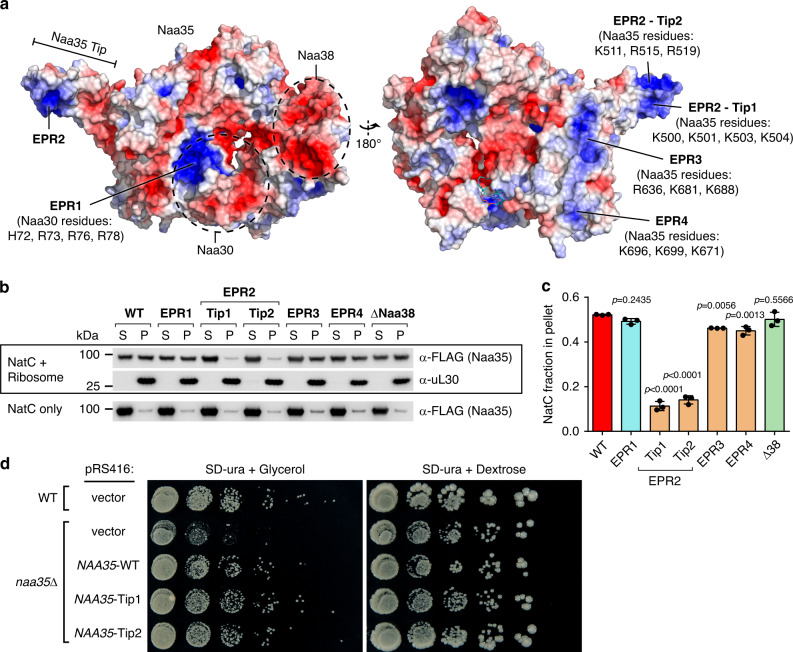
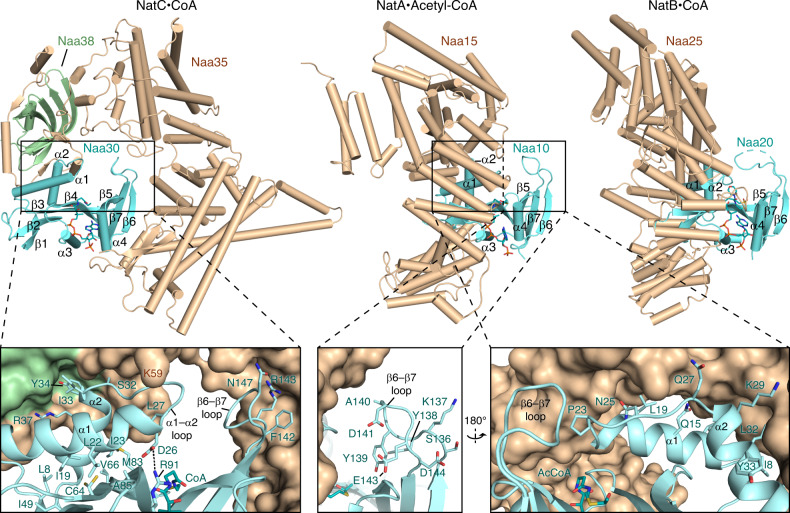
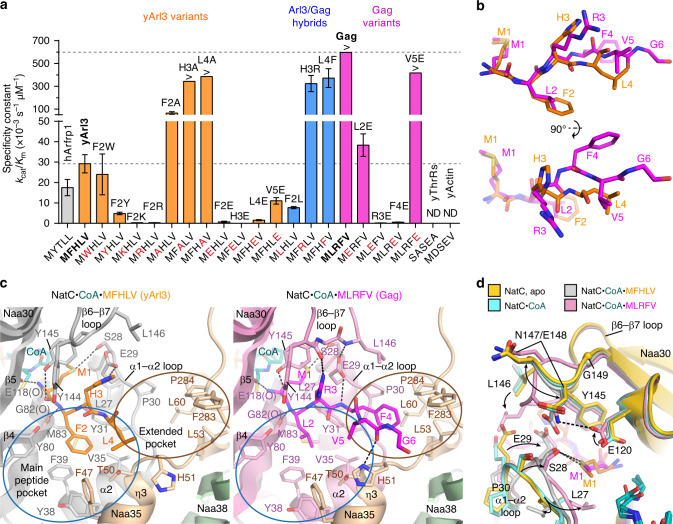
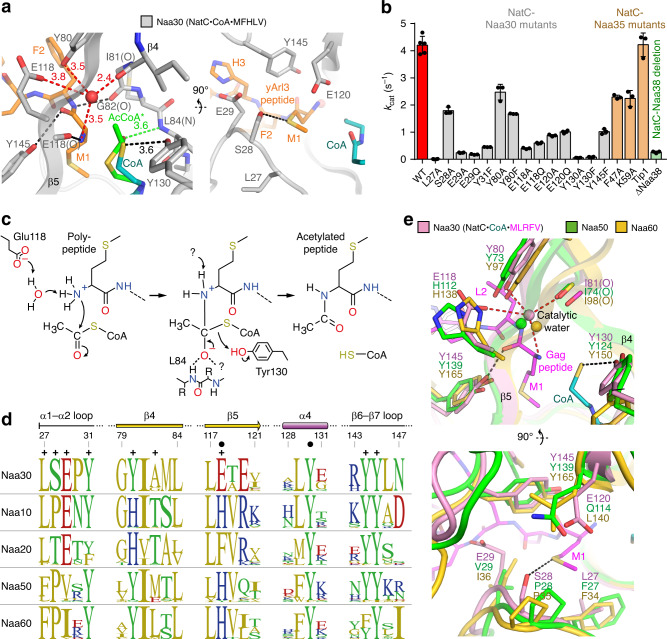
The heterotrimeric NatC complex, comprising the catalytic Naa30 and the two auxiliary subunits Naa35 and Naa38, co-translationally acetylates the N-termini of numerous eukaryotic target proteins. Despite its unique subunit composition, its essential role for many aspects of cellular function and its suggested involvement in disease, structure and mechanism of NatC have remained unknown. Here, we present the crystal structure of the Saccharomyces cerevisiae NatC complex, which exhibits a strikingly different architecture compared to previously described N-terminal acetyltransferase (NAT) complexes. Cofactor and ligand-bound structures reveal how the first four amino acids of cognate substrates are recognized at the Naa30-Naa35 interface. A sequence-specific, ligand-induced conformational change in Naa30 enables efficient acetylation. Based on detailed structure-function studies, we suggest a catalytic mechanism and identify a ribosome-binding patch in an elongated tip region of NatC. Our study reveals how NAT machineries have divergently evolved to N-terminally acetylate specific subsets of target proteins.
三聚体 NatC 复合物由催化亚基 Naa30 和两个辅助亚基 Naa35 和 Naa38 组成,可共翻译乙酰化许多真核靶蛋白的 N 末端。尽管其具有独特的亚基组成,但它对细胞功能的许多方面都具有重要作用,并且被认为与疾病有关,但其结构和机制仍然未知。在这里,我们展示了酿酒酵母 NatC 复合物的晶体结构,与之前描述的 N 端乙酰转移酶 (NAT) 复合物相比,其结构具有惊人的不同。辅因子和配体结合结构揭示了同源底物的前四个氨基酸如何在 Naa30-Naa35 界面处被识别。Naa30 中序列特异性的配体诱导构象变化可实现有效的乙酰化。基于详细的结构-功能研究,我们提出了一种催化机制,并在 NatC 的伸长尖端区域中鉴定了一个核糖体结合斑。我们的研究揭示了 NAT 机器如何进化出不同的机制来 N 端乙酰化特定的靶蛋白亚群。