Department of Psychiatry, Psychosomatic Medicine and Psychotherapy, University Hospital, Goethe University Frankfurt am Main, Frankfurt, Germany.
Psychopharmacology (Berl). 2021 May;238(5):1333-1342. doi: 10.1007/s00213-020-05693-8. Epub 2020 Nov 2.
Dysregulation of dopaminergic neurotransmission, specifically altered reward processing assessed via the reward anticipation in the MID task, plays a central role in the etiopathogenesis of neuropsychiatric disorders.
We hypothesized to find a difference in the activity level of the reward system (measured by the proxy reward anticipation) under drug administration versus placebo, in that amisulpride reduces, and L-DOPA enhances, its activity.
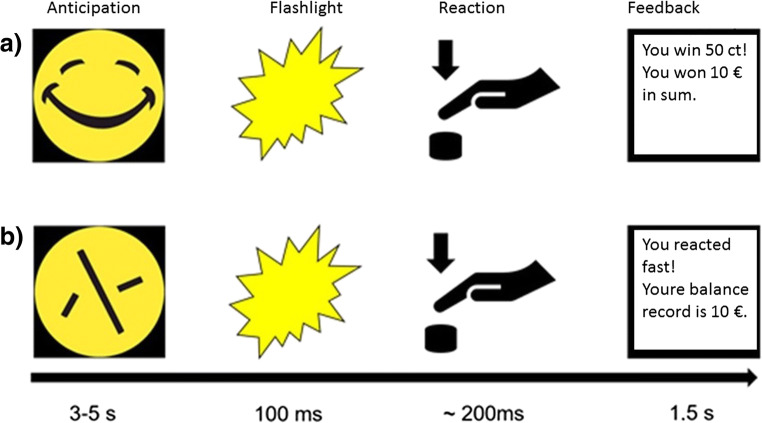
We studied the influence of dopamine agonist L-DOPA and the antagonist amisulpride on the reward system using functional magnetic resonance imaging (fMRI) during a monetary incentive delay (MID) task in n = 45 healthy volunteers in a randomized, blinded, cross-over study.
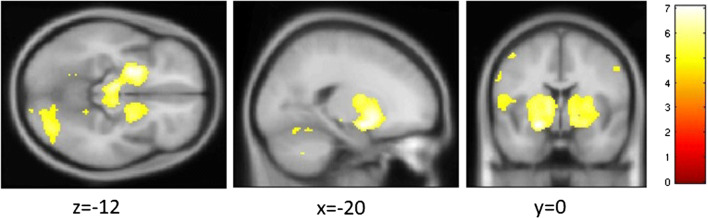
The MID paradigm elicits strong activation in reward-dependent structures (such as ventral striatum, putamen, caudate, anterior insula) during reward anticipation. The placebo effect demonstrated the expected significant blood oxygen level-dependent activity in reward-dependent brain regions. Neither amisulpride nor L-DOPA led to significant changes in comparison with the placebo condition. This was true for whole-brain analysis as well as analysis of a pre-defined nucleus accumbens region-of-interest mask.
The present results cast doubt on the sensitivity of reward anticipation contrast in the MID task for assessing dopamine-specific changes in healthy volunteers by pharmaco-fMRI. While our task was not well-suited for detailed analysis of the outcome phase, we provide reasonable arguments that the lack of effect in the anticipation phase is not due to an inefficient task but points to unexpected behavior of the reward system during pharmacological challenge. Group differences of reward anticipation should therefore not be seen as simple representatives of dopaminergic states.
多巴胺能神经传递的失调,特别是通过 MID 任务中的奖励预期来评估的奖励加工的改变,在神经精神疾病的病因发病机制中起着核心作用。
我们假设在药物给药与安慰剂相比时,奖励系统的活动水平(通过代理奖励预期来衡量)会有所不同,即安非他命降低,L-DOPA 增强其活性。
我们使用功能磁共振成像(fMRI)在一项随机、双盲、交叉研究中研究了多巴胺激动剂 L-DOPA 和拮抗剂安非他命对 45 名健康志愿者奖励系统的影响,在货币奖励延迟(MID)任务中。
MID 范式在奖励预期期间在奖励相关结构(如腹侧纹状体、壳核、尾状核、前岛叶)中产生强烈的激活。安慰剂效应显示了预期的奖励相关大脑区域的血氧水平依赖活性的显著变化。与安慰剂条件相比,安非他命或 L-DOPA 均未导致显著变化。这对于全脑分析以及预先定义的伏隔核感兴趣区掩模的分析都是如此。
目前的结果对通过药物 fMRI 评估健康志愿者中多巴胺特异性变化的 MID 任务中奖励预期对比的敏感性提出了质疑。虽然我们的任务不适合详细分析结果阶段,但我们提供了合理的论据,表明在预期阶段缺乏效果不是由于任务效率低下,而是指向药理学挑战期间奖励系统的意外行为。因此,奖励预期的组间差异不应被视为多巴胺状态的简单代表。