Mkrtchian Anahit, Qiu Zeguo, Abir Yaniv, Erdmann Tore, Dercon Quentin, Sedlinska Terezie, Browning Michael, Costello Harry, Huys Quentin J M
Applied Computational Psychiatry Lab, Mental Health Neuroscience Department, Division of Psychiatry and Max Planck UCL Centre for Computational Psychiatry and Ageing Research, Queen Square Institute of Neurology, University College London, London, United Kingdom.
Okinawa Institute of Science and Technology, Okinawa, Japan.
JAMA Psychiatry. 2025 Jun 11. doi: 10.1001/jamapsychiatry.2025.0839.
Mechanistic biomarkers for guiding treatment selection require selective sensitivity to specific pharmacological interventions. Reinforcement learning processes show potential, but there have been conflicting and sometimes inconsistent reports on how dopamine and serotonin-2 key targets in treating common mental illnesses-affect reinforcement learning in humans.
To perform a meta-analysis of pharmacological manipulations of dopamine and serotonin and examine whether they show distinct associations with reinforcement learning components in humans.
Ovid MEDLINE/PubMed, Embase, and PsycInfo databases were searched for studies published between January 1, 1946, and January 19, 2023 (repeated April 9, 2024, and October 15, 2024), investigating dopaminergic or serotonergic effects on reward and punishment processes in humans according to PRISMA guidelines.
Studies reporting randomized, placebo-controlled, dopaminergic or serotonergic manipulations on a behavioral outcome from a reward or punishment processing task in healthy humans were included.
Standardized mean difference (SMD) scores were calculated for the comparison between each drug (dopamine or serotonin) and placebo on a behavioral reward or punishment outcome and quantified in random-effects models for overall reward or punishment processes and 4 main subcategories. Study quality (Cochrane Collaboration tool), moderators, heterogeneity, and publication bias were also assessed.
Performance on reward or punishment processing tasks.
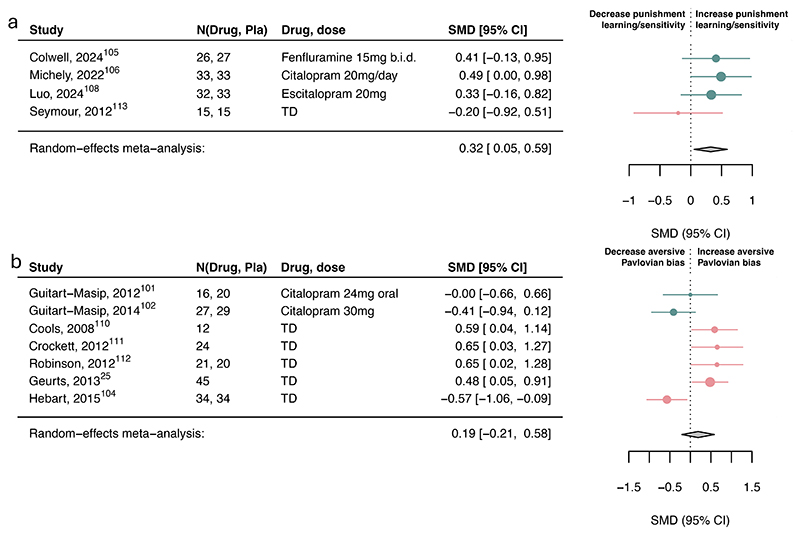
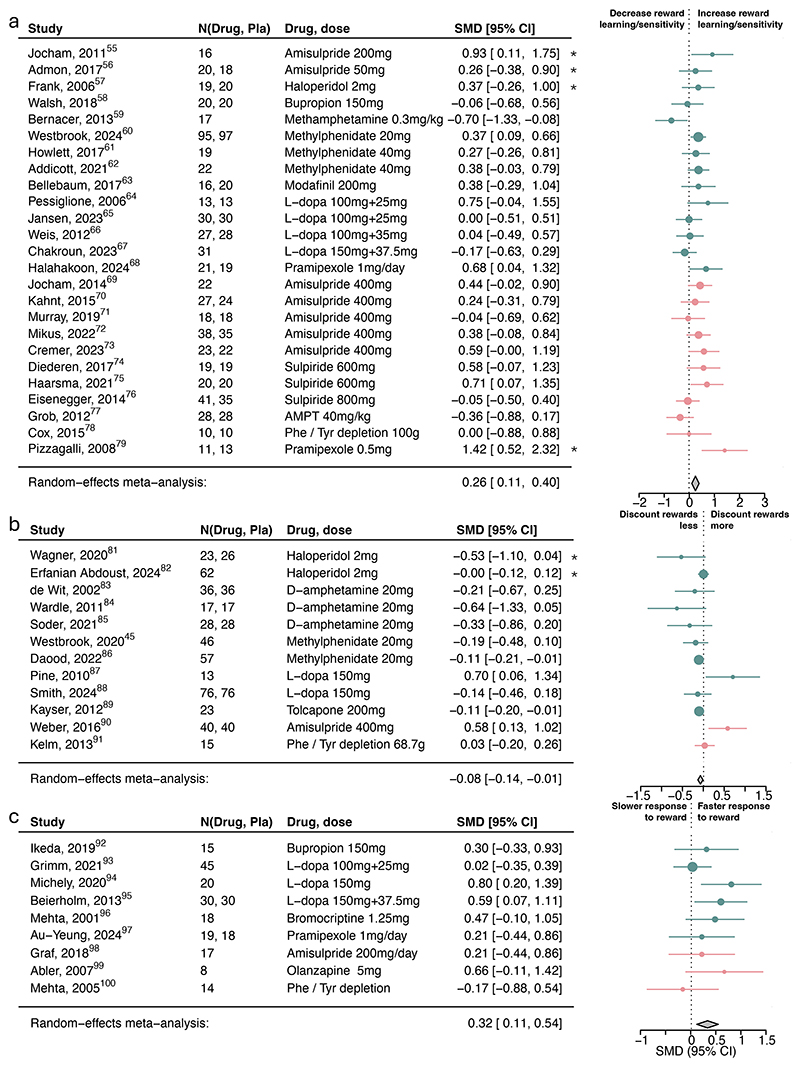
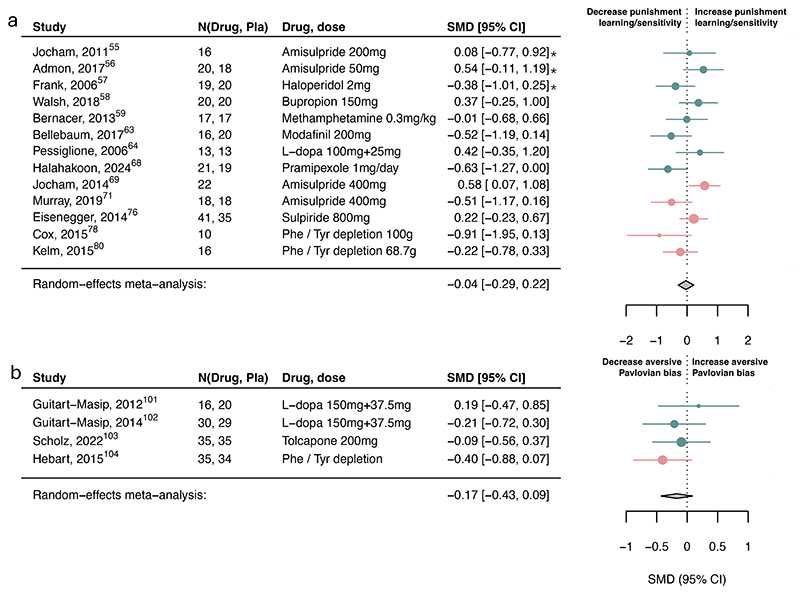
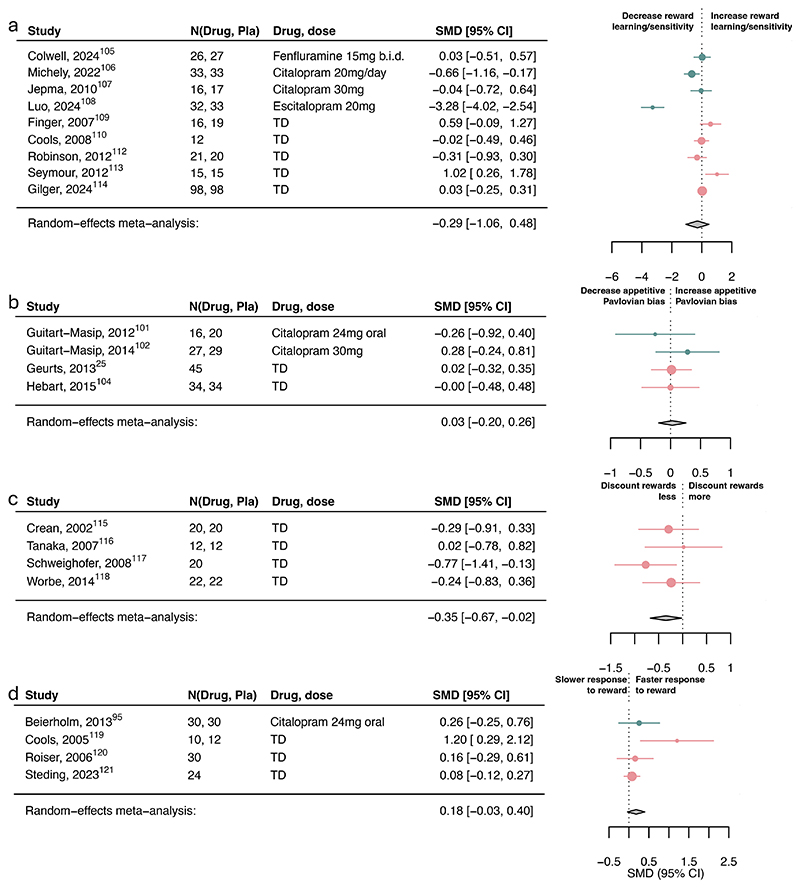
In total, 102 studies conducted among healthy volunteers were included (2291 participants receiving dopamine vs 2284 receiving placebo and 1491 receiving serotonin vs 1523 receiving placebo). Dopamine was associated with an increase in overall reward (SMD, 0.18; 95% CI, 0.09 to 0.28) but not punishment function (SMD, -0.06; 95% CI, -0.26 to 0.13). Serotonin was not meaningfully associated with overall punishment (SMD, 0.22; 95% CI, -0.04 to 0.49) or reward (SMD, 0.02; 95% CI, -0.33 to 0.36). Dopaminergic and serotonergic manipulations had distinct associations with subcomponents. Dopamine was associated with reward learning or sensitivity (SMD, 0.26; 95% CI, 0.11 to 0.40), reward discounting (SMD, -0.08; 95% CI, -0.14 to -0.01), and reward vigor (SMD, 0.32; 95% CI, 0.11 to 0.54). By contrast, serotonin was associated with punishment learning or sensitivity (SMD, 0.32; 95% CI, 0.05 to 0.59), reward discounting (SMD, -0.35; 95% CI, -0.67 to -0.02), and aversive pavlovian processes (within-participant studies only; SMD, 0.36; 95% CI, 0.20 to 0.53).
In this study, pharmacological manipulations of both dopamine and serotonin had measurable associations with reinforcement learning in humans. The selective associations with different components suggest that reinforcement learning tasks could form the basis of selective, mechanistically interpretable biomarkers to support treatment assignment.
用于指导治疗选择的机制性生物标志物需要对特定的药物干预具有选择性敏感性。强化学习过程显示出潜力,但关于多巴胺和血清素这两个治疗常见精神疾病的关键靶点如何影响人类强化学习,一直存在相互矛盾且有时不一致的报告。
对多巴胺和血清素的药理学操纵进行荟萃分析,并检查它们是否与人类强化学习成分存在不同的关联。
检索了Ovid MEDLINE/PubMed、Embase和PsycInfo数据库中1946年1月1日至2023年1月19日发表的研究(2024年4月9日和2024年10月15日重复检索),根据PRISMA指南调查多巴胺能或血清素能对人类奖励和惩罚过程的影响。
纳入了报告对健康人类奖励或惩罚处理任务的行为结果进行随机、安慰剂对照的多巴胺能或血清素能操纵的研究。
计算每种药物(多巴胺或血清素)与安慰剂在行为奖励或惩罚结果上比较的标准化平均差(SMD)分数,并在总体奖励或惩罚过程以及4个主要子类别的随机效应模型中进行量化。还评估了研究质量(Cochrane协作工具)、调节因素、异质性和发表偏倚。
奖励或惩罚处理任务的表现。
总共纳入了在健康志愿者中进行的102项研究(2291名接受多巴胺治疗的参与者与2284名接受安慰剂治疗的参与者,以及1491名接受血清素治疗的参与者与1523名接受安慰剂治疗的参与者)。多巴胺与总体奖励增加相关(SMD,0.18;95%CI,0.09至0.28),但与惩罚功能无关(SMD,-0.06;95%CI,-0.26至0.13)。血清素与总体惩罚(SMD,0.22;95%CI,-0.04至0.49)或奖励(SMD,0.02;95%CI,-0.33至0.36)无显著关联。多巴胺能和血清素能操纵与子成分有不同的关联。多巴胺与奖励学习或敏感性(SMD,0.26;95%CI,0.11至0.40)、奖励折扣(SMD,-0.08;95%CI,-0.14至-0.01)和奖励活力(SMD,0.32;95%CI,0.11至0.54)相关。相比之下,血清素与惩罚学习或敏感性(SMD,0.32;95%CI,0.05至0.59)、奖励折扣(SMD,-0.35;95%CI,-0.67至-0.02)和厌恶巴甫洛夫过程(仅在参与者内研究中;SMD,0.36;95%CI,0.20至0.53)相关。
在本研究中,多巴胺和血清素的药理学操纵与人类强化学习存在可测量到的关联。与不同成分的选择性关联表明,强化学习任务可以构成支持治疗分配的选择性、可从机制上解释的生物标志物的基础。