Department of Biomedical Sciences and Engineering, National Central University, Taoyuan, Taiwan.
Department of Dermatology and Plastic Surgery, Faculty of Life Sciences, Kumamoto University, Kumamoto, Japan.
Neoplasia. 2020 Dec;22(12):789-799. doi: 10.1016/j.neo.2020.10.009. Epub 2020 Nov 2.
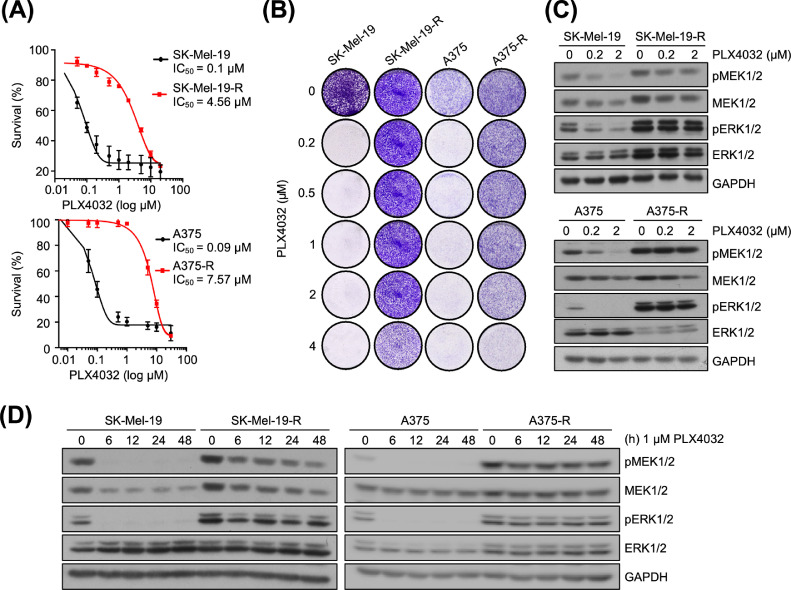
BRAF inhibitors were approved for the treatment of BRAF-mutant melanoma. However, most patients acquire the resistance to BRAF inhibitors after several months of treatment. miR-524-5p is considered as a tumor suppressor in many cancers, including melanoma. In this study, we investigated the biological functions of miR-524-5p in melanoma with acquired resistance to BRAF inhibitor and evaluated the endogenous miR-524-5p expression as a biomarker for melanoma. The results showed that the expression of miR-524-5p was 0.481-fold lower in melanoma tissues (n = 117) than in nevus tissues (n = 40). Overexpression of miR-524-5p significantly reduced proliferative, anchorage-independent growth, migratory and invasive abilities of BRAF inhibitor-resistant melanoma cells. Moreover, the introduction of miR-524-5p led to a reduced development of BRAF inhibitor-resistant melanoma in vivo. Remarkably, the MAPK/ERK signaling pathway was decreased after treatment with miR-524-5p. Furthermore, next-generation sequencing analysis implied that the complement system, leukocyte extravasation, liver X receptor/retinoid-X-receptor activation, and cAMP-mediated signaling may be related to miR-524-5p-induced pathways in the resistant cells. The miR-524-5p level was higher on average in complete response and long-term partial response patients than in progressive disease and short-term partial response patients treated with BRAF inhibitors. Our results proposed that miR-524-5p could be considered as a target for treatment BRAF inhibitor-resistant melanoma and a prognostic marker in the response of patients to BRAF inhibitors for melanoma.
BRAF 抑制剂已被批准用于治疗 BRAF 突变型黑色素瘤。然而,大多数患者在接受 BRAF 抑制剂治疗数月后会产生耐药性。miR-524-5p 在许多癌症中被认为是一种肿瘤抑制因子,包括黑色素瘤。在这项研究中,我们研究了 miR-524-5p 在对 BRAF 抑制剂获得性耐药的黑色素瘤中的生物学功能,并评估了内源性 miR-524-5p 表达作为黑色素瘤的生物标志物。结果表明,miR-524-5p 在黑色素瘤组织(n=117)中的表达水平比痣组织(n=40)低 0.481 倍。miR-524-5p 的过表达显著降低了 BRAF 抑制剂耐药性黑色素瘤细胞的增殖、非锚定依赖性生长、迁移和侵袭能力。此外,miR-524-5p 的引入导致 BRAF 抑制剂耐药性黑色素瘤在体内的发展减少。值得注意的是,MAPK/ERK 信号通路在 miR-524-5p 处理后降低。此外,下一代测序分析表明,补体系统、白细胞渗出、肝 X 受体/视黄醇 X 受体激活以及 cAMP 介导的信号转导可能与耐药细胞中 miR-524-5p 诱导的途径有关。与接受 BRAF 抑制剂治疗的进展性疾病和短期部分缓解患者相比,完全缓解和长期部分缓解患者的 miR-524-5p 水平平均更高。我们的研究结果表明,miR-524-5p 可被视为治疗 BRAF 抑制剂耐药性黑色素瘤的靶点,以及黑色素瘤患者对 BRAF 抑制剂反应的预后标志物。