Department of Internal Medicine and Pediatrics, Department of Gastroenterology and Hepatology, Hepatology Research Unit, Ghent University, B-9000 Ghent, Belgium.
Department of Basic and Applied Medical Sciences, Gut-Liver Immunopharmacology Unit, Ghent University, B-9000 Ghent, Belgium.
Cells. 2020 Oct 30;9(11):2382. doi: 10.3390/cells9112382.
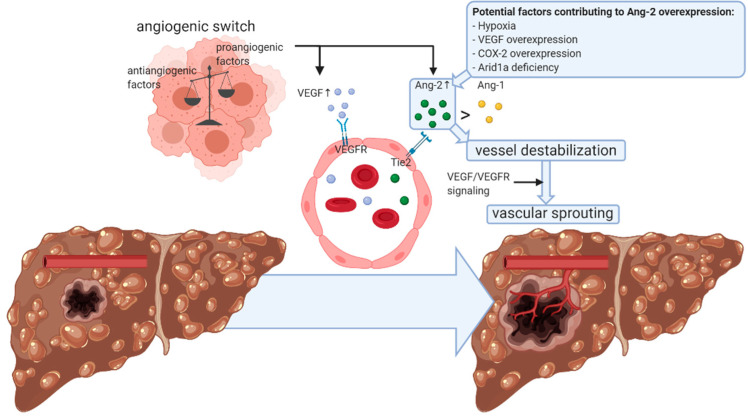
Due to the usually late diagnosis and lack of effective therapies, hepatocellular carcinoma (HCC), which poses a growing global health problem, is characterized by a poor prognosis. Angiogenesis plays an important role in HCC progression, and vascular endothelial growth factor (VEGF) and angiopoietins (Angs) are key drivers of HCC angiogenesis. VEGF-targeting strategies already represent an important component of today's systemic treatment landscape of HCC, whereas targeting the Ang/Tie2 signaling pathway may harbor future potential in this context due to reported beneficial anticancer effects when targeting this pathway. In addition, a better understanding of the relation between Angs and HCC angiogenesis and progression may reveal their potential as predictive factors for post-treatment disease progression and prognosis. In this review, we give a comprehensive overview of the complex role of Ang/Tie2 signaling in HCC, pinpointing its potential value as biomarker and target for HCC treatments, aiding HCC diagnosis and therapy.
由于通常诊断较晚且缺乏有效治疗方法,肝细胞癌 (HCC) 作为一个日益严重的全球健康问题,其预后较差。血管生成在 HCC 进展中起着重要作用,血管内皮生长因子 (VEGF) 和血管生成素 (Angs) 是 HCC 血管生成的关键驱动因素。针对 VEGF 的治疗策略已经成为 HCC 系统治疗方案的重要组成部分,而针对 Ang/Tie2 信号通路的治疗可能具有未来的潜力,因为靶向该通路具有报道的有益的抗癌作用。此外,更好地了解 Angs 与 HCC 血管生成和进展之间的关系可能揭示它们作为治疗后疾病进展和预后预测因子的潜力。在这篇综述中,我们全面概述了 Ang/Tie2 信号在 HCC 中的复杂作用,指出其作为 HCC 治疗的生物标志物和靶点的潜在价值,有助于 HCC 的诊断和治疗。