The Shraga Segal Department of Microbiology, Immunology, and Genetics, Faculty of Health Sciences, Ben-Gurion University of the Negev, Beer Sheva 84105, Israel.
The Center of Advanced Research and Education in Reproduction (CARER), Faculty of Health Sciences, Ben-Gurion University of the Negev, Beer Sheva 84105, Israel.
Int J Mol Sci. 2020 Oct 30;21(21):8143. doi: 10.3390/ijms21218143.
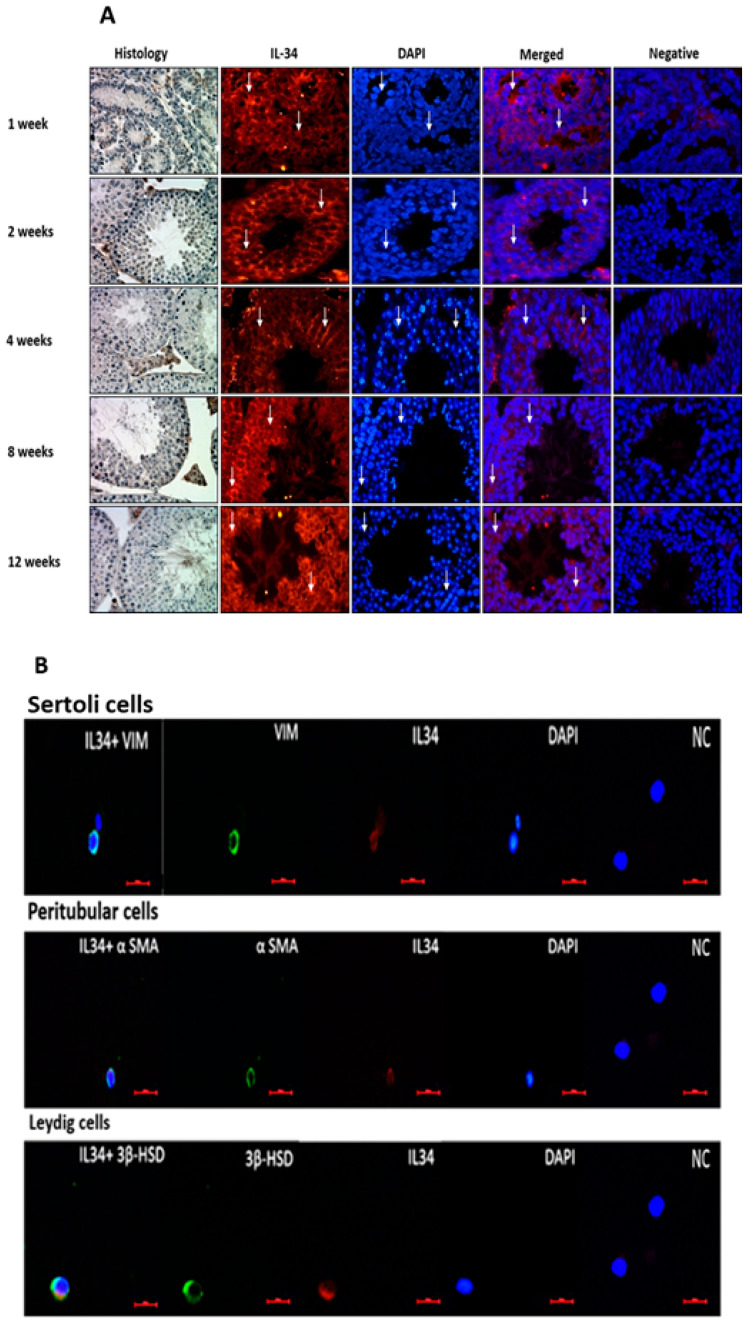
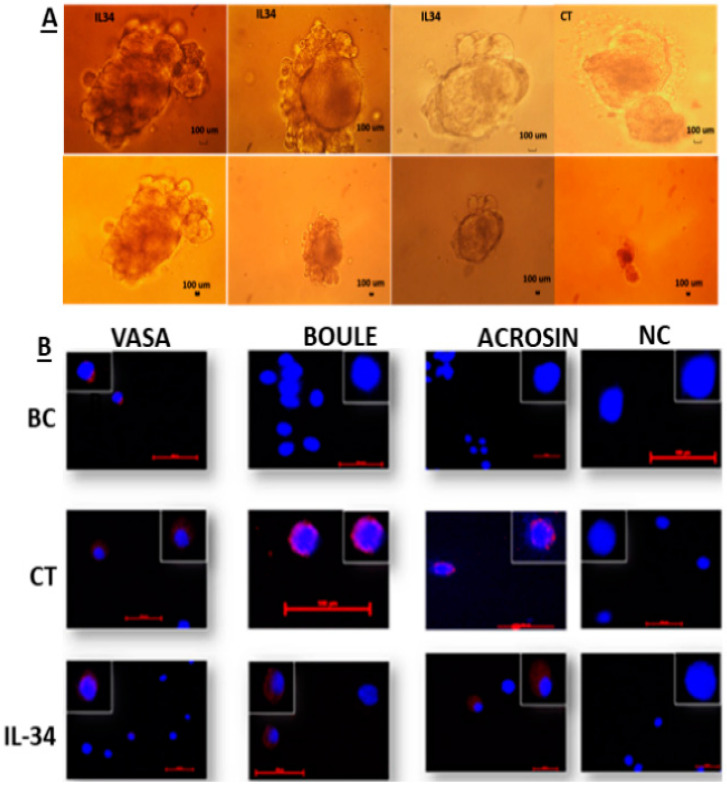
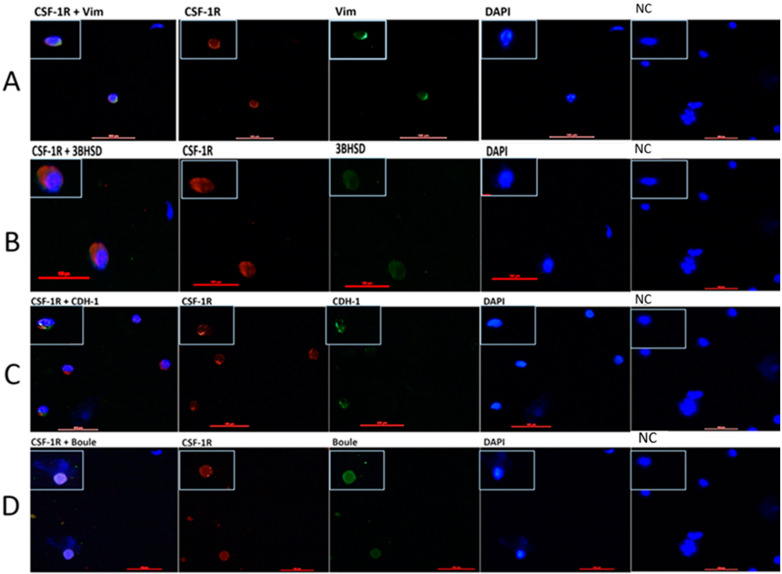
Spermatogenesis is the process of spermatogonial stem cell (SSC) proliferation and differentiation to generate sperm. This process is regulated by cell-cell interactions between Sertoli cells and developing SSCs by autocrine/paracrine and endocrine factors. It is also affected by cells in the interstitial compartment, such as Leydig cells and peritubular cells. Here, we demonstrate, for the first time, the presence of interleukin-34 (IL-34) in Leydig, Sertoli, and peritubular cells and in the premeiotic, meiotic, and postmeiotic cells. Its receptor, colony-stimulating factor-1 (CSF-1), has already been demonstrated in Leydig, Sertoli, premeiotic, and meiotic cells. IL-34 was detected in testicular homogenates and Sertoli cell-conditioned media, and was affected by mouse age. We showed that the addition of IL-34 in vitro to isolated cells from the seminiferous tubules of 7-day-old mice, using the methylcellulose culture system (MCS), increased the percentages and expression of the premeiotic cells (VASA), the meiotic cells (BOULE), and the meiotic/postmeiotic cells (ACROSIN) after four weeks of culture, when examined by immunofluorescence staining (IF) and qPCR analysis. It is possible to suggest that IL-34 is a novel paracrine/autocrine factor involved in the development of spermatogenesis. This factor may be used in future therapeutic strategies for the treatment of male infertility.
精子发生是精原干细胞 (SSC) 增殖和分化生成精子的过程。这个过程受到 Sertoli 细胞和发育中的 SSCs 之间的细胞-细胞相互作用的调节,通过自分泌/旁分泌和内分泌因子。它还受到间质细胞的影响,如 Leydig 细胞和小管周围细胞。在这里,我们首次证明白细胞介素-34 (IL-34) 存在于 Leydig 细胞、Sertoli 细胞和小管周围细胞以及减数前期、减数分裂和减数分裂后细胞中。其受体集落刺激因子-1 (CSF-1) 已经在 Leydig 细胞、Sertoli 细胞、减数前期和减数分裂细胞中得到证实。IL-34 在睾丸匀浆和 Sertoli 细胞条件培养基中被检测到,并受小鼠年龄的影响。我们表明,在体外使用甲基纤维素培养系统 (MCS) 将 7 天大的小鼠生精小管中的分离细胞添加 IL-34,可增加免疫荧光染色 (IF) 和 qPCR 分析四周后减数前期细胞 (VASA)、减数分裂细胞 (BOULE) 和减数分裂/减数分裂后细胞 (ACROSIN) 的百分比和表达。可以推测,IL-34 是一种新的旁分泌/自分泌因子,参与精子发生的发育。该因子可能用于未来治疗男性不育症的治疗策略。