Bottema-Beutel Kristen, Kim So Yoon, Crowley Shannon, Yoder Paul J
Boston College, USA.
Vanderbilt University, USA.
Autism. 2021 Feb;25(2):566-575. doi: 10.1177/1362361320968641. Epub 2020 Nov 3.
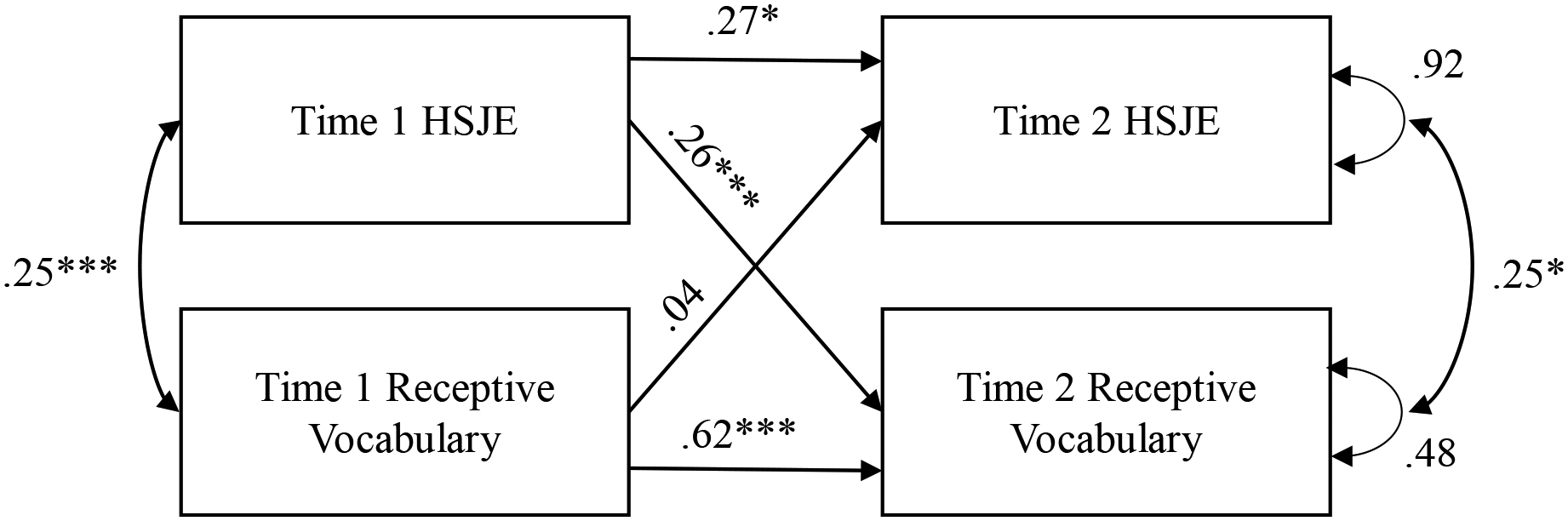
In this study, we used a to examine correlations over time between two types of engagement between children and their parents and children's later expressive and receptive vocabularies. This kind of design can help researchers understand which early developmental achievements "drive" later developmental achievements. It is important for intervention researchers to know which developmental achievements happen first, so that they can set intervention goals appropriately. The two joint engagement variables we examined were (a) higher order supported joint engagement, which occurs when caregivers influence their child's play with toys and the child reciprocally responds to the caregiver, but does not manage the interaction by shifting gaze between the toys and the caregiver, and (b) higher order supported joint engagement that co-occurs with caregiver's follow-in talk (higher order supported joint engagement + follow-in). Follow-in talk occurs when the caregiver talks about objects and events that the child is focused on. Ninety-one autistic children ( = 91) with language delay (mean chronological age = 39 months) participated, along with their primary caregivers. Each of the four variables was measured twice, 8 months apart. Our statistical procedures showed that early higher order supported joint engagement and early higher order supported joint engagement + follow-in were significantly associated with later expressive and receptive vocabulary. In contrast, associations between early vocabulary variables and later joint engagement variables were not significant. Our results suggest that higher order supported joint engagement and higher order supported joint engagement + follow-in may be useful initial intervention targets, for developmental interventions aimed at promoting language development in autistic children who are initially language delayed.
在本研究中,我们采用了一种[方法]来考察儿童与其父母之间两种互动方式随时间的相关性,以及儿童后期的表达性和接受性词汇量。这种设计有助于研究人员了解哪些早期发展成就“推动”了后期的发展成就。对于干预研究人员来说,了解哪些发展成就先出现很重要,这样他们才能适当地设定干预目标。我们考察的两个联合互动变量分别是:(a) 高阶支持性联合互动,即当照顾者影响孩子玩玩具,孩子对照顾者做出相应回应,但不会通过在玩具和照顾者之间转移目光来管理互动时发生的情况;(b) 与照顾者后续谈话同时出现的高阶支持性联合互动(高阶支持性联合互动 + 后续谈话)。后续谈话是指照顾者谈论孩子所关注的物体和事件时发生的情况。91名有语言延迟的自闭症儿童(n = 91)(平均实际年龄 = 39个月)及其主要照顾者参与了研究。四个变量中的每一个都测量了两次,间隔8个月。我们的统计程序表明,早期的高阶支持性联合互动和早期的高阶支持性联合互动 + 后续谈话与后期的表达性和接受性词汇量显著相关。相比之下,早期词汇变量与后期联合互动变量之间的关联并不显著。我们的研究结果表明,高阶支持性联合互动和高阶支持性联合互动 + 后续谈话可能是有用的初始干预目标,适用于旨在促进最初有语言延迟的自闭症儿童语言发展的发展性干预。