• 文献检索
  • 文档翻译
  • 深度研究
  • 学术资讯
  • Suppr Zotero 插件Zotero 插件
  • 邀请有礼
  • 套餐&价格
  • 历史记录
应用&插件
Suppr Zotero 插件Zotero 插件浏览器插件Mac 客户端Windows 客户端微信小程序
定价
高级版会员购买积分包购买API积分包
服务
文献检索文档翻译深度研究API 文档MCP 服务
关于我们
关于 Suppr公司介绍联系我们用户协议隐私条款
关注我们

Suppr 超能文献

核心技术专利:CN118964589B侵权必究
粤ICP备2023148730 号-1Suppr @ 2026

文献检索

告别复杂PubMed语法,用中文像聊天一样搜索,搜遍4000万医学文献。AI智能推荐,让科研检索更轻松。

立即免费搜索

文件翻译

保留排版,准确专业,支持PDF/Word/PPT等文件格式,支持 12+语言互译。

免费翻译文档

深度研究

AI帮你快速写综述,25分钟生成高质量综述,智能提取关键信息,辅助科研写作。

立即免费体验

避免使用歧视性语言:给自闭症研究者的建议。

Avoiding Ableist Language: Suggestions for Autism Researchers.

作者信息

Bottema-Beutel Kristen, Kapp Steven K, Lester Jessica Nina, Sasson Noah J, Hand Brittany N

机构信息

Lynch School of Education and Human Development, Boston College, Chestnut Hill, Massachusetts, USA.

Department of Psychology, University of Portsmouth, Portsmouth, United Kingdom.

出版信息

Autism Adulthood. 2021 Mar 1;3(1):18-29. doi: 10.1089/aut.2020.0014. Epub 2021 Mar 18.

DOI:10.1089/aut.2020.0014
PMID:36601265
原文链接:https://pmc.ncbi.nlm.nih.gov/articles/PMC8992888/
Abstract

UNLABELLED

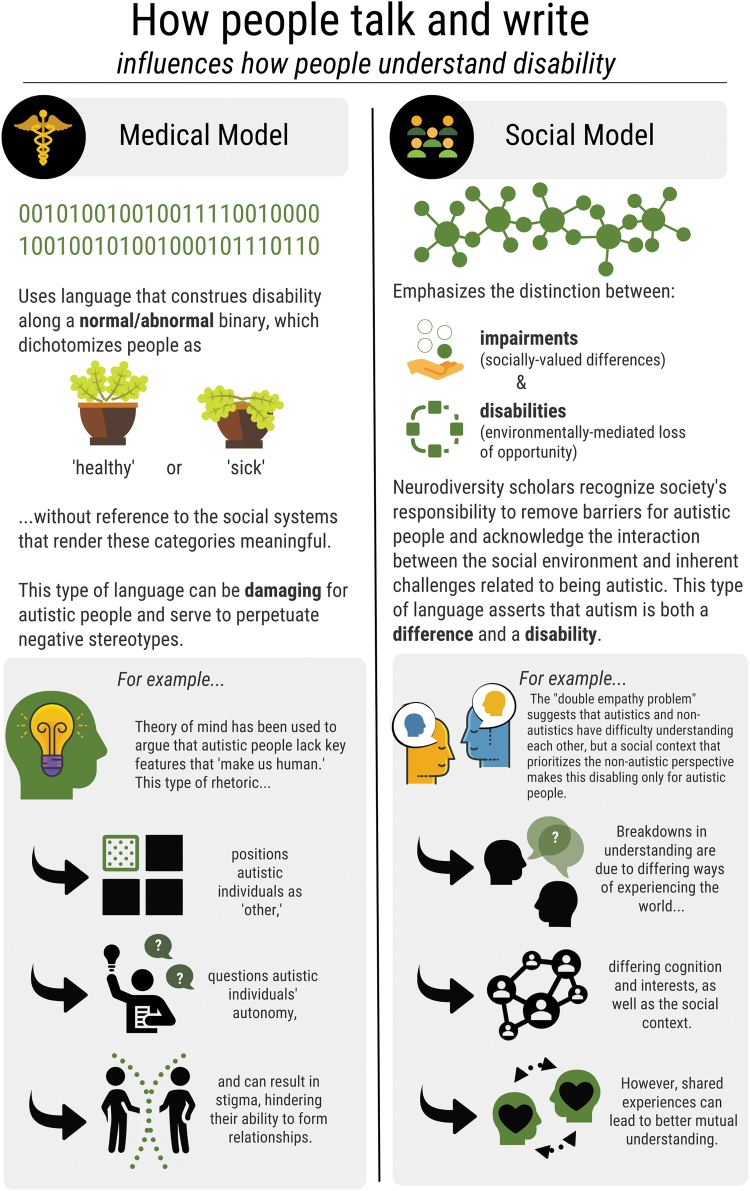
In this commentary, we describe how language used to communicate about autism within much of autism research can reflect and perpetuate ableist ideologies (i.e., beliefs and practices that discriminate against people with disabilities), whether or not researchers intend to have such effects. Drawing largely from autistic scholarship on this subject, along with research and theory from disability studies and discourse analysis, we define ableism and its realization in linguistic practices, provide a historical overview of ableist language used to describe autism, and review calls from autistic researchers and laypeople to adopt alternative ways of speaking and writing. Finally, we provide several specific avenues to aid autism researchers in reflecting on and adjusting their language choices.

LAY SUMMARY

In the past, autism research has mostly been conducted by nonautistic people, and researchers have described autism as something bad that should be fixed. Describing autism in this way has negative effects on how society views and treats autistic people and may even negatively affect how autistic people view themselves. Despite recent positive changes in how researchers write and speak about autism, "ableist" language is still used. language refers to language that assumes disabled people are inferior to nondisabled people. We wrote this article to describe how ableism influences the way autism is often described in research. We also give autism researchers strategies for avoiding ableist language in their future work. We believe that ableism is a "system of discrimination," which means that it influences how people talk about and perceive autism whether or not they are aware of it, and regardless of whether or not they actually believe that autistic people are inferior to nonautistic people. We also believe that language choices are part of what perpetuates this system. Because of this, researchers need to take special care to determine whether their language choices reflect ableism and take steps to use language that is not ableist. Autistic adults (including researchers and nonresearchers) have been writing and speaking about ableist language for several decades, but nonautistic autism researchers may not be aware of this work. We have compiled this material and summarized it for autism researchers. We recommend that researchers understand what ableism is, reflect on the language they use in their written and spoken work, and use nonableist language alternatives to describe autism and autistic people. For example, many autistic people find terms such as "special interests" and "special needs" patronizing; these terms could be replaced with "focused interests" and descriptions of autistic people's specific needs. Medicalized/deficit language such as "at risk for autism" should be replaced by more neutral terms such as "increased likelihood of autism." Finally, ways of speaking about autism that are not restricted to particular terms but still contribute to marginalization, such as discussion about the "economic burden of autism," should be replaced with discourses that center the impacts of social arrangements on autistic people. Language is a powerful means for shaping how people view autism. If researchers take steps to avoid ableist language, researchers, service providers, and society at large may become more accepting and accommodating of autistic people.
摘要

未标注

在这篇评论中,我们描述了在许多自闭症研究中用于交流自闭症的语言如何反映并延续残障歧视意识形态(即歧视残疾人的信念和做法),无论研究人员是否有意产生此类影响。我们主要借鉴了关于这一主题的自闭症学术研究,以及残疾研究和话语分析的研究与理论,定义了残障歧视及其在语言实践中的体现,提供了用于描述自闭症的残障歧视语言的历史概述,并回顾了自闭症研究人员和普通民众呼吁采用替代性的言说和写作方式。最后,我们提供了几条具体途径,以帮助自闭症研究人员反思并调整他们的语言选择。

内容摘要

过去,自闭症研究大多由非自闭症患者进行,研究人员将自闭症描述为一种应该被纠正的不良状况。以这种方式描述自闭症会对社会看待和对待自闭症患者的方式产生负面影响,甚至可能对自闭症患者如何看待自己产生负面影响。尽管最近研究人员在撰写和谈论自闭症方面有了积极变化,但“残障歧视”语言仍在使用。残障歧视语言是指那种假定残疾人不如非残疾人的语言。我们撰写本文是为了描述残障歧视如何影响研究中经常描述自闭症的方式。我们还为自闭症研究人员提供了在未来工作中避免使用残障歧视语言的策略。我们认为残障歧视是一种“歧视系统”,这意味着它会影响人们谈论和理解自闭症的方式,无论他们是否意识到这一点,也无论他们是否真的认为自闭症患者不如非自闭症患者。我们还认为语言选择是使这个系统长期存在的部分因素。因此,研究人员需要格外注意确定他们的语言选择是否反映了残障歧视,并采取措施使用非残障歧视性语言。自闭症成年人(包括研究人员和非研究人员)几十年来一直在撰写和谈论残障歧视语言,但非自闭症的自闭症研究人员可能并未意识到这项工作。我们整理了这些材料并为自闭症研究人员进行了总结。我们建议研究人员了解什么是残障歧视,反思他们在书面和口头工作中使用的语言,并使用非残障歧视性的语言替代词来描述自闭症和自闭症患者。例如,许多自闭症患者觉得“特殊兴趣”和“特殊需求”等术语带有优越感;这些术语可以用“专注兴趣”和对自闭症患者具体需求的描述来替代。诸如“患自闭症风险”这样的医学化/缺陷性语言应该用更中性的术语如“自闭症可能性增加”来替代。最后,那些不限于特定术语但仍会导致边缘化的谈论自闭症的方式,比如关于“自闭症经济负担”的讨论,应该用以社会安排对自闭症患者的影响为中心的论述来替代。语言是塑造人们如何看待自闭症的有力手段。如果研究人员采取措施避免使用残障歧视语言,研究人员、服务提供者和整个社会可能会对自闭症患者更加接纳和包容。

https://cdn.ncbi.nlm.nih.gov/pmc/blobs/88fd/8992888/c8c94c0f4313/aut.2020.0014_figure1.jpg

相似文献

1
Avoiding Ableist Language: Suggestions for Autism Researchers.避免使用歧视性语言:给自闭症研究者的建议。
Autism Adulthood. 2021 Mar 1;3(1):18-29. doi: 10.1089/aut.2020.0014. Epub 2021 Mar 18.
2
Intersectionality Within Critical Autism Studies: A Narrative Review.批判性自闭症研究中的交叉性:一项叙事综述。
Autism Adulthood. 2022 Dec 1;4(4):281-289. doi: 10.1089/aut.2021.0014. Epub 2022 Dec 13.
3
Moving from Disorder to Difference: A Systematic Review of Recent Language Use in Autism Research.从障碍到差异:对自闭症研究中近期语言使用情况的系统综述
Autism Adulthood. 2024 Jun 17;6(2):128-140. doi: 10.1089/aut.2023.0030. eCollection 2024 Jun.
4
Early-Career Autism Researchers Are Shifting Their Research Directions: Tragedy or Opportunity?早期职业自闭症研究人员正在改变他们的研究方向:悲剧还是机遇?
Autism Adulthood. 2023 Sep 1;5(3):218-224. doi: 10.1089/aut.2023.0021. Epub 2023 Aug 30.
5
"Autism research is in crisis": A mixed method study of researcher's constructions of autistic people and autism research.“自闭症研究正处于危机之中”:一项关于研究人员对自闭症患者及自闭症研究认知建构的混合方法研究
Front Psychol. 2022 Nov 24;13:1050897. doi: 10.3389/fpsyg.2022.1050897. eCollection 2022.
6
Recognizing and Resisting Ableist Language in Schools: Suggestions for School-Based Speech-Language Pathologists and Related Professionals.识别和抵制学校中的歧视性语言:为学校言语治疗师和相关专业人员提供的建议。
Lang Speech Hear Serv Sch. 2024 Oct 16;55(4):1025-1038. doi: 10.1044/2024_LSHSS-24-00036. Epub 2024 Oct 7.
7
Autism-Related Language Preferences of French-Speaking Autistic Adults: An Online Survey.说法语的成年自闭症患者的自闭症相关语言偏好:一项在线调查
Autism Adulthood. 2023 Sep 1;5(3):275-288. doi: 10.1089/aut.2022.0056. Epub 2023 Aug 30.
8
The Development and Pilot-Testing of the Autism Attitude Acceptance Scale: An Instrument Measuring Autism Acceptance.自闭症态度接纳量表的开发与预测试:一种测量自闭症接纳程度的工具
Autism Adulthood. 2020 Sep 1;2(3):204-215. doi: 10.1089/aut.2019.0066. Epub 2020 Sep 3.
9
A Conceptual Analysis of Autistic Masking: Understanding the Narrative of Stigma and the Illusion of Choice.自闭症掩饰行为的概念分析:理解污名化的叙事与选择的幻象
Autism Adulthood. 2021 Mar 1;3(1):52-60. doi: 10.1089/aut.2020.0043. Epub 2021 Mar 18.
10
Anti-ableism and scientific accuracy in autism research: a false dichotomy.自闭症研究中的反能力歧视与科学准确性:一种错误的二分法。
Front Psychiatry. 2023 Sep 8;14:1244451. doi: 10.3389/fpsyt.2023.1244451. eCollection 2023.

引用本文的文献

1
Our Challenges, Our Solutions: The Impact of Autism on Families.我们的挑战,我们的解决方案:自闭症对家庭的影响。
J Autism Dev Disord. 2025 Sep 9. doi: 10.1007/s10803-025-07034-0.
2
Applied Behavior Analysis in the Crosshairs: Neurodiversity, the Intact Mind, and Autism Politics.处于风口浪尖的应用行为分析:神经多样性、健全心智与自闭症政治
Perspect Behav Sci. 2025 Mar 3;48(3):547-553. doi: 10.1007/s40614-025-00439-3. eCollection 2025 Sep.
3
Subcortical brain volume variations in autistic individuals across the lifespan.自闭症个体在整个生命周期中的皮质下脑容量变化。

本文引用的文献

1
Negotiation of Individual and Collective Identities in the Online Discourse of Autistic Adults.自闭症成年人在线话语中个体与集体身份的协商
Autism Adulthood. 2019 Mar 1;1(1):69-78. doi: 10.1089/aut.2018.0029. Epub 2019 Mar 11.
2
"It Defines Who I Am" or "It's Something I Have": What Language Do [Autistic] Australian Adults [on the Autism Spectrum] Prefer?“它定义了我是谁”还是“它是我所拥有的东西”:澳大利亚成年自闭症患者更喜欢哪种表述方式?
J Autism Dev Disord. 2023 Feb;53(2):677-687. doi: 10.1007/s10803-020-04425-3.
3
High School Experiences and Support Recommendations of Autistic Youth.
Mol Autism. 2025 Sep 1;16(1):46. doi: 10.1186/s13229-025-00673-1.
4
Profiling Language Skills in Minimally Verbal Autism: Findings From Greek-Speaking Preschoolers.对极少言语型自闭症儿童语言技能的剖析:来自说希腊语的学龄前儿童的研究结果
Autism Dev Lang Impair. 2025 Aug 25;10:23969415251371550. doi: 10.1177/23969415251371550. eCollection 2025 Jan-Dec.
5
Redesigning an Autism Evidence-Based Practice Adoption and Decision-Making Implementation Toolkit for Middle and High Schools.重新设计面向初中和高中的自闭症循证实践采用与决策实施工具包。
School Ment Health. 2024 Sep;16(3):727-745. doi: 10.1007/s12310-024-09657-7. Epub 2024 Apr 12.
6
The Power of Two: Exploring the Impact of Mothers' and Fathers' Involvement in Speech-Language Pathology Treatment for Children with Autism.两人的力量:探究母亲和父亲参与自闭症儿童言语语言病理学治疗的影响
Autism Dev Lang Impair. 2025 Jul 31;10:23969415251355462. doi: 10.1177/23969415251355462. eCollection 2025 Jan-Dec.
7
Prior contextual information and autistic traits influence eye gaze behaviour and emotional valence ratings for facial expressions.先前的背景信息和自闭症特征会影响面部表情的目光注视行为和情感效价评级。
Sci Rep. 2025 Jul 29;15(1):27574. doi: 10.1038/s41598-025-13507-0.
8
"There is just too much going on there": Nonverbal communication experiences of autistic adults.“那里发生的事情太多了”:自闭症成年人的非言语交流体验。
PLoS One. 2025 Jul 11;20(7):e0325465. doi: 10.1371/journal.pone.0325465. eCollection 2025.
9
Accuracy of a 2-minute eye-tracking assessment to differentiate young children with and without autism.一项用于区分患有和未患有自闭症幼儿的2分钟眼动追踪评估的准确性。
Mol Autism. 2025 Jul 10;16(1):36. doi: 10.1186/s13229-025-00670-4.
10
Melodic bridges: music intervention as a catalyst for social skills development in preschool children with autism.旋律桥梁:音乐干预作为自闭症学龄前儿童社交技能发展的催化剂
Front Psychol. 2025 Jun 25;16:1542662. doi: 10.3389/fpsyg.2025.1542662. eCollection 2025.
自闭症青年的高中经历和支持建议。
J Autism Dev Disord. 2020 Sep;50(9):3397-3412. doi: 10.1007/s10803-019-04261-0.
4
A comprehensive psychometric analysis of autism-spectrum quotient factor models using two large samples: Model recommendations and the influence of divergent traits on total-scale scores.使用两个大样本对自闭症谱系商数因子模型进行全面的心理计量学分析:模型建议和发散特质对总评分的影响。
Autism Res. 2020 Jan;13(1):45-60. doi: 10.1002/aur.2198. Epub 2019 Aug 29.
5
A Portfolio Analysis of Autism Research Funding in Australia, 2008-2017.澳大利亚自闭症研究经费组合分析,2008-2017 年。
J Autism Dev Disord. 2019 Nov;49(11):4400-4408. doi: 10.1007/s10803-019-04155-1.
6
The misnomer of 'high functioning autism': Intelligence is an imprecise predictor of functional abilities at diagnosis.“高功能自闭症”的误用:在诊断时,智力是功能能力的一个不精确预测指标。
Autism. 2020 Jan;24(1):221-232. doi: 10.1177/1362361319852831. Epub 2019 Jun 19.
7
Talking about autism-thoughts for researchers.谈自闭症——研究人员的思考。
Autism Res. 2019 Jul;12(7):1004-1006. doi: 10.1002/aur.2119. Epub 2019 May 12.
8
The AASPIRE practice-based guidelines for the inclusion of autistic adults in research as co-researchers and study participants.AASPIRE 基于实践的指南:将自闭症成年人纳入研究中,作为共同研究者和研究参与者。
Autism. 2019 Nov;23(8):2007-2019. doi: 10.1177/1362361319830523. Epub 2019 Apr 3.
9
'People should be allowed to do what they like': Autistic adults' views and experiences of stimming.“人们应该被允许做他们喜欢的事情”:自闭症成年人对自我刺激的看法和体验。
Autism. 2019 Oct;23(7):1782-1792. doi: 10.1177/1362361319829628. Epub 2019 Feb 28.
10
Identifying Language for People on the Autism Spectrum: A Scoping Review.自闭症谱系人群语言识别:范围综述。
Issues Ment Health Nurs. 2019 Apr;40(4):317-325. doi: 10.1080/01612840.2018.1522400. Epub 2019 Jan 11.