Department of Chemistry, Brown University, Providence, RI, USA.
Department of Molecular Biology, Cell Biology and Biochemistry, Brown University, Providence, RI, USA.
Pediatr Res. 2021 Jul;90(1):58-65. doi: 10.1038/s41390-020-01224-5. Epub 2020 Nov 3.
Prolonged exposure to high oxygen concentrations in premature infants, although lifesaving, can induce lung oxidative stress and increase the risk of developing BPD, a form of chronic lung disease. The lung alveolar epithelium is damaged by sustained hyperoxia, causing oxidative stress and alveolar simplification; however, it is unclear what duration of exposure to hyperoxia negatively impacts cellular function.
Here we investigated the role of a very short exposure to hyperoxia (95% O, 5% CO) on mitochondrial function in cultured mouse lung epithelial cells and neonatal mice.
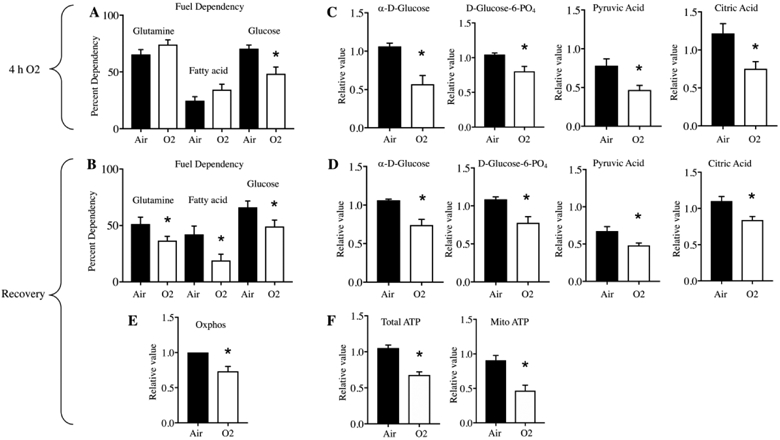
In epithelial cells, 4 h of hyperoxia reduced oxidative phosphorylation, respiratory complex I and IV activity, utilization of mitochondrial metabolites, and caused mitochondria to form elongated tubular networks. Cells allowed to recover in air for 24 h exhibited a persistent global reduction in fuel utilization. In addition, neonatal mice exposed to hyperoxia for only 12 h demonstrated alveolar simplification at postnatal day 14.
A short exposure to hyperoxia leads to changes in lung cell mitochondrial metabolism and dynamics and has a long-term impact on alveolarization. These findings may help inform our understanding and treatment of chronic lung disease.
Many studies use long exposures (up to 14 days) to hyperoxia to mimic neonatal chronic lung disease. We show that even a very short exposure to hyperoxia leads to long-term cellular injury in type II-like epithelial cells. This study demonstrates that a short (4 h) period of hyperoxia has long-term residual effects on cellular metabolism. We show that neonatal mice exposed to hyperoxia for a short time (12 h) demonstrate later alveolar simplification. This work suggests that any exposure to clinical hyperoxia leads to persistent lung dysfunction.
尽管早产儿长时间暴露在高浓度氧气中可以救命,但会导致肺部氧化应激,并增加发生 BPD(一种慢性肺部疾病)的风险。持续的高氧会损伤肺泡上皮细胞,导致氧化应激和肺泡简化;然而,目前尚不清楚暴露在高氧环境中的时间长短会对细胞功能产生负面影响。
在这里,我们研究了短暂暴露于高氧(95%O2,5%CO)对培养的小鼠肺上皮细胞和新生小鼠线粒体功能的影响。
在肺上皮细胞中,4 小时的高氧暴露会降低氧化磷酸化、呼吸复合物 I 和 IV 的活性、线粒体代谢物的利用,并导致线粒体形成拉长的管状网络。在空气中恢复 24 小时的细胞表现出持续的燃料利用全局减少。此外,仅暴露于高氧 12 小时的新生小鼠在出生后 14 天表现出肺泡简化。
短暂暴露于高氧会导致肺细胞线粒体代谢和动力学发生变化,并对肺泡化产生长期影响。这些发现可能有助于我们理解和治疗慢性肺部疾病。
许多研究使用长达 14 天的高氧暴露来模拟新生儿慢性肺部疾病。我们表明,即使是短暂暴露于高氧也会导致 II 型样上皮细胞的长期细胞损伤。本研究表明,短暂(4 小时)的高氧暴露对细胞代谢有长期的残留影响。我们表明,短暂暴露于高氧(12 小时)的新生小鼠表现出后来的肺泡简化。这项工作表明,任何临床高氧暴露都会导致持续的肺部功能障碍。